


![[Marketing] Questao Topo - deslogado](https://storage.estuda.com.br/banners/0_6b7ebee90b03af1c560c73bb8bcce34a_banner_deslogado_70_dias.png)
Questões de Inglês
19.971 Questões
Questão 20 187598
ITA 2014DISTANT PEAK CAR
Carmakers worry that one day demand for cars will stop rising. But that is a long way off.
[1] IN 1924 FORD ran an advertisement headlined “His First Car”, urging fathers to buy their teenage sons their
first set of wheels. The idea caught on. For boys, especially, learning to drive became an essential part of growing up.
By the late 1970s 86% of American 18-year-olds—of both sexes—had a driving licence. But then the trend went into
reverse: researchers at the University of Michigan found that in 2010 only 61% of 18-year-old Americans had licences.
[5] Other rich countries are going the same way. Teenagers are showing less interest in cars as they turn their attention
to smartphones and social networking.
This is a worry for carmakers, who are wondering where their future customers are going to come from. In the
two decades to 2008 the number of miles driven by Americans in their 20s fell by 8%. In Britain a study for the RAC
Foundation, a transport-research body, found a 30% drop among men in the same age group between 1996 and
[10] 2006.
One reason for concern is that half the world’s population now lives in towns and cities, which have only so
much space for cars. Even in rapidly growing car markets such as China, city governments in the more prosperous
parts of the country are beginning to restrict new car registrations and invest heavily in public transport.
Young urban residents may also be meeting up less often in person, thanks to social-networking sites that let
[15] them keep in touch digitally. So they have less need for a car, and when they do need one they turn to car clubs,
which offer rental by the hour in their neighbourhood, and to car-sharing schemes. In particular, the generation who
came of age after 2000, the so-called “millennials”, express a preference for having access to rather than owning cars.
But some of that may be just talk. In a survey by McKinsey, American millennials said they expected to use car clubs
in the future, but when asked if owning a car would remain an important status symbol, they were much more likely to
[20] answer “yes” than older consumers.
Economic factors, too, work against car ownership. Sheryl Connelly, Ford’s “global trends and futuring”
manager, notes that a few decades ago teenagers in America often got free driving lessons at school, but now they
may have to pay up to $800 for them before they can sit their test. The cost of adding a young driver to the family’s
car-insurance policy too has risen sharply, she says. In Britain the RAC Foundation study found that fewer young men
[25] are driving because their employers have cut back on providing company cars.
However, studies also show a marked rise in the proportion of elderly people with driving licences. Baby
boomers pretty much all learned to drive, and now that they are beginning to retire they expect to continue motoring.
The development of assisted driving, followed one day by fully automated cars, will allow them to stay mobile for much
longer.
[30] What may be happening in rich countries is a one-off shift in the timing of people’s driving careers, so that they
start later but then continue well into old age. This may be no bad thing for carmakers. It has long been an open secret
in the business that cars are advertised as being for the young but are bought mainly by the middle-aged with the
necessary disposable income. In America the average Mercedes buyer is in his late 50s, and even the supposedly
youth-oriented MINI Cooper is typically bought by people in their early 40s. The world’s biggest car markets—China,
[35] North America and Europe—are all greying.
So it is not clear that declining car ownership among young urbanites will have more than a marginal effect on
overall car sales. Besides, argues Renault-Nissan’s Mr Ghosn, for most people “their car is more than an object.” For
some it is an extension of their home, he says, and most people would rather not share their home. For others it is
their pet, and who wants to share their pet?
[40] All in all, “peak car”—the point at which worldwide demand for cars will stop rising—still seems quite a long way
off. In the rich world some of the economic factors that have deterred young people from taking up driving will fade
away: as cars become increasingly self-piloting and accident rates fall, insurance costs should decrease, and in time
there will be little or no need to take expensive lessons.
The Economist, April 20th, 2013.
Considere as sentenças:
I. Houve queda no número de motoristas na Inglaterra até 1996.
II. No passado, estudantes americanos geralmente tinham aulas gratuitas de direção.
III. A propaganda “His First Car” tinha como público alvo pais de jovens rapazes.
Está(ão) correta(s)
Questão 8 187563
ITA 2014[1] Harvard conducted one of the longest and most comprehensive studies of human development — the 75 year
old Grant Study — that’s reached some fascinating conclusions regarding the recipe for leading a happy life. The
sample group was comprised of healthy male Harvard college students who, over the course of their lifetime, agreed
to meet with an array of scientists and researchers who measured their psychological, physical and anthropological
[5] traits. Though all identities are confidential, it was recently discovered that John F. Kennedy was a sample participant.
Following these men through times of war, their careers, parenthood and old age, the Grant Study has amassed an
exorbitant amount of data that deeply reflects the human condition. What can be concluded from seven decades of
data? It is quite simple actually; warm relationships between parents, spouses, children and friends have the greatest
impact on your health and happiness in old age. The study found that 93 percent of the sample group who were
[10] thriving at age 65, had a close relationship with a sibling when they were younger. As George Vaillant, the lead
director of the study states, it can all be boiled down into five simple words: “Happiness is love. Full stop.” (Business
Insider.)
http://www.goodnet.org/articles/1055 (acesso em 10/06/2013).
A Grant Study, pesquisa realizada pela Universidade de Harvard,
Questão 6 187557
ITA 2014A HISTORY OF PI
[1] The history of Pi, says the author, though a small part of the history of mathematics, is nevertheless a mirror of
the history of man. Petr Beckmann holds up this mirror, giving the background of the times when Pi made progress —
and also when it did not, because science was being stifled by militarism or religious fanaticism. The mathematical
level of this book is flexible, and there is plenty for readers of all ages and interests.
[5]
ABOUT THE AUTHOR
Petr Beckmann was born in Prague, Czechoslovakia, in 1924. Until 1963, he worked as a research scientist for
the Czechoslovak Academy of Sciences, when he was invited as a Visiting Professor to the University of Colorado,
[10] where he decided to stay permanently as professor of electrical engineering.
Dr. Beckmann has authored 11 books and more than 50 scientific papers, mostly on probability theory and
electromagnetic wave propagation. History is one of his side interests; another is linguistics (he is fluent in five
languages and he has worked out a new generative grammar which enables a computer to construct trillions of
grammatical sentences from a dictionary of less than 100 unprocessed words).
[15] He also publishes a monthly pro-science, pro-technology, pro-free enterprise newsletter Access to Energy, in
which he promotes the viewpoint that clean energy can be made plentiful, but that access to it is blocked by
government interference and environmental paranoia.
BECKMANN, Petr. A History of Pi. New York: Barnes & Noble Books, 1983.
A opção que contém a reescrita correta de “... science was being stifled by militarism or religious fanaticism.” (linha 3) é: Militarism or religious fanaticism
Questão 2 187550
ITA 2014A HISTORY OF PI
[1] The history of Pi, says the author, though a small part of the history of mathematics, is nevertheless a mirror of
the history of man. Petr Beckmann holds up this mirror, giving the background of the times when Pi made progress —
and also when it did not, because science was being stifled by militarism or religious fanaticism. The mathematical
level of this book is flexible, and there is plenty for readers of all ages and interests.
[5]
ABOUT THE AUTHOR
Petr Beckmann was born in Prague, Czechoslovakia, in 1924. Until 1963, he worked as a research scientist for
the Czechoslovak Academy of Sciences, when he was invited as a Visiting Professor to the University of Colorado,
[10] where he decided to stay permanently as professor of electrical engineering.
Dr. Beckmann has authored 11 books and more than 50 scientific papers, mostly on probability theory and
electromagnetic wave propagation. History is one of his side interests; another is linguistics (he is fluent in five
languages and he has worked out a new generative grammar which enables a computer to construct trillions of
grammatical sentences from a dictionary of less than 100 unprocessed words).
[15] He also publishes a monthly pro-science, pro-technology, pro-free enterprise newsletter Access to Energy, in
which he promotes the viewpoint that clean energy can be made plentiful, but that access to it is blocked by
government interference and environmental paranoia.
BECKMANN, Petr. A History of Pi. New York: Barnes & Noble Books, 1983.
O livro A History of Pi
Questão 30 174221
UEL 2° Fase 2014Brazil judicial decision paves way for gay marriage
The authorities in Brazil have ruled that marriage licences should not be denied to same-sex couples. The council that oversees the country’s judiciary said it was wrong for some offices just to issue civil union documents when the couple wanted full marriage certificates. Correspondents say the decision in effect authorises gay marriage. However full legalisation depends on approval of a bill being examined by the Congress. Tuesday’s resolution by Brazil’s National Council of Justice was based on a 2011 Supreme Court ruling that recognised same-sex civil unions. Notary publics were not legally bound to converting such unions into marriages when asked by gay couples. This led to some being denied marriage certificates at certain places, but being granted the document at others. That would be illegal, according to the new resolution.
“If a notary public officer rejects a gay marriage, he could eventually face disciplinary sanctions”, NCJ judge Guilherme Calmon told BBC Brasil. The ruling brings Brazil one step closer to its neighbours Argentina and Uruguay, which have legalised gay marriages. But opponents could still challenge it at the Supreme Court. And the same-sex marriage bill being examined by the Congress faces strong opposition from religious and conservative lawmakers. Brazil is the world’s most populous Roman Catholic nation and has an estimated 60,000 gay couples.
(BBC World News. Disponível em: . Acesso em: 10 maio 2013.)
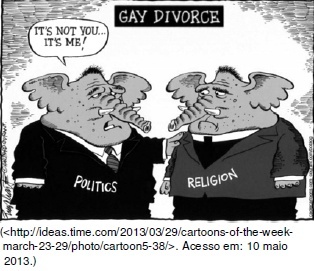
Com base na charge e na notícia de jornal, considere as afirmativas a seguir.
I. A charge indica a separação entre religião e estado, ao passo que a notícia aponta uma interferência da bancada religiosa na política.
II. A charge pressupõe que o obstáculo ao casamento homossexual é religioso, e a notícia sugere que a bancada religiosa seja católica.
III. A charge satiriza o modo como as leis sobre o casamento homossexual têm sido tratadas pela religião, enquanto a notícia problematiza as políticas de legalização.
IV. A charge satiriza o divórcio homossexual, já a notícia satiriza a oposição ao casamento homossexual.
Assinale a alternativa correta.
Questão 28 174218
UEL 2° Fase 2014Brazil judicial decision paves way for gay marriage
The authorities in Brazil have ruled that marriage licences should not be denied to same-sex couples. The council that oversees the country’s judiciary said it was wrong for some offices just to issue civil union documents when the couple wanted full marriage certificates. Correspondents say the decision in effect authorises gay marriage. However full legalisation depends on approval of a bill being examined by the Congress. Tuesday’s resolution by Brazil’s National Council of Justice was based on a 2011 Supreme Court ruling that recognised same-sex civil unions. Notary publics were not legally bound to converting such unions into marriages when asked by gay couples. This led to some being denied marriage certificates at certain places, but being granted the document at others. That would be illegal, according to the new resolution.
“If a notary public officer rejects a gay marriage, he could eventually face disciplinary sanctions”, NCJ judge Guilherme Calmon told BBC Brasil. The ruling brings Brazil one step closer to its neighbours Argentina and Uruguay, which have legalised gay marriages. But opponents could still challenge it at the Supreme Court. And the same-sex marriage bill being examined by the Congress faces strong opposition from religious and conservative lawmakers. Brazil is the world’s most populous Roman Catholic nation and has an estimated 60,000 gay couples.
(BBC World News. Disponível em: . Acesso em: 10 maio 2013.)
Com base nas informações contidas na notícia de jornal, atribua V (verdadeiro) ou F (falso) às afirmativas a seguir.
( ) A nova resolução permite o direito de legalização das uniões de pessoas do mesmo sexo.
( ) A completa legalização do casamento entre pessoas do mesmo sexo depende de lei a ser examinada pelo Congresso.
( ) Os registros de união estável e as certidões de casamento são concedidos aos casais homossexuais desde 2011.
( ) A nova resolução afeta o poder de decisão dos tabeliães em conceder certidões de casamento.
( ) O Brasil tem atualmente as mesmas leis em relação ao casamento homossexual que a Argentina e o Uruguai.
Assinale a alternativa que contém, de cima para baixo, a sequência correta.
06