


![[Marketing] Questao Topo - deslogado](https://storage.estuda.com.br/banners/0_6b7ebee90b03af1c560c73bb8bcce34a_banner_deslogado_70_dias.png)
Questões de Inglês
19.971 Questões
Questão 24 235077
UESB Caderno 1 2014TEXTO:
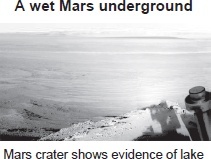
New photos of a huge crater on Mars suggest water
may lurk in crevices under the planet’s surface, hinting
that life might have once lived there, and raising the
possibility that it may live there still, researchers say.
[5] Future research looking into the chances of life on Mars
could shed light on the origins of life on Earth, scientists
added. […]
Space agencies have deployed many missions to
Mars over the decades to explore how habitable its
[10] surface may have been or is today. However, the Martian
surface has been extremely cold, arid and chemically
hostile to life as we know it for most of the history of
Mars. Instead of scanning the surface of Mars for life,
scientists have suggested the most viable habitat for
[15] ancient simple life may have been in Martian water hidden
underground.
On Earth, microbes up to 3 miles or more
underground make up perhaps half of all of the planet’s
living matter. Most of these organisms represent some
[20] of the most primitive kinds of microbes known, hinting
that life may actually have started underground, or at
least survived there during a series of devastating cosmic
impacts known as the Late Heavy Bombardment that
Earth and the rest of the inner solar system endured
[25] about 4.1 billion to 3.8 billion years ago.
Since Mars has less gravity — a surface gravity of
a little more than one-third Earth’s — its crust is less
dense and more porous than that of our planet,
which means that more water can leak underground,
[30] researchers said. Wherever there is liquid water on Earth,
there is virtually always life, and microbes underground
on Mars could be sustained by energy sources
and chemical reactions similar to those that support
deep-dwelling organisms on Earth.
[35] “The deep crust has always been the most habitable
place on Mars, and would be a wise place to search for
evidence for organic processes in the future,” Michalski
[of the Planetary Science Institute in Tucson, Ariz.] told
SPACE.com.
A wet Mars underground. Disponível em: <http://www.foxnews.com/science/2013/01/21/giant-mars-crater-shows-evidence-lake-life/ #ixzz2IcWy5oCl>. Acesso em: 12 out. 2013.
Fill in the parentheses with T (True) or F (False).
The scientists who have been studying the planet Mars
( ) already know that its surface is too cold and dry to support life.
( ) think that, if Mars has some kind of life, it must be in possible water under its crust.
( ) say that about fifty percent of all of Earth’s living matter is found deep under its surface.
( ) affirm that most of the microbes underground on Earth belong to the modern age.
According to the text, the correct sequence, from top to bottom, is
Questão 23 235076
UESB Caderno 1 2014TEXTO:

New photos of a huge crater on Mars suggest water
may lurk in crevices under the planet’s surface, hinting
that life might have once lived there, and raising the
possibility that it may live there still, researchers say.
[5] Future research looking into the chances of life on Mars
could shed light on the origins of life on Earth, scientists
added. […]
Space agencies have deployed many missions to
Mars over the decades to explore how habitable its
[10] surface may have been or is today. However, the Martian
surface has been extremely cold, arid and chemically
hostile to life as we know it for most of the history of
Mars. Instead of scanning the surface of Mars for life,
scientists have suggested the most viable habitat for
[15] ancient simple life may have been in Martian water hidden
underground.
On Earth, microbes up to 3 miles or more
underground make up perhaps half of all of the planet’s
living matter. Most of these organisms represent some
[20] of the most primitive kinds of microbes known, hinting
that life may actually have started underground, or at
least survived there during a series of devastating cosmic
impacts known as the Late Heavy Bombardment that
Earth and the rest of the inner solar system endured
[25] about 4.1 billion to 3.8 billion years ago.
Since Mars has less gravity — a surface gravity of
a little more than one-third Earth’s — its crust is less
dense and more porous than that of our planet,
which means that more water can leak underground,
[30] researchers said. Wherever there is liquid water on Earth,
there is virtually always life, and microbes underground
on Mars could be sustained by energy sources
and chemical reactions similar to those that support
deep-dwelling organisms on Earth.
[35] “The deep crust has always been the most habitable
place on Mars, and would be a wise place to search for
evidence for organic processes in the future,” Michalski
[of the Planetary Science Institute in Tucson, Ariz.] told
SPACE.com.
A wet Mars underground. Disponível em: <http://www.foxnews.com/science/2013/01/21/giant-mars-crater-shows-evidence-lake-life/ #ixzz2IcWy5oCl>. Acesso em: 12 out. 2013.
Scientists believe that the possible existence of life on Mar
Questão 30 218685
FACISA 2014/1TEXT C
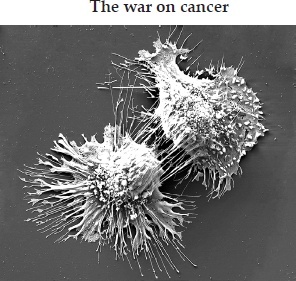
In “The Cancer Chronicles”, George Johnson, a science writer, (…) explains the point, rarely made clear, that cancer is an inevitable side-effect of being multicellular. Most of the cells in such (multicellular) organisms are capable of reproducing; the greater good of the organism requires that they be constantly and assiduously stopped from doing so. But the finely crafted locks intended to keep cell division in check wear down over time, and eventually give way. The result is a cell line whose proliferation gets out of control and, worse, dispatches colonists to other parts of the body. (…)
Some tissues, too, are more susceptible than others. The epithelial cells of lung, gut, liver, breast and the endometrial lining of the womb constantly proliferate, multiplying the opportunities for mutation. Cancer of the heart, whose muscle cells last undivided for their owner’s lifetime, is all but unknown. (…)
If you really want to avoid cancer, don’t smoke (30% of cancers are caused by smoking), and don’t be fat and lazy (obesity and inactivity account for a further 20%). A mixed and balanced diet helps (10-25% of cancers can be attributed to poor diet), but faddily eating lots of this or none of that will not. Alcohol accounts for a further 4% of cancers, so not drinking helps a bit as well.
The Economist, September 14th 2013
A factor which may help to prevent cancer, according to TEXT C, is
Questão 29 218682
FACISA 2014/1TEXT C
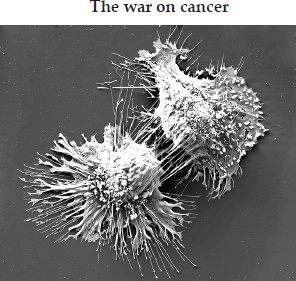
In “The Cancer Chronicles”, George Johnson, a science writer, (…) explains the point, rarely made clear, that cancer is an inevitable side-effect of being multicellular. Most of the cells in such (multicellular) organisms are capable of reproducing; the greater good of the organism requires that they be constantly and assiduously stopped from doing so. But the finely crafted locks intended to keep cell division in check wear down over time, and eventually give way. The result is a cell line whose proliferation gets out of control and, worse, dispatches colonists to other parts of the body. (…)
Some tissues, too, are more susceptible than others. The epithelial cells of lung, gut, liver, breast and the endometrial lining of the womb constantly proliferate, multiplying the opportunities for mutation. Cancer of the heart, whose muscle cells last undivided for their owner’s lifetime, is all but unknown. (…)
If you really want to avoid cancer, don’t smoke (30% of cancers are caused by smoking), and don’t be fat and lazy (obesity and inactivity account for a further 20%). A mixed and balanced diet helps (10-25% of cancers can be attributed to poor diet), but faddily eating lots of this or none of that will not. Alcohol accounts for a further 4% of cancers, so not drinking helps a bit as well.
The Economist, September 14th 2013
TEXT C points out that the organ least likely to be affected by cancer is
Questão 26 218676
FACISA 2014/1TEXT B

Educators and researchers say that you do not need the carefree mind of the grade-schooler or the late-night stamina of a teenager to be a good student. All you need is the determination to learn something new and the right tools.
1. Get visual. Apparently, learning via graphic novels is about to become the next big thing. A recent study found that comic books were better at helping business majors remember things word for word than traditional textbooks. (…) Such graphic guides exist for just about anything you might want to learn more about.
2. Join a gym. Study after study has confirmed that regular exercise improves cognitive function, memory and even students’ grades. Cardiovascular exercise sends more oxygen to the brain in the moment, and as you age, and some research suggests the cumulative effect may benefit neuron health. (…)
3. Share your progress. Recopying my class notes or writing out questions and answers always helped me do better on tests when I was at school. Composing updates about what you are learning and posting on social networks such as Twitter could be the 2013 version of that practice. (...)
4. Test yourself before you study. Psychologists have known for decades that taking a test helps people retain what they have learned better than if they simply spend more time studying. But recent research has revealed a surprising twist: it works even better if you take the test before you know anything about a subject, so you are all but guaranteed to get the answers wrong. (…)The experts haven’t figured out quite yet why this counterintuitive learning trick works, but it appears that trying – and failing – to recall the information is key.
Scientific American Mind, September/ October 2013.
TEXT B claims that you retain information better if
Questão 23 218665
FACISA 2014/1TEXT A
The Final Upgrade

Every new computer comes with one guarantee: There will be a faster, shinier, newer model in short order – and you will fawn over it. It’s hard not to. Processors double in power every 18 months, and other parts turn over even more quickly. Memory gets faster. Screens pack more pixels. Hard drives grow larger. And so on. Like it or not, the product cycle is also a cycle of dependency. We don’t just want the newest thing – we actually need it in order to run the latest programs. But there is a way out (…)
In the last decade, the cloud has started to change how people use their PCs. Connectivity is now just as important as hardware, which gives users ready access to software and backup services over the Internet. (…) In 2011 Google introduced Chromebooks, the first laptops that rely almost entirely on the cloud to deliver software to users. As a result, the machines need only a bit of memory and a low-power processor. (…)
Neverware, a New York start-up, has developed software that can deliver complete instances of Windows to up to 100 computers over Ethernet or Wi-fi. (…) And as broadband access improves, Neverware hopes to deliver the entire service through the cloud. Intel Labs’s Clone Cloud project (…) could do for old smartphones what Neverware does for old computers. (…) Every videogame, every website, every piece of software will work everywhere. And hardware will never be out-of-date again.
Popular Science, October 2013.
According to TEXT A, the cloud
06