


![[Marketing] Questao Topo - deslogado](https://storage.estuda.com.br/banners/0_6b7ebee90b03af1c560c73bb8bcce34a_banner_deslogado_70_dias.png)
Questões de Inglês
19.971 Questões
Questão 51 533073
FDV 2014/2READ THE TEXT:
Barrister vs. solicitor
Hi, I'm Matt. Thanks very much for joining us.
Today I'm going to be talking about a few terms that are easily confused. And these are some Legal English words that often come up during my Legal English classes. Let's have a look at these first two, solicitor and attorney. You're probably familiar with the term attorney. Attorney is a common term in American Legal English for lawyer. Solicitor is not quite the same. Solicitor is particular to England and a lot of Commonwealth countries, and it's a particular type of lawyer. And in the UK we contrast the term solicitor with another branch of the legal profession, the barrister. Now, one of these, the solicitor or the barrister has rights of audience at court. That means that they can go and represent clients at court and carry out the advocacy work. One of them does the preparation – all of the work that leads up to the actual advocacy work in court. Which one do you think is which? OK, it's the solicitor that does the initial litigation, the initial work or the preparatory work and generally speaking if it's, say, a breach of contract case, or a non-criminal matter, the case usually begins and ends with a solicitor, because most cases end in an out-of-court settlement. If the parties can't settle, then the solicitor will get a barrister's advice. The barrister if often seen as the expert in particular areas of law and then the barrister will take the brief, the file, the documents from the solicitor that cover all of the facts of the case and will then represent the client in court.
(Disponível em: . Acesso em: 31 maio 2014)
Check the correct answer according to the text
From the information in the text one learns that:
Questão 47 497325
UCPEL Verão 2014Leia o texto e responda a pergunta.
In Search of the Next Boom, Developers Cram Their Apps into Smart Watches
Clever apps might persuade people that they need a wrist-worn computer.

The age of wearable computing is upon us. Forget the debate over how
capable or fashionable the first devices are, how popular they may eventually
[5] become, or even whether we fully understand what we’re getting into with these
devices. The big question is simply: what will they do? And the answer will have
much to do with the apps that emerge.
Both hardware makers and software developers hope that wearables, like
the smartphone, tablet, and television, will become a new platform for application
[10] development. The two most promising platforms are the headset and the smart
watch. But while the only viable headset is Google’s still-in-beta Glass, smart
watches and smart watch apps have arrived. These early smart watches may
also help clarify what does and doesn’t work for software development in the broader emerging category of
wearable technology.
[15] Samsung is launching the Galaxy Gear, which runs a modified version of the Android smartphone
operating system, with a small group of third-party application developers, both to work out the kinks in its
software application programming interface, and to establish best practices for app development. One of
Samsung’s launch partners for Galaxy Gear is Runkeeper, which has already developed a popular fitness
application for smartphones and for the Pebble smart watch.
[20] Nine months ago, Runkeeper began working with Samsung on apps for other devices. Runkeeper’s
CEO, Jason Jacobs, compares this generation of smart watches to the first tablet computers. “As with any
new category that emerges, it’s a question getting to know the category and figuring out what the use cases
are,” he says. For the Galaxy Gear, Runkeeper is following Samsung’s and Pebble’s approach of using the
smart watch as a companion for the smartphone. This approach will affect the way apps are designed.
[25] “It’s not a replacement for the app on the phone,” says Jacobs of the Runkeeper app for the Galaxy
Gear. “It’s a remote control so you can keep your phone in your pocket, can start and stop without pulling
your phone out. It’s the same data, the same application, but changes the experience to make it less intrusive.”
Jacobs believes some unexpected ways of using smart watches will emerge as apps appear. “No one
really imagined that doctors would use tablets as they made their rounds,” says Jacobs. “The skeptics who
[30] say ‘no one would ever use that’ [about smart watches] are some of the same people who said they would
never use a laptop without a keyboard.”
Pocket’s founder and CEO Nate Weiner acknowledges that a smart-watch screen is limited. “This
device is not for long periods in which a person is looking at their watch to consume content,” he says. “We
weren’t going to just drop a Pocket list on there and assume people would want to read or watch a video on
[35] their watch for a long period of time.”
This may be a veiled jab at Google Glass, but it’s also part of our expectations for a wristwatch:
besides being relatively hands-free, the appeal of checking time, weather, or notifications on a smart watch
is that it’s quick, natural, and discreet. Ideally, third-party applications will follow the same approach.
By Tim Carmody, Technology Review published by MIT, 25/09/2013
Adapted from http://www.technologyreview.com/news/519541/in-search-of-the-next-boom-developers-cram-their-appsinto-smart-watches/
No título, o verbo “cram” em “Developers Cram Their Apps into Smart Watches” tem o sentido de
Questão 45 459228
IFRS Superior 2014/1Digital dementia: The memory problem plaguing teens and young adults
[1] Dementia is a disease that typically affects the elderly. But recently, a new cognitive condition has
[2] been discovered that is afflicting people in their teens and 20s. It’s called “digital dementia.”
[3] A recent study from South Korea found that individuals who rely heavily on technology may suffer a
[4] deterioration in cognitive abilities such as short term memory dysfunction.
[5] Dr. Carolyn Brockington from St. Luke’s Roosevelt Medical Center in New York City sat down with Dr.
[6] Manny Alvarez, senior managing health editor for FoxNews.com, to talk about this new phenomenon.
[7] She said one of the reasons younger adults are suffering from poor memory is because they don’t feel the
[8] need to memorize information anymore. “The problem is that we’re using technology, which is good, but
[9] we’re overusing in many ways,” Brockington said. “We’re not relying on our brains to sort of retrieve the
[10] information when we need it.”
[11] _________ elderly dementia is typically a permanent condition, Brockington said that’s not necessarily
[12] the case with digital dementia. __________ , she said these kind of memory issues could affect future
[13] generations.“I think they use dementia in this case just to mean a memory problem,” she said. “But you
[14] know, if you think over an evolutionary time period, if we use the brain in this way and we don’t use our
[15] short-term memory, maybe years and years (later) we’re going to have difficulty with short-term memory.”
[16] In order to counteract the effects of digital dementia, Brockington suggests engaging in more conventional
[17] forms of communication. “Have a conversation,” she recommended. “…Don’t always text. You know, you
[18] go to the restaurant, and you see people sitting over a meal, and everybody’s on their cell phone. Nobody’s
[19] having a communication or talking sessions, so that’s important.”
[20] Brockington said exercise is also important for brain function, because it increases blood flow and the
[21] transportation of nutrients. __________ , the best way for people to learn is to read an actual book rather
[22] than a computer screen – and then try to recall information without the aid of technology. “Don’t always go
[23] to the Internet or go to your cell phone in order to find answers,” Brockington said. “You have many of the
[24] answers in your brain and actually using your retrieval mechanism of your memory allows your memory to
[25] get better and better over time.”
Disponível em: <http://www.foxnews.com/health/2013/08/15/digital-dementia-memory-problem-plaguing-teens-and-young-adults/>.
Acesso em: 18 set. 2013.
Considere as seguintes afirmativas sobre algumas palavras usadas no texto
I - “condition” (linha 01) poderia ser substituída, sem prejuízo de significado, por “disease”.
II - “kind” (linha 12) é um substantivo e significa o mesmo que “type”.
III - “actual” (linha 21 ) pode ser traduzida como “moderno”.
IV- “better” (linha 25) corresponde ao superlativo do adjetivo “good”.
Estão corretas as afirmativas
Questão 44 459223
IFRS Superior 2014/1Digital dementia: The memory problem plaguing teens and young adults
[1] Dementia is a disease that typically affects the elderly. But recently, a new cognitive condition has
[2] been discovered that is afflicting people in their teens and 20s. It’s called “digital dementia.”
[3] A recent study from South Korea found that individuals who rely heavily on technology may suffer a
[4] deterioration in cognitive abilities such as short term memory dysfunction.
[5] Dr. Carolyn Brockington from St. Luke’s Roosevelt Medical Center in New York City sat down with Dr.
[6] Manny Alvarez, senior managing health editor for FoxNews.com, to talk about this new phenomenon.
[7] She said one of the reasons younger adults are suffering from poor memory is because they don’t feel the
[8] need to memorize information anymore. “The problem is that we’re using technology, which is good, but
[9] we’re overusing in many ways,” Brockington said. “We’re not relying on our brains to sort of retrieve the
[10] information when we need it.”
[11] _________ elderly dementia is typically a permanent condition, Brockington said that’s not necessarily
[12] the case with digital dementia. __________ , she said these kind of memory issues could affect future
[13] generations.“I think they use dementia in this case just to mean a memory problem,” she said. “But you
[14] know, if you think over an evolutionary time period, if we use the brain in this way and we don’t use our
[15] short-term memory, maybe years and years (later) we’re going to have difficulty with short-term memory.”
[16] In order to counteract the effects of digital dementia, Brockington suggests engaging in more conventional
[17] forms of communication. “Have a conversation,” she recommended. “…Don’t always text. You know, you
[18] go to the restaurant, and you see people sitting over a meal, and everybody’s on their cell phone. Nobody’s
[19] having a communication or talking sessions, so that’s important.”
[20] Brockington said exercise is also important for brain function, because it increases blood flow and the
[21] transportation of nutrients. __________ , the best way for people to learn is to read an actual book rather
[22] than a computer screen – and then try to recall information without the aid of technology. “Don’t always go
[23] to the Internet or go to your cell phone in order to find answers,” Brockington said. “You have many of the
[24] answers in your brain and actually using your retrieval mechanism of your memory allows your memory to
[25] get better and better over time.”
Disponível em: <http://www.foxnews.com/health/2013/08/15/digital-dementia-memory-problem-plaguing-teens-and-young-adults/>.
Acesso em: 18 set. 2013.
Assinale com V (verdadeiro) ou F (falso) as seguintes afirmações, conforme elas estejam ou não de acordo com o texto.
( ) Overusing technology may cause memory problems.
( ) Elderly dementia often afflicts young people.
( ) Exercising memory might lead to digital dementia.
( ) A way to prevent digital dementia is to have face-to-face conversations.
A sequência correta de preenchimento dos parênteses, de cima para baixo, é
Questão 43 459219
IFRS Superior 2014/1Digital dementia: The memory problem plaguing teens and young adults
[1] Dementia is a disease that typically affects the elderly. But recently, a new cognitive condition has
[2] been discovered that is afflicting people in their teens and 20s. It’s called “digital dementia.”
[3] A recent study from South Korea found that individuals who rely heavily on technology may suffer a
[4] deterioration in cognitive abilities such as short term memory dysfunction.
[5] Dr. Carolyn Brockington from St. Luke’s Roosevelt Medical Center in New York City sat down with Dr.
[6] Manny Alvarez, senior managing health editor for FoxNews.com, to talk about this new phenomenon.
[7] She said one of the reasons younger adults are suffering from poor memory is because they don’t feel the
[8] need to memorize information anymore. “The problem is that we’re using technology, which is good, but
[9] we’re overusing in many ways,” Brockington said. “We’re not relying on our brains to sort of retrieve the
[10] information when we need it.”
[11] _________ elderly dementia is typically a permanent condition, Brockington said that’s not necessarily
[12] the case with digital dementia. __________ , she said these kind of memory issues could affect future
[13] generations.“I think they use dementia in this case just to mean a memory problem,” she said. “But you
[14] know, if you think over an evolutionary time period, if we use the brain in this way and we don’t use our
[15] short-term memory, maybe years and years (later) we’re going to have difficulty with short-term memory.”
[16] In order to counteract the effects of digital dementia, Brockington suggests engaging in more conventional
[17] forms of communication. “Have a conversation,” she recommended. “…Don’t always text. You know, you
[18] go to the restaurant, and you see people sitting over a meal, and everybody’s on their cell phone. Nobody’s
[19] having a communication or talking sessions, so that’s important.”
[20] Brockington said exercise is also important for brain function, because it increases blood flow and the
[21] transportation of nutrients. __________ , the best way for people to learn is to read an actual book rather
[22] than a computer screen – and then try to recall information without the aid of technology. “Don’t always go
[23] to the Internet or go to your cell phone in order to find answers,” Brockington said. “You have many of the
[24] answers in your brain and actually using your retrieval mechanism of your memory allows your memory to
[25] get better and better over time.”
Disponível em: <http://www.foxnews.com/health/2013/08/15/digital-dementia-memory-problem-plaguing-teens-and-young-adults/>.
Acesso em: 18 set. 2013.
Assinale a alternativa que preenche correta e respectivamente as lacunas das linhas 11, 12 e 21.
Questão 42 459215
IFRS Superior 2014/1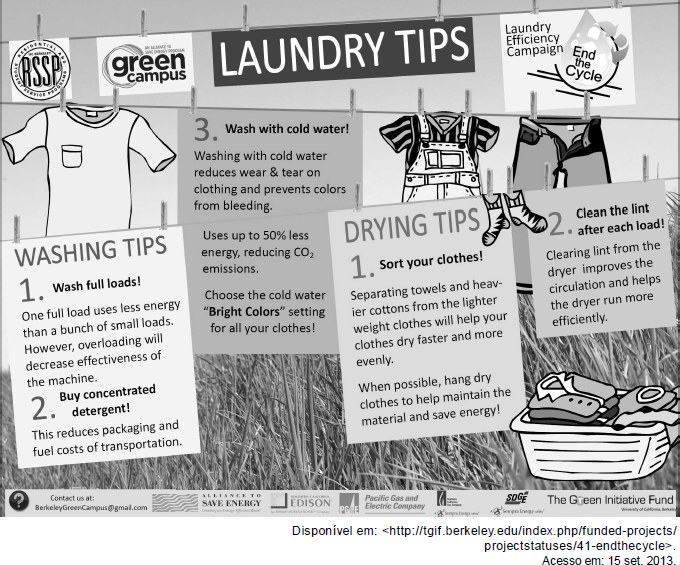
A pergunta que NÃO pode ser respondida com base nas Laundry Tips é
06