


![[Marketing] Questao Topo - deslogado](https://storage.estuda.com.br/banners/0_6b7ebee90b03af1c560c73bb8bcce34a_banner_deslogado_70_dias.png)
Questões de Inglês
19.971 Questões
Questão 16 2338739
UERR 2020Text
Hero for All: Martin Luther King, Jr.
Civil Rights leader Dr. Martin Luther King, Jr., never backed down in his stand against racism. Learn more about the life of this courageous hero who inspired millions of people to right a historical wrong
Dr. Martin Luther King, Jr., was born in Atlanta, Georgia, in 1929. At the time in that part of the country, segregation—or the separation of races in places like schools, buses, and restaurants—was the law. He experienced racial prejudice from the time he was very young, which inspired him to dedicate his life to achieving equality and justice for Americans of all colors. King believed that peaceful refusal to obey unjust law was the best way to bring about social change.
King and his wife, Coretta Scott King, lead demonstrators on the fourth day of a historic fiveday march in 1965. Starting in Selma, Alabama, where local African Americans had been campaigning for the right to vote, King led thousands of nonviolent demonstrators 54 miles to the state capitol of Montgomery.
King was arrested several times during his lifetime. In 1960, he joined black college students in a sit-in at a segregated lunch counter. Presidential candidate John F. Kennedy interceded to have King released from jail, an action that is credited with helping Kennedy win the presidency.
Excerpt from the site https://kids.nationalgeographic.com/explore/history/mart in-luther-king-jr/ researched in August, 2019.
Dr. Martin Luther King Jr is from the United States, he is American.
The word in bold is a:
Questão 10 2338623
UERR 2020Text
Our Kids Do Not Need a Weight Watchers App: A registered dietitian explains why you should never put your child on a diet.
By Christy Harrison
Weight Watchers — now rebranded as WW — has introduced an app called Kurbo, for children 8 to 17 years old. As a registered dietitian who specializes in helping people recover from disordered eating, I strongly recommend that parents keep this new tool — and any weight-loss program — away from their children.
Our society is unfair and cruel to people who are in larger bodies, so I can empathize with parents who might believe their child needs to lose weight, and with any child who wants to. Unfortunately, attempts to shrink a child’s body are likely to be both ineffective and harmful to physical and mental health.
Over the last 60 years, numerous studies have shown that among people who lose weight, more than 90 percent gain it back over the long run. For example, a 2000 study of adults 20 to 45 found that less than 5 percent lost weight and kept it off long term. And a 2015 study of more than 176,000 higher-weight people age 20 and older found that 95 percent to 98 percent of those who lost weight gained back all of it (or more) within five years. A 2007 review of the scientific evidence found that most people likely gained back more.
Excerpt from the site: https://www.nytimes.com/2019/08/18/opinion/weightwatcherskids.html?action=click&module=Opinion&pgtype=Hom epage.
The genre of the text is:
Questão 28 1735961
UEL 2° Fase 2020Leia o texto a seguir e responda a questão.
After failing to learn a new language on five separate occasions, I taught myself to speak Spanish like a native in just six months by watching movies and TV shows, listening to music, and reading books and comics like Harry Potter and Garfield.
This simple, easy-to-learn technique, that even the most linguistically-challenged can master literally overnight, is used by many of the most respected and skilled polyglots and language teachers in the world, and it’s never really been laid out, explained, and demonstrated in full, point-by-point, step-by-step detail until now.
When characters in a movie or TV show are speaking the dialogue, unless it’s set in a previous period like the 1800s or something, they speak normal, everyday language. So if you wanted to learn Spanish, the type of normal everyday Spanish that native speakers use every day, aka “conversational Spanish”. . . Don’t you think that Spanish-language TV shows, movies, music, and books might be a good source to learn from. . . if only you knew how?
Not only that, but it would be fun, wouldn’t it? Far better than learning the language from some boring, dry textbook or workbook that, even worse, is teaching outdated, formal, “non-conversational” Spanish (look at the dialogue in one sometime: do people actually talk like that? No).
The basic technique is obvious: consume popular Spanish-language media and try to learn what they’re saying by looking up what you don’t understand. Sure. But the issue is twofold:
1) The problems you will inevitably run into (how do I apply what I’ve learned? how do I ensure I’m not misunderstanding the meaning and thereby learning something incorrect? where do I look things up? what if it’s not in the dictionary and Google Translate isn’t cutting it? etc.), and...
2) How do we do things as efficiently as possible? If you’re a beginner you’re going to have to sort out how to do this all on your own, how to solve any problems you might run into on your own, while probably doing many things less effectively and slower than is necessary. I’ve already learned all this stuff the hard way, I’ve made many of the mistakes you would if you went this alone, let me just save you a ton of time, trouble, and possibly money by teaching you what I already know from experience.
Has this basic technique been used for centuries by language students and teachers alike? Yes, there are records dating back to the 18th century of language teachers using popular media in the language they’re teaching to help their students learn it. I’m not claiming to have invented it. What I’ve done here is, after having used and refined the technique myself for several years, distilled it down to a system that’s easy to learn, and which is taught in a format that’s organized, easy to understand, and which takes advantage of all the latest technology, such as all the various resources available on the internet now.
Adaptado de: Andrew Tracey - author of The Telenovela Method www.amazon.com
Andrew Tracey, autor do livro The Telenovela Method, afirma que a técnica para aprender espanhol que ele expõe em seu livro
Questão 35 1718805
FAMEMA 2020America's Growing Smartphone Addiction
% of American smartphone owners who check their phones at least several times an hour
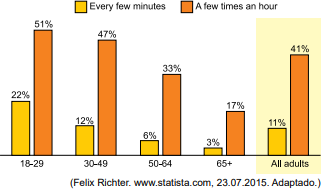
According to the chart,
Questão 34 1718797
FAMEMA 2020Leia o texto para responder a questão.
An increasing body of evidence suggests that the time we spend on our smartphones is interfering with our sleep, self-esteem, relationships, memory, attention spans, creativity, productivity and problem-solving and decision-making skills. But there is another reason for us to rethink our relationships with our devices. By chronically raising levels of cortisol, the body’s main stress hormone, our phones may be threatening our health and shortening our lives.
If they happened only occasionally, phone-induced cortisol spikes might not matter. But the average American spends four hours a day staring at their smartphone and keeps it within arm’s reach nearly all the time, according to a tracking app called Moment.
“Your cortisol levels are elevated when your phone is in sight or nearby, or when you hear it or even think you hear it,” says David Greenfield, professor of clinical psychiatry at the University of Connecticut School of Medicine and founder of the Center for Internet and Technology Addiction. “It’s a stress response, and it feels unpleasant, and the body’s natural response is to want to check the phone to make the stress go away.”
But while doing so might soothe you for a second, it probably will make things worse in the long run. Any time you check your phone, you’re likely to find something else stressful waiting for you, leading to another spike in cortisol and another craving to check your phone to make your anxiety go away. This cycle, when continuously reinforced, leads to chronically elevated cortisol levels. And chronically elevated cortisol levels have been tied to an increased risk of serious health problems, including depression, obesity, metabolic syndrome, Type 2 diabetes, fertility issues, high blood pressure, heart attack, dementia and stroke.
(Catherine Price. www.nytimes.com, 24.04.2019. Adaptado.)
No trecho do último parágrafo “while doing so might soothe you for a second”, o termo sublinhado equivale, em português, a
Questão 85 1563738
UFPR 2020O texto a seguir é referência para a questão.
More Than Just Children’s Books
Krumulus, a small bookstore in Germany, has everything a kid could want: parties, readings, concerts, plays, puppet shows, workshops and book clubs.
“I knew it was going to be very difficult to open a bookstore, everyone tells you you’re crazy, there will be no future,” says Anna Morlinghaus, Krumulus’s founder. Still, she wanted to try. A month before her third son was born, she opened the store in Berlin’s Kreuzberg district.
BERLIN — On a recent Saturday afternoon, a hush fell in the bright, airy “reading-aloud” room at Krumulus, a small children’s bookstore in Berlin, as Sven Wallrodt, one of the store’s employees, stood up to speak. Brandishing a newly published illustrated children’s book about the life of Johannes Gutenberg, the inventor of the printing press, he looked at the crowd of eager, mostly school-aged children and their parents. “Welcome to this book presentation”, he said. “If you fall asleep, snore quietly”. Everyone laughed, but no one fell asleep. An hour later, the children followed Wallrodt down to the bookstore’s basement workshop, where he showed them how Gutenberg fit leaden block letters into a metal plate. Then the children printed their own bookmark using a technique similar to Gutenberg’s, everyone was thrilled.
(Disponível em: https://www.nytimes.com/2019/05/20/books/berlin-germany-krumulus.html)
Taking into consideration the last sentence of the text, it is correct to say that after the workshop everybody was:
06