


![[Marketing] Questao Topo - deslogado](https://storage.estuda.com.br/banners/0_6b7ebee90b03af1c560c73bb8bcce34a_banner_deslogado_70_dias.png)
Questões de Inglês
19.971 Questões
Questão 47 95040
ESPM 2015/1The trouble with trying to make trains go faster
By Katia Moskvitch
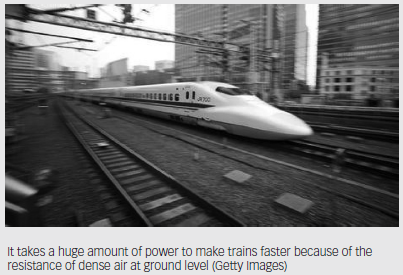
As technology advances, transport gets ever faster, and trains are no exception. But with great speed come great drawbacks. Katia Moskvitch reports on the pitfalls facing train designers trying to reach even greater speed on rails
Since George Stephenson’s Rocket, designers have been trying to make trains go faster and faster. Despite all the innovations, particularly in the last 50 years it’s still a dream that all cities around the world could be connected by high-speed trains that complete journeys in a flash, allowing you to arrive at your destination relaxed and untroubled. Why is this the case?
Going fast on rails brings its own special set of problems. Human bodies are simply not built for rapid acceleration, we experience certain low frequency motions that create discomfort – a feeling of “motion sickness”. We also experience rapid acceleration, for example, each time we take off and land in a plane.
Then there is the logistics of trying to send a train faster along a track. Going fast means pushing air out of the way, which also requires a lot of power. A train travelling at 300mph (480km/h) uses roughly 27 times more power than one travelling at 100mph (160km/h). And at ground level the air is a lot denser than it is at 35,000ft (10,600m) where airliners regularly cruise. That means more resistance, and therefore more vibrations
If trains could travel just in straight lines and without any dips, then high speeds would not be a big issue. It’s the bends and the ups and downs that create a problem, especially in Europe, with its many rivers and mountains and old train lines following long-travelled routes.
14 August 2014 | www.bbc.co.uk
The underlined pronoun which in the 4th paragraph of the text refers to:
Questão 46 95039
ESPM 2015/1The trouble with trying to make trains go faster
By Katia Moskvitch
As technology advances, transport gets ever faster, and trains are no exception. But with great speed come great drawbacks. Katia Moskvitch reports on the pitfalls facing train designers trying to reach even greater speed on rails
Since George Stephenson’s Rocket, designers have been trying to make trains go faster and faster. Despite all the innovations, particularly in the last 50 years it’s still a dream that all cities around the world could be connected by high-speed trains that complete journeys in a flash, allowing you to arrive at your destination relaxed and untroubled. Why is this the case?
Going fast on rails brings its own special set of problems. Human bodies are simply not built for rapid acceleration, we experience certain low frequency motions that create discomfort – a feeling of “motion sickness”. We also experience rapid acceleration, for example, each time we take off and land in a plane.
Then there is the logistics of trying to send a train faster along a track. Going fast means pushing air out of the way, which also requires a lot of power. A train travelling at 300mph (480km/h) uses roughly 27 times more power than one travelling at 100mph (160km/h). And at ground level the air is a lot denser than it is at 35,000ft (10,600m) where airliners regularly cruise. That means more resistance, and therefore more vibrations
If trains could travel just in straight lines and without any dips, then high speeds would not be a big issue. It’s the bends and the ups and downs that create a problem, especially in Europe, with its many rivers and mountains and old train lines following long-travelled routes.
14 August 2014 | www.bbc.co.uk
The underlined conjunction therefore in the 4th paragraph of the text conveys an idea of
Questão 45 95038
ESPM 2015/1The trouble with trying to make trains go faster
By Katia Moskvitch
As technology advances, transport gets ever faster, and trains are no exception. But with great speed come great drawbacks. Katia Moskvitch reports on the pitfalls facing train designers trying to reach even greater speed on rails
Since George Stephenson’s Rocket, designers have been trying to make trains go faster and faster. Despite all the innovations, particularly in the last 50 years it’s still a dream that all cities around the world could be connected by high-speed trains that complete journeys in a flash, allowing you to arrive at your destination relaxed and untroubled. Why is this the case?
Going fast on rails brings its own special set of problems. Human bodies are simply not built for rapid acceleration, we experience certain low frequency motions that create discomfort – a feeling of “motion sickness”. We also experience rapid acceleration, for example, each time we take off and land in a plane.
Then there is the logistics of trying to send a train faster along a track. Going fast means pushing air out of the way, which also requires a lot of power. A train travelling at 300mph (480km/h) uses roughly 27 times more power than one travelling at 100mph (160km/h). And at ground level the air is a lot denser than it is at 35,000ft (10,600m) where airliners regularly cruise. That means more resistance, and therefore more vibrations
If trains could travel just in straight lines and without any dips, then high speeds would not be a big issue. It’s the bends and the ups and downs that create a problem, especially in Europe, with its many rivers and mountains and old train lines following long-travelled routes.
14 August 2014 | www.bbc.co.uk
The main idea of the text is
Questão 44 95037
ESPM 2015/1Air strikes in Iraq
A time to act
by Lexington
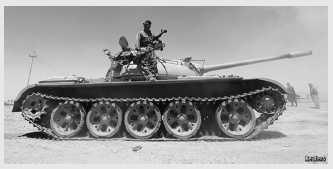
OVERCOMING his deep wariness of overseas entanglements, President Barack Obama has authorised American generals to launch air strikes in Iraq against the fanatical jihadists of the Islamic State (IS). The first strike was carried out on August 8th within 12 hours of the president’s announcement, and involved the bombing of a mobile IS artillery piece near Erbil, capital of the autonomous Kurdish region in the country’s north.
Seeking to reassure a war-weary public, the president described two tightly defined missions that would trigger air attacks. First, the president told his public in a late-night address from the White House, warplanes would strike convoys of IS fighters if they threaten either American diplomats and troops stationed in Erbil or Baghdad.
Second, air strikes might be used to break an IS siege of thousands of civilians from the minority Yazidi sect, who have been trapped in mountains near the city of Sinjar without food and water, facing threats of mass slaughter from IS forces waiting below.
American transport planes dropped bundles of food and water onto the Sinjar mountains, with Kurdish peshmerga fighters on a nearby hilltop able to report that most were safely received—though more will doubtless be needed.
Mr Obama cast the operations in glowingly humanitarian terms. America cannot and should not intervene in every crisis around the world, he said. But when America has a mandate, as it does in this case, after being asked for help by the Iraqi government, and when it has “the unique capabilities to help avert a massacre”, then his country could not “turn a blind eye”.
Aug 8th 2014 | www.economist.com
The underlined expression ‘turn a blind eye’ in the last paragraph of the text means
Questão 43 95036
ESPM 2015/1Air strikes in Iraq
A time to act
by Lexington
OVERCOMING his deep wariness of overseas entanglements, President Barack Obama has authorised American generals to launch air strikes in Iraq against the fanatical jihadists of the Islamic State (IS). The first strike was carried out on August 8th within 12 hours of the president’s announcement, and involved the bombing of a mobile IS artillery piece near Erbil, capital of the autonomous Kurdish region in the country’s north.
Seeking to reassure a war-weary public, the president described two tightly defined missions that would trigger air attacks. First, the president told his public in a late-night address from the White House, warplanes would strike convoys of IS fighters if they threaten either American diplomats and troops stationed in Erbil or Baghdad.
Second, air strikes might be used to break an IS siege of thousands of civilians from the minority Yazidi sect, who have been trapped in mountains near the city of Sinjar without food and water, facing threats of mass slaughter from IS forces waiting below.
American transport planes dropped bundles of food and water onto the Sinjar mountains, with Kurdish peshmerga fighters on a nearby hilltop able to report that most were safely received—though more will doubtless be needed.
Mr Obama cast the operations in glowingly humanitarian terms. America cannot and should not intervene in every crisis around the world, he said. But when America has a mandate, as it does in this case, after being asked for help by the Iraqi government, and when it has “the unique capabilities to help avert a massacre”, then his country could not “turn a blind eye”.
Aug 8th 2014 | www.economist.com
The underlined conjunction though in the 4th paragraph of the text could be replaced in the sentence, without changing its structure, by
Questão 42 95035
ESPM 2015/1Air strikes in Iraq
A time to act
by Lexington
OVERCOMING his deep wariness of overseas entanglements, President Barack Obama has authorised American generals to launch air strikes in Iraq against the fanatical jihadists of the Islamic State (IS). The first strike was carried out on August 8th within 12 hours of the president’s announcement, and involved the bombing of a mobile IS artillery piece near Erbil, capital of the autonomous Kurdish region in the country’s north.
Seeking to reassure a war-weary public, the president described two tightly defined missions that would trigger air attacks. First, the president told his public in a late-night address from the White House, warplanes would strike convoys of IS fighters if they threaten either American diplomats and troops stationed in Erbil or Baghdad.
Second, air strikes might be used to break an IS siege of thousands of civilians from the minority Yazidi sect, who have been trapped in mountains near the city of Sinjar without food and water, facing threats of mass slaughter from IS forces waiting below.
American transport planes dropped bundles of food and water onto the Sinjar mountains, with Kurdish peshmerga fighters on a nearby hilltop able to report that most were safely received—though more will doubtless be needed.
Mr Obama cast the operations in glowingly humanitarian terms. America cannot and should not intervene in every crisis around the world, he said. But when America has a mandate, as it does in this case, after being asked for help by the Iraqi government, and when it has “the unique capabilities to help avert a massacre”, then his country could not “turn a blind eye”.
Aug 8th 2014 | www.economist.com
According to the text,
06