


![[Marketing] Questao Topo - deslogado](https://storage.estuda.com.br/banners/0_6b7ebee90b03af1c560c73bb8bcce34a_banner_deslogado_70_dias.png)
Questões de Inglês
19.971 Questões
Questão 44 95117
ESPM 2015/2Fidel Loses the Race to the Grave
It’s fitting that the thaw was brokered by a president who wasn’t alive when Castro came to power.
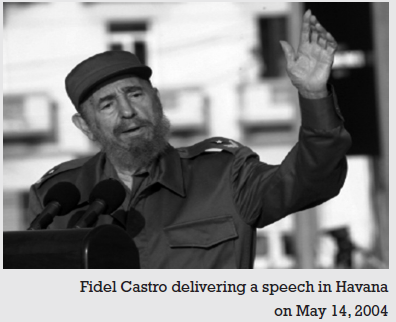
The world now has the answer to a question as old as the New World Order: Which would die first? Fidel Castro? Or the chokehold his angry critics maintained on U.S. foreign policy since El Comandante came to power in Cuba 55 years ago? It was entirely fitting that the answer was delivered by an American president whose own age is 53. As he noted in his historic address from the White House, Barak Obama was born two years after Castro’s Communist guerrillas swept into Havana. Like the children and grandchildren of the Cubans who fled to Miami after the Communists arrived, the events Obama actually lived through were the ones that steadily reduced the island from a marquee venue of the Cold War — the thrust stage from which, in the 1962 Cuban Missile Crisis, Armageddon was nearly launched — to whatever the place qualifies as today: basically a scenic relic of Marxism, with beaches and cigars.
Other stout lobbies remain as present as their animating issue: The NRA likely will be around as long as gun owners are, and the Israel lobby as long as the state. But the U.S. government’s determined, and solitary isolation of Cuba was, as Obama alluded, a victim of generational change. The collapse of the Soviet Union, so thrillingly dramatic, was followed by the more gradual senescence of those who had invested most in opposing its most famous client state.
Time waits for no man, not even Fidel. The regime that Fidel once made a model of resistance to U.S. dominance is now run by his 83-year-old kid brother. It was Raul Castro who spoke from Havana at the same moment Obama made his historic address, the two speeches pre-arranged by the leaders’ staffs to begin at the same hour, signaling both sides’ commitment to a new era of cooperation.
But the Cuban side appeared to be locked in that other era: Raul Castro was seated between dark paneling and a massive desk. The framed snapshots at his elbows were in black and white — the kind of vintage photographs that adorn the Hotel Nacional at the edge of the magnificent ruin that is Havana’s Old City. The glossies in the hotel are there for the tourists, images of the like of Frank Sinatra and the Rat Pack making themselves at home in a version of Havana glamour familiar to Americans who — forbidden by the travel restrictions Obama says will be pushed away — last saw the city in The Godfather Part II, or any other movie set in Cuba before Castro took over.
The reality just outside the hotel’s doors is far more compelling, from the ardent struggles of human rights activists and artists, to the joyously sensual quality of street life in what may well be the sexiest capital city in the world. Americans who dared to visit — it wasn’t hard, routing through Canada or Cancun — returned with enthusiastic reports of a poor but intensely vibrant society. Its economy may be a shambles now, but the island’s physical features alone, including 2,300 miles of Caribbean coastline not an hour from the U.S., all but assure development, especially by American retirees. Which would be fitting as well, since they would be old enough to appreciate just how time can change things.
(adapted from www.time.com, December 17th 2014)
The underline word but in the sentence: “(…) the island’s physical features alone, including 2,300 miles of Caribbean coastline not an hour from the U.S., all but assure development, especially by American retirees.” can be replaced by which of the following word without changing its meaning?
Questão 42 95115
ESPM 2015/2Fidel Loses the Race to the Grave
It’s fitting that the thaw was brokered by a president who wasn’t alive when Castro came to power.
The world now has the answer to a question as old as the New World Order: Which would die first? Fidel Castro? Or the chokehold his angry critics maintained on U.S. foreign policy since El Comandante came to power in Cuba 55 years ago? It was entirely fitting that the answer was delivered by an American president whose own age is 53. As he noted in his historic address from the White House, Barak Obama was born two years after Castro’s Communist guerrillas swept into Havana. Like the children and grandchildren of the Cubans who fled to Miami after the Communists arrived, the events Obama actually lived through were the ones that steadily reduced the island from a marquee venue of the Cold War — the thrust stage from which, in the 1962 Cuban Missile Crisis, Armageddon was nearly launched — to whatever the place qualifies as today: basically a scenic relic of Marxism, with beaches and cigars.
Other stout lobbies remain as present as their animating issue: The NRA likely will be around as long as gun owners are, and the Israel lobby as long as the state. But the U.S. government’s determined, and solitary isolation of Cuba was, as Obama alluded, a victim of generational change. The collapse of the Soviet Union, so thrillingly dramatic, was followed by the more gradual senescence of those who had invested most in opposing its most famous client state.
Time waits for no man, not even Fidel. The regime that Fidel once made a model of resistance to U.S. dominance is now run by his 83-year-old kid brother. It was Raul Castro who spoke from Havana at the same moment Obama made his historic address, the two speeches pre-arranged by the leaders’ staffs to begin at the same hour, signaling both sides’ commitment to a new era of cooperation.
But the Cuban side appeared to be locked in that other era: Raul Castro was seated between dark paneling and a massive desk. The framed snapshots at his elbows were in black and white — the kind of vintage photographs that adorn the Hotel Nacional at the edge of the magnificent ruin that is Havana’s Old City. The glossies in the hotel are there for the tourists, images of the like of Frank Sinatra and the Rat Pack making themselves at home in a version of Havana glamour familiar to Americans who — forbidden by the travel restrictions Obama says will be pushed away — last saw the city in The Godfather Part II, or any other movie set in Cuba before Castro took over.
The reality just outside the hotel’s doors is far more compelling, from the ardent struggles of human rights activists and artists, to the joyously sensual quality of street life in what may well be the sexiest capital city in the world. Americans who dared to visit — it wasn’t hard, routing through Canada or Cancun — returned with enthusiastic reports of a poor but intensely vibrant society. Its economy may be a shambles now, but the island’s physical features alone, including 2,300 miles of Caribbean coastline not an hour from the U.S., all but assure development, especially by American retirees. Which would be fitting as well, since they would be old enough to appreciate just how time can change things.
(adapted from www.time.com, December 17th 2014)
The phrase “Time waits for no man, not even Fidel” in the beginning of paragraph 3 makes allusion to:
Questão 41 95114
ESPM 2015/2Fidel Loses the Race to the Grave
It’s fitting that the thaw was brokered by a president who wasn’t alive when Castro came to power.

The world now has the answer to a question as old as the New World Order: Which would die first? Fidel Castro? Or the chokehold his angry critics maintained on U.S. foreign policy since El Comandante came to power in Cuba 55 years ago? It was entirely fitting that the answer was delivered by an American president whose own age is 53. As he noted in his historic address from the White House, Barak Obama was born two years after Castro’s Communist guerrillas swept into Havana. Like the children and grandchildren of the Cubans who fled to Miami after the Communists arrived, the events Obama actually lived through were the ones that steadily reduced the island from a marquee venue of the Cold War — the thrust stage from which, in the 1962 Cuban Missile Crisis, Armageddon was nearly launched — to whatever the place qualifies as today: basically a scenic relic of Marxism, with beaches and cigars.
Other stout lobbies remain as present as their animating issue: The NRA likely will be around as long as gun owners are, and the Israel lobby as long as the state. But the U.S. government’s determined, and solitary isolation of Cuba was, as Obama alluded, a victim of generational change. The collapse of the Soviet Union, so thrillingly dramatic, was followed by the more gradual senescence of those who had invested most in opposing its most famous client state.
Time waits for no man, not even Fidel. The regime that Fidel once made a model of resistance to U.S. dominance is now run by his 83-year-old kid brother. It was Raul Castro who spoke from Havana at the same moment Obama made his historic address, the two speeches pre-arranged by the leaders’ staffs to begin at the same hour, signaling both sides’ commitment to a new era of cooperation.
But the Cuban side appeared to be locked in that other era: Raul Castro was seated between dark paneling and a massive desk. The framed snapshots at his elbows were in black and white — the kind of vintage photographs that adorn the Hotel Nacional at the edge of the magnificent ruin that is Havana’s Old City. The glossies in the hotel are there for the tourists, images of the like of Frank Sinatra and the Rat Pack making themselves at home in a version of Havana glamour familiar to Americans who — forbidden by the travel restrictions Obama says will be pushed away — last saw the city in The Godfather Part II, or any other movie set in Cuba before Castro took over.
The reality just outside the hotel’s doors is far more compelling, from the ardent struggles of human rights activists and artists, to the joyously sensual quality of street life in what may well be the sexiest capital city in the world. Americans who dared to visit — it wasn’t hard, routing through Canada or Cancun — returned with enthusiastic reports of a poor but intensely vibrant society. Its economy may be a shambles now, but the island’s physical features alone, including 2,300 miles of Caribbean coastline not an hour from the U.S., all but assure development, especially by American retirees. Which would be fitting as well, since they would be old enough to appreciate just how time can change things.
(adapted from www.time.com, December 17th 2014)
One of the text´s main ideas is that:
Questão 50 95043
ESPM 2015/1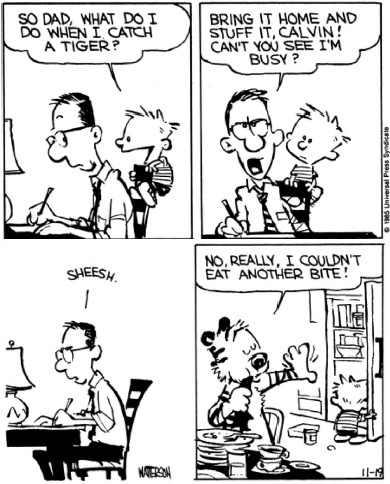
According to the comic strip,
Questão 49 95042
ESPM 2015/1
In the last strip the modal verb couldn’t could be replaced, without changing its meaning, by
Questão 48 95041
ESPM 2015/1The trouble with trying to make trains go faster
By Katia Moskvitch
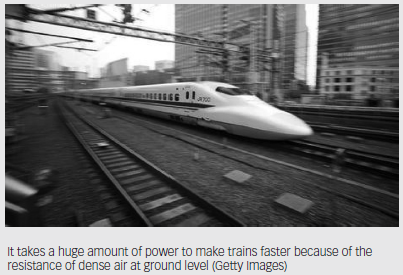
As technology advances, transport gets ever faster, and trains are no exception. But with great speed come great drawbacks. Katia Moskvitch reports on the pitfalls facing train designers trying to reach even greater speed on rails
Since George Stephenson’s Rocket, designers have been trying to make trains go faster and faster. Despite all the innovations, particularly in the last 50 years it’s still a dream that all cities around the world could be connected by high-speed trains that complete journeys in a flash, allowing you to arrive at your destination relaxed and untroubled. Why is this the case?
Going fast on rails brings its own special set of problems. Human bodies are simply not built for rapid acceleration, we experience certain low frequency motions that create discomfort – a feeling of “motion sickness”. We also experience rapid acceleration, for example, each time we take off and land in a plane.
Then there is the logistics of trying to send a train faster along a track. Going fast means pushing air out of the way, which also requires a lot of power. A train travelling at 300mph (480km/h) uses roughly 27 times more power than one travelling at 100mph (160km/h). And at ground level the air is a lot denser than it is at 35,000ft (10,600m) where airliners regularly cruise. That means more resistance, and therefore more vibrations
If trains could travel just in straight lines and without any dips, then high speeds would not be a big issue. It’s the bends and the ups and downs that create a problem, especially in Europe, with its many rivers and mountains and old train lines following long-travelled routes.
14 August 2014 | www.bbc.co.uk
According to the text,
06