


![[Marketing] Questao Topo - deslogado](https://storage.estuda.com.br/banners/0_6b7ebee90b03af1c560c73bb8bcce34a_banner_deslogado_70_dias.png)
Questões de Inglês
19.971 Questões
Questão 53 102050
UnP Medicina 2° Dia 2015/2Carlsberg parody Protein World poster with 'beer body ready' ad campaign
By Ewan Palmer - April 30, 2015 18:06 BST
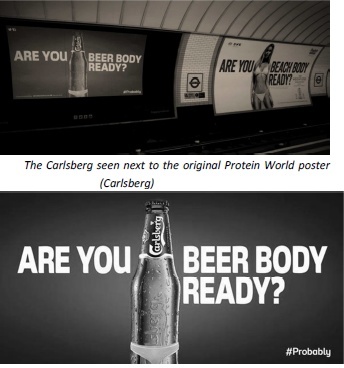
[1.] Carlsberg has parodied Protein World's
controversial "beach body ready" campaign with
its own London Underground adverts.
[2]. The ad features a green beer bottle in a yellow
bikini along with the tag line "are you beer body
ready?".
[3]. The digital poster will even briefly be displayed
next to Protein World's original advert at Liverpool
The Carlsberg seen next to the original Protein World poster
(Carlsberg)
Street's Underground station before it is taken down, with the end of its campaign approaching.
[4]. The "beach body ready" campaign has come under huge criticism since it was first displayed, with more
than 60,000 people signing an online petition demanding the adverts be removed.
[5]. The Advertising Standards Authority (ASA) has also announced it will launch an investigation to establish
if the ads broke "harm and offence rules or is socially irresponsible".
[6]. Dharmesh Rana, senior brand manager at Carlsberg UK, said: "At Carlsberg, we're not bothered about
beer drinkers being beach body ready, our priority is
ensuring they're able to enjoy a nice, cold Carlsberg
without worrying about their appearance”.
[7]. "That's why we've decided to remind the public at
major commuter spots across London that it's not
about the way you look, or having probably the best
body this summer, it's about enjoying a Carlsberg
whether you're on the beach or at your local."
[8]. The advert even appeared to be a hit with Protein World, who tweeted a picture of the ad on its official
account.
Disponível em http://www.ibtimes.co.uk/carlsberg-creates-parody-protein-world-posterbeer- body-ready-ad-campaign-1499193, consultado em 14/05/2015.
Reading carefully the text, we can admit that:
Questão 52 102049
UnP Medicina 2° Dia 2015/2Carlsberg parody Protein World poster with 'beer body ready' ad campaign
By Ewan Palmer - April 30, 2015 18:06 BST
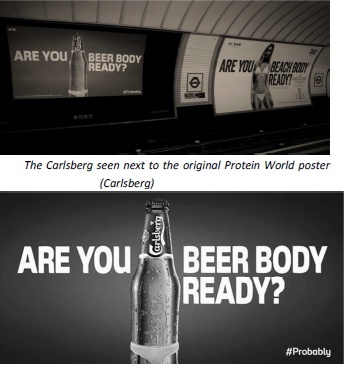
[1.] Carlsberg has parodied Protein World's
controversial "beach body ready" campaign with
its own London Underground adverts.
[2]. The ad features a green beer bottle in a yellow
bikini along with the tag line "are you beer body
ready?".
[3]. The digital poster will even briefly be displayed
next to Protein World's original advert at Liverpool
The Carlsberg seen next to the original Protein World poster
(Carlsberg)
Street's Underground station before it is taken down, with the end of its campaign approaching.
[4]. The "beach body ready" campaign has come under huge criticism since it was first displayed, with more
than 60,000 people signing an online petition demanding the adverts be removed.
[5]. The Advertising Standards Authority (ASA) has also announced it will launch an investigation to establish
if the ads broke "harm and offence rules or is socially irresponsible".
[6]. Dharmesh Rana, senior brand manager at Carlsberg UK, said: "At Carlsberg, we're not bothered about
beer drinkers being beach body ready, our priority is
ensuring they're able to enjoy a nice, cold Carlsberg
without worrying about their appearance”.
[7]. "That's why we've decided to remind the public at
major commuter spots across London that it's not
about the way you look, or having probably the best
body this summer, it's about enjoying a Carlsberg
whether you're on the beach or at your local."
[8]. The advert even appeared to be a hit with Protein World, who tweeted a picture of the ad on its official
account.
Disponível em http://www.ibtimes.co.uk/carlsberg-creates-parody-protein-world-posterbeer- body-ready-ad-campaign-1499193, consultado em 14/05/2015.
The reference pronoun it in 3rd paragraph refers to:
Questão 51 102048
UnP Medicina 2° Dia 2015/2Carlsberg parody Protein World poster with 'beer body ready' ad campaign
By Ewan Palmer - April 30, 2015 18:06 BST
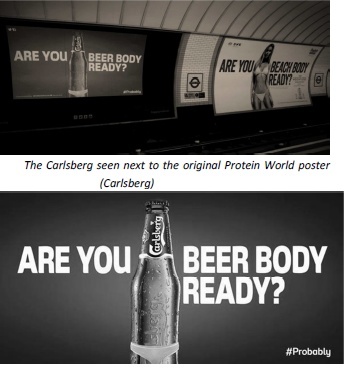
[1.] Carlsberg has parodied Protein World's
controversial "beach body ready" campaign with
its own London Underground adverts.
[2]. The ad features a green beer bottle in a yellow
bikini along with the tag line "are you beer body
ready?".
[3]. The digital poster will even briefly be displayed
next to Protein World's original advert at Liverpool
The Carlsberg seen next to the original Protein World poster
(Carlsberg)
Street's Underground station before it is taken down, with the end of its campaign approaching.
[4]. The "beach body ready" campaign has come under huge criticism since it was first displayed, with more
than 60,000 people signing an online petition demanding the adverts be removed.
[5]. The Advertising Standards Authority (ASA) has also announced it will launch an investigation to establish
if the ads broke "harm and offence rules or is socially irresponsible".
[6]. Dharmesh Rana, senior brand manager at Carlsberg UK, said: "At Carlsberg, we're not bothered about
beer drinkers being beach body ready, our priority is
ensuring they're able to enjoy a nice, cold Carlsberg
without worrying about their appearance”.
[7]. "That's why we've decided to remind the public at
major commuter spots across London that it's not
about the way you look, or having probably the best
body this summer, it's about enjoying a Carlsberg
whether you're on the beach or at your local."
[8]. The advert even appeared to be a hit with Protein World, who tweeted a picture of the ad on its official
account.
Disponível em http://www.ibtimes.co.uk/carlsberg-creates-parody-protein-world-posterbeer- body-ready-ad-campaign-1499193, consultado em 14/05/2015.
Analyze the sentences below and answer the question
I. Protein World has shown Carlsberg’s add in its twitter account on the Internet.
II. Carlsberg campaign tries to remind people drinking beer is better than keep worried about appearance.
III. Advertising Standards Authority (ASA) are going to investigate Carlsberg parody campaign against Protein World’s “beach body ready”.
IV. People have rejected Protein World Campaign since it has begun.
According to the text, we must consider:
Questão 17 100167
UNISC Medicina 2015/1Benjamin Franklin once said, “Early to bed
and early to rise makes a man healthy, wealthy, and
wise.”_________ in Franklin’s time most people
________ in an unconsolidated fashion: They
went to “first sleep” shortly after the sun went
down, and woke four or five hours later for a few
hours of activity before returning to “second
sleep.”
Industrialization and electric lighting put the
unconsolidated sleep pattern to rest, so to speak,
and today most adults are expected to work from
mid-morning to mid-evening and, if they’re very
lucky, sleep a solid eight hours from night to
morning. This is easier for some than others.
Mounting research suggests that differences in
lifestyle, personality, brain functioning, and even
brain physicality define two distinct chronotypes
(a person’s characteristic sleep pattern), which
could roughly be defined as “night owls” and
“morning larks.” Morning larks, those who
naturally wake up early and are energized in the
pre-lunch hours, are more suited to the typical
work schedule, while the propensities of night
owls put them at odds with it, leading them to
suffer from chronic social jetlag.
Only an estimated 10 percent of the global
population are morning larks, and roughly twenty
percent are night owls, with the rest of us falling
somewhere in between. Night owls are more
prone to depression and are more likely to smoke
and drink, and while they’re potentially smarter,
their academic abilities fall short of early birds
(possibly because they were half-asleep for most
of school). It gets worse: A study published in 2013
found that night owls are more likely to have a
cluster of personality traits known as the “Dark
Triad” — narcissism, Machiavellianism, and
psychopathy. Morning larks, conversely, have
been found to be more moral.
One’s circadian rhythm does change over time
— babies are often up at dawn, while teenagers are
zombie-esque until the afternoon — and there are
certain things you can do to adjust your natural
rhythms, such as avoiding light in the hours before
bed, seeking light upon waking, and regimenting
sleep and wake time. But there’s a great deal of
evidence that our essential propensity for larkness
or owlishness is rooted in genetics. Genetic
variation can affect a person’s sleep and wake
cycle by up to an hour, and, gruesomely, can help
predict what time of a day a person will die.
One thing both groups (and those of us in
between) have in common: We probably aren’t
getting enough sleep. A December, 2013 Gallup
poll found that Americans average less than seven
hours of sleep a night — more than an hour less than
Americans slept per night in 1942. From 2006 to
2011, the market for over-the-counter sleep aids
grew 31 percent.
Adapted from: World Science Festival | September 11, 2014 http://theweek.com/article/index/267811/is-there-really-such-a-thingas- a-morning-person.
According to the text, if you are a “night owl” you will probably not
I – be energized in the pre-lunch hours.
II – be a morning person.
III – smoke and suffer from depression.
IV – be up at dawn.
V – adjust your natural rhythms.
Choose the correct alternative.
Questão 14 100164
UNISC Medicina 2015/1Benjamin Franklin once said, “Early to bed
and early to rise makes a man healthy, wealthy, and
wise.”_________ in Franklin’s time most people
________ in an unconsolidated fashion: They
went to “first sleep” shortly after the sun went
down, and woke four or five hours later for a few
hours of activity before returning to “second
sleep.”
Industrialization and electric lighting put the
unconsolidated sleep pattern to rest, so to speak,
and today most adults are expected to work from
mid-morning to mid-evening and, if they’re very
lucky, sleep a solid eight hours from night to
morning. This is easier for some than others.
Mounting research suggests that differences in
lifestyle, personality, brain functioning, and even
brain physicality define two distinct chronotypes
(a person’s characteristic sleep pattern), which
could roughly be defined as “night owls” and
“morning larks.” Morning larks, those who
naturally wake up early and are energized in the
pre-lunch hours, are more suited to the typical
work schedule, while the propensities of night
owls put them at odds with it, leading them to
suffer from chronic social jetlag.
Only an estimated 10 percent of the global
population are morning larks, and roughly twenty
percent are night owls, with the rest of us falling
somewhere in between. Night owls are more
prone to depression and are more likely to smoke
and drink, and while they’re potentially smarter,
their academic abilities fall short of early birds
(possibly because they were half-asleep for most
of school). It gets worse: A study published in 2013
found that night owls are more likely to have a
cluster of personality traits known as the “Dark
Triad” — narcissism, Machiavellianism, and
psychopathy. Morning larks, conversely, have
been found to be more moral.
One’s circadian rhythm does change over time
— babies are often up at dawn, while teenagers are
zombie-esque until the afternoon — and there are
certain things you can do to adjust your natural
rhythms, such as avoiding light in the hours before
bed, seeking light upon waking, and regimenting
sleep and wake time. But there’s a great deal of
evidence that our essential propensity for larkness
or owlishness is rooted in genetics. Genetic
variation can affect a person’s sleep and wake
cycle by up to an hour, and, gruesomely, can help
predict what time of a day a person will die.
One thing both groups (and those of us in
between) have in common: We probably aren’t
getting enough sleep. A December, 2013 Gallup
poll found that Americans average less than seven
hours of sleep a night — more than an hour less than
Americans slept per night in 1942. From 2006 to
2011, the market for over-the-counter sleep aids
grew 31 percent.
Adapted from: World Science Festival | September 11, 2014 http://theweek.com/article/index/267811/is-there-really-such-a-thingas- a-morning-person.
Consider the statements about the text.
I – After industrialization and electric lighting people started resting less because they had more time to speak.
II – Night owls will suffer when they travel by plane.
III – Going to bed late brings about negative health consequences.
IV – Sleep pattern and genetics may be closely related.
Choose the correct alternative.
Questão 13 100163
UNISC Medicina 2015/1Benjamin Franklin once said, “Early to bed
and early to rise makes a man healthy, wealthy, and
wise.”_________ in Franklin’s time most people
________ in an unconsolidated fashion: They
went to “first sleep” shortly after the sun went
down, and woke four or five hours later for a few
hours of activity before returning to “second
sleep.”
Industrialization and electric lighting put the
unconsolidated sleep pattern to rest, so to speak,
and today most adults are expected to work from
mid-morning to mid-evening and, if they’re very
lucky, sleep a solid eight hours from night to
morning. This is easier for some than others.
Mounting research suggests that differences in
lifestyle, personality, brain functioning, and even
brain physicality define two distinct chronotypes
(a person’s characteristic sleep pattern), which
could roughly be defined as “night owls” and
“morning larks.” Morning larks, those who
naturally wake up early and are energized in the
pre-lunch hours, are more suited to the typical
work schedule, while the propensities of night
owls put them at odds with it, leading them to
suffer from chronic social jetlag.
Only an estimated 10 percent of the global
population are morning larks, and roughly twenty
percent are night owls, with the rest of us falling
somewhere in between. Night owls are more
prone to depression and are more likely to smoke
and drink, and while they’re potentially smarter,
their academic abilities fall short of early birds
(possibly because they were half-asleep for most
of school). It gets worse: A study published in 2013
found that night owls are more likely to have a
cluster of personality traits known as the “Dark
Triad” — narcissism, Machiavellianism, and
psychopathy. Morning larks, conversely, have
been found to be more moral.
One’s circadian rhythm does change over time
— babies are often up at dawn, while teenagers are
zombie-esque until the afternoon — and there are
certain things you can do to adjust your natural
rhythms, such as avoiding light in the hours before
bed, seeking light upon waking, and regimenting
sleep and wake time. But there’s a great deal of
evidence that our essential propensity for larkness
or owlishness is rooted in genetics. Genetic
variation can affect a person’s sleep and wake
cycle by up to an hour, and, gruesomely, can help
predict what time of a day a person will die.
One thing both groups (and those of us in
between) have in common: We probably aren’t
getting enough sleep. A December, 2013 Gallup
poll found that Americans average less than seven
hours of sleep a night — more than an hour less than
Americans slept per night in 1942. From 2006 to
2011, the market for over-the-counter sleep aids
grew 31 percent.
Adapted from: World Science Festival | September 11, 2014 http://theweek.com/article/index/267811/is-there-really-such-a-thingas- a-morning-person.
Choose the alternative which best fills in the blanks of the sentence in lines 3 and 4 of the text.
06