


![[Marketing] Questao Topo - deslogado](https://storage.estuda.com.br/banners/0_6b7ebee90b03af1c560c73bb8bcce34a_banner_deslogado_70_dias.png)
Questões de Inglês
19.971 Questões
Questão 57 154730
AFA 2015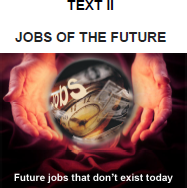
There is no future in any job. The future lies in the person who holds the job.” – George W. Crane
education is that they tend to prepare students for jobs of
the past. Similarly, the best paying jobs of the future are
all jobs that currently exist today. Many of them will still
[5] exist in the future, but with some changes as technology
and communication systems make their impact.
As a rule of thumb, 60% of the jobs 10 years
from now haven’t been invented yet. With that in mind,
I’ve decided to put together a list of some jobs that will be
[10] in high demand in the future.
Jobs before 2020
Many of the changes we see today will cause
new jobs to materialize quickly. This first section deals
[15] with new positions that will likely be developed within the
next 10 years.
3D printing engineers – Classes in 3D printing are
already being introduced into high schools and the
demand for printer-produced products will rise quickly.
[20] The trend will be for these worker-less workshops to
enter virtually different fields, at the same time, driving
the need for competent technicians and engineers to
design and maintain the next wave of this technology.
Nano-medics – Health professionals capable of working
[25] on the nano-level, both in designing diagnostics systems,
remedies, and monitoring solutions will be in high
demand.
Organ agents – The demand for transplantable organs
is exploding and people who can track down and deliver
[30] healthy organs will be in hot demand.
Octogenarian service providers – As the population
continues to age we will have record numbers of people
living into their 80s, 90s, and 100s. This growing group of
active oldsters will provide a demand for goods and
[35] services currently not being addressed in today’s
marketplace.
Jobs in 2030 and beyond
A number of technologies currently on the
drawing board will require a bit longer lead time before
[40]the industry comes into its own. Here are a few examples
of these kinds of jobs:
Body part & limb makers – The organ agents listed
before will quickly find themselves out of work as soon as
we figure out how to efficiently grow and mass produce
[45] our own organs from scratch.
Earthquake forecasters – While scientists are
developing skills to work with nanoscale precision on the
earth’s surface, the best we can know about below the
surface is blindfolded guesswork done with 100-mile
[50] precision. What we don’t know is literally killing us – over
226,000 killed in 2010 alone. But that will change over
time as we begin to understand the inner working of the
earth and accurately forecast when the next big quakes
are about to hit.
[55] “Heavy air” engineers – Compressed air is useful in a
wide variety of ways. However, we have yet to figure out
how to compress streams of air as they pass through our
existing atmosphere. Once we do, it will create untold
opportunity for non-surface based housing and
[60] transportation system, weather control, and other kinds
of experimentation.
Final thoughts
The jobs and occupations listed above are just
scratching the surface. This list is intended to help
[65] stretch your imagination and start you down a path of
imagining your own future.
(Adapted from http://www.futuristspeaker.com/2011/11/55-jobs-of-the-future)
Read the statements and mark the right option.
I. Universities and colleges prepare students for jobs that already exist.
II. All jobs of the future will be better paid than today's jobs.
III. The majority of future jobs are still unknown.
The correct statement(s) is (are)
Questão 56 154729
AFA 2015TEXT I
JOBS AT HIGH RISK
It is an invisible force that goes by many names.
Computerization. Automation. Artificial intelligence.
Technology. Innovation. And, everyone's favorite,
ROBOTS.
[5] Whatever name you prefer, some form of it has
been stimulating progress and killing jobs — from tailors
to paralegals — for centuries. But this time is different:
nearly half of American jobs today could be automated in
"a decade or two". The question is: which half?
[10] Another way of posing the same question is:
Where do machines work better than people? Tractors
are more powerful than farmers. Robotic arms are
stronger and more tireless than assembly-line workers.
But in the past 30 years, software and robots have
[15] succeeded replacing a particular kind of occupation: the
average-wage, middle-skill, routine-heavy worker,
especially in manufacturing and office administration.
Indeed, it's projected that the next wave of
computer progress will continue to endanger human
[20] work where it already has: manufacturing, administrative
support, retail, and transportation. Most remaining
factory jobs are "likely to diminish over the next
decades". Cashiers, counter clerks, and telemarketers
are similarly endangered. On the other hand, health care
[25] workers, people responsible for our safety, and
management positions are the least likely to be
automated.
The next big thing
[30] We might be on the edge of an innovating
moment in robotics and artificial intelligence. Although
the past 30 years have reduced the middle, high- and
low-skill jobs have actually increased, as if protected
from the invading armies of robots by their own moats.
[35] Higher-skill workers have been protected by a kind of
social-intelligence moat. Computers are historically good
at executing routines, but they're bad at finding patterns,
communicating with people, and making decisions,
which is what managers are paid to do. This is why
[40] some people think managers are, for the moment, one of
the largest categories immune to the fast wave of AI.
Meanwhile, lower-skill workers have been
protected by the Moravec moat. Hans Moravec was a
futurist who pointed out that machine technology copied
[45] a savant infant: Machines could do long math equations
instantly and beat anybody in chess, but they can't
answer a simple question or walk up a flight of stairs. As
a result, not skilled work done by people without much
education (like home health care workers, or fast-food
[50] attendants) have been saved, too.
The human half
In the 19th century, new manufacturing
technology replaced what was then skilled labor. In the
[55] second half of the 20th century, however, software
technology took the place of median-salaried office work.
The first wave showed that machines are better at
assembling things. The second showed that machines
are better at organizing things. Now data analytics and
[60] self-driving cars suggest they might be better at patternrecognition
and driving. So what are we better at?
The safest industries and jobs are dominated by
managers, health-care workers, and a super-category
that includes education, media, and community service.
[65] One conclusion to draw from this is that humans are,
and will always be, superior at working with, and caring
for other humans. In this light, automation doesn't make
the world worse. Far from it: it creates new opportunities
for human creativity.
[70] But robots are already creeping into diagnostics
and surgeries. Schools are already experimenting with
software that replaces teaching hours. The fact that
some industries have been safe from automation for the
last three decades doesn't guarantee that they'll be safe
[75] for the next one.
It would be anxious enough if we knew exactly
which jobs are next in line for automation. The truth is
scarier. We don't really have a clue.
(Adapted from http://www.businessinsider.com/robots-overtakingamerican- jobs-2014-1)
Mark the option that contains an adjective in the same form as in “The safest industries and jobs are dominated by managers [...]” (lines 62 and 63).
Questão 52 154725
AFA 2015TEXT I
JOBS AT HIGH RISK
It is an invisible force that goes by many names.
Computerization. Automation. Artificial intelligence.
Technology. Innovation. And, everyone's favorite,
ROBOTS.
[5] Whatever name you prefer, some form of it has
been stimulating progress and killing jobs — from tailors
to paralegals — for centuries. But this time is different:
nearly half of American jobs today could be automated in
"a decade or two". The question is: which half?
[10] Another way of posing the same question is:
Where do machines work better than people? Tractors
are more powerful than farmers. Robotic arms are
stronger and more tireless than assembly-line workers.
But in the past 30 years, software and robots have
[15] succeeded replacing a particular kind of occupation: the
average-wage, middle-skill, routine-heavy worker,
especially in manufacturing and office administration.
Indeed, it's projected that the next wave of
computer progress will continue to endanger human
[20] work where it already has: manufacturing, administrative
support, retail, and transportation. Most remaining
factory jobs are "likely to diminish over the next
decades". Cashiers, counter clerks, and telemarketers
are similarly endangered. On the other hand, health care
[25] workers, people responsible for our safety, and
management positions are the least likely to be
automated.
The next big thing
[30] We might be on the edge of an innovating
moment in robotics and artificial intelligence. Although
the past 30 years have reduced the middle, high- and
low-skill jobs have actually increased, as if protected
from the invading armies of robots by their own moats.
[35] Higher-skill workers have been protected by a kind of
social-intelligence moat. Computers are historically good
at executing routines, but they're bad at finding patterns,
communicating with people, and making decisions,
which is what managers are paid to do. This is why
[40] some people think managers are, for the moment, one of
the largest categories immune to the fast wave of AI.
Meanwhile, lower-skill workers have been
protected by the Moravec moat. Hans Moravec was a
futurist who pointed out that machine technology copied
[45] a savant infant: Machines could do long math equations
instantly and beat anybody in chess, but they can't
answer a simple question or walk up a flight of stairs. As
a result, not skilled work done by people without much
education (like home health care workers, or fast-food
[50] attendants) have been saved, too.
The human half
In the 19th century, new manufacturing
technology replaced what was then skilled labor. In the
[55] second half of the 20th century, however, software
technology took the place of median-salaried office work.
The first wave showed that machines are better at
assembling things. The second showed that machines
are better at organizing things. Now data analytics and
[60] self-driving cars suggest they might be better at patternrecognition
and driving. So what are we better at?
The safest industries and jobs are dominated by
managers, health-care workers, and a super-category
that includes education, media, and community service.
[65] One conclusion to draw from this is that humans are,
and will always be, superior at working with, and caring
for other humans. In this light, automation doesn't make
the world worse. Far from it: it creates new opportunities
for human creativity.
[70] But robots are already creeping into diagnostics
and surgeries. Schools are already experimenting with
software that replaces teaching hours. The fact that
some industries have been safe from automation for the
last three decades doesn't guarantee that they'll be safe
[75] for the next one.
It would be anxious enough if we knew exactly
which jobs are next in line for automation. The truth is
scarier. We don't really have a clue.
(Adapted from http://www.businessinsider.com/robots-overtakingamerican- jobs-2014-1)
In the sentence “Hans Moravec was a futurist who pointed out that machine technology copied a savant infant [...]” the pronoun “who” can be replaced, with no change in meaning, by
Questão 49 154721
AFA 2015TEXT I
JOBS AT HIGH RISK
It is an invisible force that goes by many names.
Computerization. Automation. Artificial intelligence.
Technology. Innovation. And, everyone's favorite,
ROBOTS.
[5] Whatever name you prefer, some form of it has
been stimulating progress and killing jobs — from tailors
to paralegals — for centuries. But this time is different:
nearly half of American jobs today could be automated in
"a decade or two". The question is: which half?
[10] Another way of posing the same question is:
Where do machines work better than people? Tractors
are more powerful than farmers. Robotic arms are
stronger and more tireless than assembly-line workers.
But in the past 30 years, software and robots have
[15] succeeded replacing a particular kind of occupation: the
average-wage, middle-skill, routine-heavy worker,
especially in manufacturing and office administration.
Indeed, it's projected that the next wave of
computer progress will continue to endanger human
[20] work where it already has: manufacturing, administrative
support, retail, and transportation. Most remaining
factory jobs are "likely to diminish over the next
decades". Cashiers, counter clerks, and telemarketers
are similarly endangered. On the other hand, health care
[25] workers, people responsible for our safety, and
management positions are the least likely to be
automated.
The next big thing
[30] We might be on the edge of an innovating
moment in robotics and artificial intelligence. Although
the past 30 years have reduced the middle, high- and
low-skill jobs have actually increased, as if protected
from the invading armies of robots by their own moats.
[35] Higher-skill workers have been protected by a kind of
social-intelligence moat. Computers are historically good
at executing routines, but they're bad at finding patterns,
communicating with people, and making decisions,
which is what managers are paid to do. This is why
[40] some people think managers are, for the moment, one of
the largest categories immune to the fast wave of AI.
Meanwhile, lower-skill workers have been
protected by the Moravec moat. Hans Moravec was a
futurist who pointed out that machine technology copied
[45] a savant infant: Machines could do long math equations
instantly and beat anybody in chess, but they can't
answer a simple question or walk up a flight of stairs. As
a result, not skilled work done by people without much
education (like home health care workers, or fast-food
[50] attendants) have been saved, too.
The human half
In the 19th century, new manufacturing
technology replaced what was then skilled labor. In the
[55] second half of the 20th century, however, software
technology took the place of median-salaried office work.
The first wave showed that machines are better at
assembling things. The second showed that machines
are better at organizing things. Now data analytics and
[60] self-driving cars suggest they might be better at patternrecognition
and driving. So what are we better at?
The safest industries and jobs are dominated by
managers, health-care workers, and a super-category
that includes education, media, and community service.
[65] One conclusion to draw from this is that humans are,
and will always be, superior at working with, and caring
for other humans. In this light, automation doesn't make
the world worse. Far from it: it creates new opportunities
for human creativity.
[70] But robots are already creeping into diagnostics
and surgeries. Schools are already experimenting with
software that replaces teaching hours. The fact that
some industries have been safe from automation for the
last three decades doesn't guarantee that they'll be safe
[75] for the next one.
It would be anxious enough if we knew exactly
which jobs are next in line for automation. The truth is
scarier. We don't really have a clue.
(Adapted from http://www.businessinsider.com/robots-overtakingamerican- jobs-2014-1)
One of the purposes of the text is to show that
Questão 4 153949
UEG 2015/1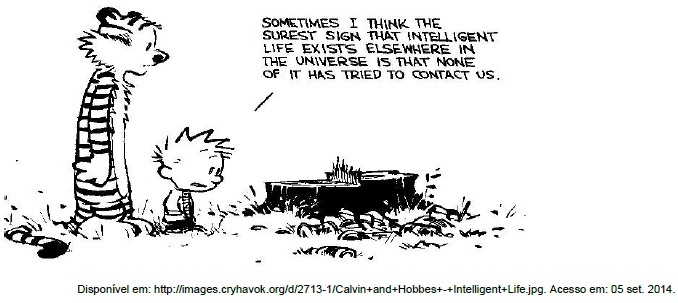
De acordo com a imagem e a fala da personagem Calvin,
Questão 3 153948
UEG 2015/1CATEGORIES OF TERRORIST GROUPS
There are many different categories of terrorism and terrorist groups that are currently in use. These categories serve to differentiate terrorist organizations according to specific criteria, which are usually related to the field or specialty of whoever is selecting the categories. Also, some categories are simply labels appended arbitrarily or redundantly, often by the media. For example, every terrorist organization is by definition "radical", as terror tactics are not the norm for the mainstream of any group.
Separatist. Separatist groups are those with the goal of separation from existing entities through independence, political autonomy, or religious freedom or domination.
Revolutionary. Dedicated to the overthrow of an established order and replacing it with a new political or social structure.
Political. Political ideologies are concerned with the structure and organization of the forms of government and communities.
Religious. Religiously inspired terrorism is on the rise. While Islamic terrorists and organizations have been the most active, and the greatest recent threat to the United States, all of the major world religions have extremists that have taken up violence to further their perceived religious goals.
International or Transnational. International groups typically operate in multiple countries, but retain a geographic focus for their activities. Transnational groups operate internationally, but are not tied to a particular country, or even region.
Disponível em: <http://www.terrorism-research.com/groups/categories.php>. Acesso em: 05 set. 2014. (Adaptado).
A estrutura linguística do texto evidencia que
06