


![[Marketing] Questao Topo - deslogado](https://storage.estuda.com.br/banners/0_6b7ebee90b03af1c560c73bb8bcce34a_banner_deslogado_70_dias.png)
Questões de Inglês
19.971 Questões
Questão 28 343391
UNICENTRO 2015/1When I first arrived in Brazil in 1992, it was never my intention to stay. My first months in Brazil were extremely difficult. Everything was different. Probably the thing that shocked me the most was the poverty, I lived in a rich neighborhoods surrounded by favelas. The owner of the house where I lived instructed me shortly after I arrived that when someone clapped their hands outside the fence to get attention and then asked for food, I was to ignore them. The first day I was alone I broke the rule. Who was I to deny a hungry person a cup of water and a slice of bread? On the second day, more people arrived asking for food. By the third day, lines had begun to form outside our gate. That night my host took me aside and wanted me to explain why I had disobeyed his instructions. The maid had informed him that there was a rumor circulating round the favela that a foreigner was living in his house giving away free food. Twenty years ago the communications system in Brazil was extremely bad. When a telegram arrived from New Zealand informing me the applications for the fishing inspector position I was seeking had opened, it was already past the date of inscription. I was very irritated, but things soon changed when I met a girl. After five years of commuting between Brazil and New Zealand, we married. When you marry a Brazilian, you do not just marry your spouse you marry the whole extended family. In some respects, this can be cool because you become a part of a large group, but at times it can be a little frustrating. You just need to sneeze and you can be sure that within a few hours some third cousin of my wife’s will be on the phone asking me if it is true that I am dying of pneumonia. It is extremely difficult to be alone here.
(Adapted from: Kiwi never alone in Brazil. Source: http://www.stuff.co.nz/stuff-nation/assignments/home-sweet-expat-home/ 9875411/Kiwi-never-alone-in-Brazil. Accessed on: March 29th 2014.)
Based on the author’s opinion about Brazil, consider the following statements.
I. In 1992, Brazil was developing a more effective means of communication.
II. The contrast between the slums and wealthy areas caused great impact.
III. Brazilian families include not only the couple and kids but also all relatives.
IV. Privacy is a different concept as Brazilians praise close social coexistence.
Choose the correct alternative.
Questão 27 343389
UNICENTRO 2015/1When I first arrived in Brazil in 1992, it was never my intention to stay. My first months in Brazil were extremely difficult. Everything was different. Probably the thing that shocked me the most was the poverty, I lived in a rich neighborhoods surrounded by favelas. The owner of the house where I lived instructed me shortly after I arrived that when someone clapped their hands outside the fence to get attention and then asked for food, I was to ignore them. The first day I was alone I broke the rule. Who was I to deny a hungry person a cup of water and a slice of bread? On the second day, more people arrived asking for food. By the third day, lines had begun to form outside our gate. That night my host took me aside and wanted me to explain why I had disobeyed his instructions. The maid had informed him that there was a rumor circulating round the favela that a foreigner was living in his house giving away free food. Twenty years ago the communications system in Brazil was extremely bad. When a telegram arrived from New Zealand informing me the applications for the fishing inspector position I was seeking had opened, it was already past the date of inscription. I was very irritated, but things soon changed when I met a girl. After five years of commuting between Brazil and New Zealand, we married. When you marry a Brazilian, you do not just marry your spouse you marry the whole extended family. In some respects, this can be cool because you become a part of a large group, but at times it can be a little frustrating. You just need to sneeze and you can be sure that within a few hours some third cousin of my wife’s will be on the phone asking me if it is true that I am dying of pneumonia. It is extremely difficult to be alone here.
(Adapted from: Kiwi never alone in Brazil. Source: http://www.stuff.co.nz/stuff-nation/assignments/home-sweet-expat-home/ 9875411/Kiwi-never-alone-in-Brazil. Accessed on: March 29th 2014.)
According to the text, choose the alternative which contains the reason why the author was forbidden from giving food to the poor people.
Questão 23 343374
UNICENTRO 2015/1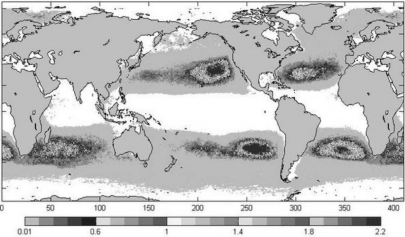
Before Malaysia Airlines Flight 370 went missing, sea trash was not a global headliner. However, as hundreds of objects sighted off the Australian coast as possible aircraft debris turn out to be discarded fishing equipment, cargo container parts, or plastic shopping bags, a new narrative is emerging in the hunt for the missing plane: There is more garbage out there than you think. Most of it is plastic. And marine life ingests it, with catastrophic consequences. Kathleen Dohan, a scientist at Earth and Space Research in Seattle, Washington, plotted the movement of debris in a time-lapse video that shows where objects dropped into the ocean will end up in ten years. The objects migrate to regions known as garbage patches. The Pacific and Atlantic Oceans have two patches each, north and south. The Indian Ocean’s garbage patch is centered roughly halfway between Africa and Australia. The term “patch” suggests this floating detritus is packed together in an oceanic version of a landfill. Instead, these “patches” are actually huge zones where debris accumulates but floats free, circulating continuously. So it’s possible for sailing ships and other small boats to inadvertently sail into a garbage patch region and encounter rubbish. About 90 percent of the debris in all five garbage patches is plastic, says Marcus Eriksen, a marine scientist and founder of the 5 Gyres Institute, which works to reduce pollution from disposable plastics. “This is relatively new if you think about plastic. Only since the 1950s have consumers used plastics. Now, a half-century later, we are seeing an abundant accumulation of microplastics from all single-use, throwaway plastics like bags, bottles, bottle caps, kitchen utensils. I have pulled cigarette lighters from hundreds of bird skeletons.”
(Adapted from: http://news.nationalgeographic.com/news/2014/04/140404-garbage-patch-indian-ocean-debris-malaysian-plane/ ?utm_source=Facebook&utm_medium=Social&utm_content=link_fb20140407news-malpla&utm_campaign=Content. Accessed on: April 6th 2014.)
According to the text, the “garbage patches” represent a threat to marine life. Choose the alternative which contains this threat.
Questão 22 343373
UNICENTRO 2015/1
Before Malaysia Airlines Flight 370 went missing, sea trash was not a global headliner. However, as hundreds of objects sighted off the Australian coast as possible aircraft debris turn out to be discarded fishing equipment, cargo container parts, or plastic shopping bags, a new narrative is emerging in the hunt for the missing plane: There is more garbage out there than you think. Most of it is plastic. And marine life ingests it, with catastrophic consequences. Kathleen Dohan, a scientist at Earth and Space Research in Seattle, Washington, plotted the movement of debris in a time-lapse video that shows where objects dropped into the ocean will end up in ten years. The objects migrate to regions known as garbage patches. The Pacific and Atlantic Oceans have two patches each, north and south. The Indian Ocean’s garbage patch is centered roughly halfway between Africa and Australia. The term “patch” suggests this floating detritus is packed together in an oceanic version of a landfill. Instead, these “patches” are actually huge zones where debris accumulates but floats free, circulating continuously. So it’s possible for sailing ships and other small boats to inadvertently sail into a garbage patch region and encounter rubbish. About 90 percent of the debris in all five garbage patches is plastic, says Marcus Eriksen, a marine scientist and founder of the 5 Gyres Institute, which works to reduce pollution from disposable plastics. “This is relatively new if you think about plastic. Only since the 1950s have consumers used plastics. Now, a half-century later, we are seeing an abundant accumulation of microplastics from all single-use, throwaway plastics like bags, bottles, bottle caps, kitchen utensils. I have pulled cigarette lighters from hundreds of bird skeletons.”
(Adapted from: http://news.nationalgeographic.com/news/2014/04/140404-garbage-patch-indian-ocean-debris-malaysian-plane/ ?utm_source=Facebook&utm_medium=Social&utm_content=link_fb20140407news-malpla&utm_campaign=Content. Accessed on: April 6th 2014.)
According to the text, the ocean’s garbage patches are
Questão 21 327035
CESMAC Demais Cursos 2015/2Read the text below and answer following four question according to it.
Doctors without Borders / Médecins Sans Frontières (MSF)
Every year, Doctors Without Borders/Médecins Sans Frontières (MSF) provides emergency medical care to millions of people caught in crises in some 70 countries around the world. MSF provides assistance when catastrophic events—such as armed conflict, epidemics, malnutrition, or natural disasters—overwhelm local health systems. MSF also assists people who face discrimination or neglect from their local health systems or when populations are otherwise excluded from health care.
MSF is a neutral and impartial humanitarian organization that aims first and foremost to provide high-quality medical care to the people who need it the most. It does not promote the agenda of any country, political party, or religious faith, and, as such, endeavors to communicate its history, background, and capabilities to all parties in a given situation so that it may gain the necessary access to populations in need.
On any given day, more than 30,000 doctors, nurses, logisticians, water-and-sanitation experts, administrators, and other qualified professionals working with MSF can be found providing medical care around the world.
At its core, the purpose of humanitarian action is to save the lives and ease the suffering of people caught in acute crises, thereby restoring their ability to rebuild their lives and communities.
In the countries where MSF works, one or more of the following crises is usually occurring or has occurred: armed conflict, epidemics, malnutrition, natural disasters, or exclusion from health care.
Adaptado de: http://www.doctorswithoutborders.org/our-work/howwe- work/types-of-projects Acessado em 1 de maio de 2015.
The humanitarian action carried out by MSF
Questão 20 327033
CESMAC Demais Cursos 2015/2Read the text below and answer following four question according to it.
Doctors without Borders / Médecins Sans Frontières (MSF)
Every year, Doctors Without Borders/Médecins Sans Frontières (MSF) provides emergency medical care to millions of people caught in crises in some 70 countries around the world. MSF provides assistance when catastrophic events—such as armed conflict, epidemics, malnutrition, or natural disasters—overwhelm local health systems. MSF also assists people who face discrimination or neglect from their local health systems or when populations are otherwise excluded from health care.
MSF is a neutral and impartial humanitarian organization that aims first and foremost to provide high-quality medical care to the people who need it the most. It does not promote the agenda of any country, political party, or religious faith, and, as such, endeavors to communicate its history, background, and capabilities to all parties in a given situation so that it may gain the necessary access to populations in need.
On any given day, more than 30,000 doctors, nurses, logisticians, water-and-sanitation experts, administrators, and other qualified professionals working with MSF can be found providing medical care around the world.
At its core, the purpose of humanitarian action is to save the lives and ease the suffering of people caught in acute crises, thereby restoring their ability to rebuild their lives and communities.
In the countries where MSF works, one or more of the following crises is usually occurring or has occurred: armed conflict, epidemics, malnutrition, natural disasters, or exclusion from health care.
Adaptado de: http://www.doctorswithoutborders.org/our-work/howwe- work/types-of-projects Acessado em 1 de maio de 2015.
MSF has an impartial agenda,
06