


![[Marketing] Questao Topo - deslogado](https://storage.estuda.com.br/banners/0_6b7ebee90b03af1c560c73bb8bcce34a_banner_deslogado_70_dias.png)
Questões de Inglês
19.971 Questões
Questão 25 748447
UEFS Caderno 1 2015/2TEXTO:
Stephanie Kwolek
The lifesaving inventor of Kevlar
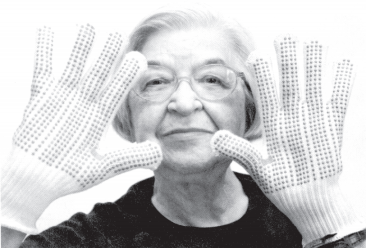
On the long list of happy accidents in science, some discoveries prove to be more monumental than others.
Stephanie Kwolek’s was one of them. In the mid-1960s, Kwolek, who died June 18 at 90, was working at DuPont—a rare
exception in the male-dominated world of chemistry—looking for a new synthetic fiber to use in tires. As she toiled in the
lab, she noticed that one mixture of a polymer and a solvent looked different from the rest. Instead of assuming she’d
[5] made a mistake, she was curious and followed up on her observation. When her formula was spun into fiber, it proved to
be five times as strong as steel. DuPont called it Kevlar.
Kevlar is famous for its protective powers, and thanks to its application in bulletproof vests and body armor (helmets,
ballistic facemasks, etc), it has saved countless lives. But that’s not the only reason it landed Kwolek in the National
Inventors Hall of Fame. The Kevlar gloves Kwolek wears in the photo above, for example, help workers avoid cuts. Kevlar
[10] has also been used to strengthen items from boats and baseball bats to shoelaces and cell phones. And in a nice
full-circle twist, it’s used in tires too.

The word or expression on the left has not been correctly defined in
Questão 24 748441
UEFS Caderno 1 2015/2TEXTO:
Stephanie Kwolek
The lifesaving inventor of Kevlar
On the long list of happy accidents in science, some discoveries prove to be more monumental than others.
Stephanie Kwolek’s was one of them. In the mid-1960s, Kwolek, who died June 18 at 90, was working at DuPont—a rare
exception in the male-dominated world of chemistry—looking for a new synthetic fiber to use in tires. As she toiled in the
lab, she noticed that one mixture of a polymer and a solvent looked different from the rest. Instead of assuming she’d
[5] made a mistake, she was curious and followed up on her observation. When her formula was spun into fiber, it proved to
be five times as strong as steel. DuPont called it Kevlar.
Kevlar is famous for its protective powers, and thanks to its application in bulletproof vests and body armor (helmets,
ballistic facemasks, etc), it has saved countless lives. But that’s not the only reason it landed Kwolek in the National
Inventors Hall of Fame. The Kevlar gloves Kwolek wears in the photo above, for example, help workers avoid cuts. Kevlar
[10] has also been used to strengthen items from boats and baseball bats to shoelaces and cell phones. And in a nice
full-circle twist, it’s used in tires too.
The reason why the products on the left benefit from Kevlar is correctly stated in alternative
Questão 23 748439
UEFS Caderno 1 2015/2TEXTO:
Stephanie Kwolek
The lifesaving inventor of Kevlar
On the long list of happy accidents in science, some discoveries prove to be more monumental than others.
Stephanie Kwolek’s was one of them. In the mid-1960s, Kwolek, who died June 18 at 90, was working at DuPont—a rare
exception in the male-dominated world of chemistry—looking for a new synthetic fiber to use in tires. As she toiled in the
lab, she noticed that one mixture of a polymer and a solvent looked different from the rest. Instead of assuming she’d
[5] made a mistake, she was curious and followed up on her observation. When her formula was spun into fiber, it proved to
be five times as strong as steel. DuPont called it Kevlar.
Kevlar is famous for its protective powers, and thanks to its application in bulletproof vests and body armor (helmets,
ballistic facemasks, etc), it has saved countless lives. But that’s not the only reason it landed Kwolek in the National
Inventors Hall of Fame. The Kevlar gloves Kwolek wears in the photo above, for example, help workers avoid cuts. Kevlar
[10] has also been used to strengthen items from boats and baseball bats to shoelaces and cell phones. And in a nice
full-circle twist, it’s used in tires too.
Considering its lifesaving properties, Kevlar has been effectively used in ____________
The only alternative that does not complete this blank correctly is
Questão 22 748436
UEFS Caderno 1 2015/2TEXTO:
Stephanie Kwolek
The lifesaving inventor of Kevlar
On the long list of happy accidents in science, some discoveries prove to be more monumental than others.
Stephanie Kwolek’s was one of them. In the mid-1960s, Kwolek, who died June 18 at 90, was working at DuPont—a rare
exception in the male-dominated world of chemistry—looking for a new synthetic fiber to use in tires. As she toiled in the
lab, she noticed that one mixture of a polymer and a solvent looked different from the rest. Instead of assuming she’d
[5] made a mistake, she was curious and followed up on her observation. When her formula was spun into fiber, it proved to
be five times as strong as steel. DuPont called it Kevlar.
Kevlar is famous for its protective powers, and thanks to its application in bulletproof vests and body armor (helmets,
ballistic facemasks, etc), it has saved countless lives. But that’s not the only reason it landed Kwolek in the National
Inventors Hall of Fame. The Kevlar gloves Kwolek wears in the photo above, for example, help workers avoid cuts. Kevlar
[10] has also been used to strengthen items from boats and baseball bats to shoelaces and cell phones. And in a nice
full-circle twist, it’s used in tires too.
About Stephanie Kwolek, it’s correct to say:
Questão 21 748428
UEFS Caderno 1 2015/2TEXTO:
Stephanie Kwolek
The lifesaving inventor of Kevlar
On the long list of happy accidents in science, some discoveries prove to be more monumental than others.
Stephanie Kwolek’s was one of them. In the mid-1960s, Kwolek, who died June 18 at 90, was working at DuPont—a rare
exception in the male-dominated world of chemistry—looking for a new synthetic fiber to use in tires. As she toiled in the
lab, she noticed that one mixture of a polymer and a solvent looked different from the rest. Instead of assuming she’d
[5] made a mistake, she was curious and followed up on her observation. When her formula was spun into fiber, it proved to
be five times as strong as steel. DuPont called it Kevlar.
Kevlar is famous for its protective powers, and thanks to its application in bulletproof vests and body armor (helmets,
ballistic facemasks, etc), it has saved countless lives. But that’s not the only reason it landed Kwolek in the National
Inventors Hall of Fame. The Kevlar gloves Kwolek wears in the photo above, for example, help workers avoid cuts. Kevlar
[10] has also been used to strengthen items from boats and baseball bats to shoelaces and cell phones. And in a nice
full-circle twist, it’s used in tires too.
Fill in the parentheses with T (True) or F (False).
About Kevlar, it’s correct to say:
( ) It’s a natural fiber.
( ) It’s a high-strength material.
( ) It was discovered by chance.
( ) It provides protection against different kinds of danger.
The correct sequence, from top to bottom, is
Questão 75 737065
FAI 2015/2Instilling empathy among doctors pays off for patient care
Sandra G. Boodman
The patient was dying and she knew it. In her mid-50s, she had been battling breast cancer for years, but it had spread to her bones, causing unrelenting pain that required hospitalization. Jeremy Force, a first-year oncology fellow at Duke University Medical Center who had never met the woman, was assigned to stop by her room last November to discuss her decision to enter hospice.
Employing the skills he had just learned in a day-long course, Force sat at the end of her bed and listened intently. The woman wept, telling him she was exhausted and worried about the impact her death would have on her two daughters. “I acknowledged how hard what she was going through was,” Force said of their 15-minute conversation, “and told her I had two children, too” and that hospice was designed to provide her additional support. A few days later, he ran into the woman in the hall. “You’re the best physician I’ve ever worked with,” Force remembers her telling him. “I was blown away,” he says. “It was such an honor.”
Force credits “Oncotalk,” a course required of Duke’s oncology fellows, for the unexpected accolade. Developed by medical faculty at Duke, the University of Pittsburgh and several other medical schools, “Oncotalk” is part of a burgeoning effort to teach doctors an essential but often overlooked skill: clinical empathy. Unlike sympathy, which is defined as feeling sorry for another person, clinical empathy is the ability to stand in a patient’s shoes and to convey an understanding of the patient’s situation as well as the desire to help.
Clinical empathy was once dismissively known as “good bedside manner” and traditionally regarded as far less important than technical acumen. But a spate of studies in the past decade has found that it is no mere frill. Increasingly, empathy is considered essential to establishing trust, the foundation of a good doctor-patient relationship. Studies have linked empathy to greater patient satisfaction, better outcomes, decreased physician burnout and a lower risk of malpractice suits and errors.
While some people are naturally better at being empathic, said Mohammadreza Hojat, a research professor of psychiatry at Jefferson Medical College in Philadelphia, empathy can be taught. “Empathy is a cognitive attribute, not a personality trait,” said Hojat, who developed the Jefferson Scale of Empathy, a tool used by researchers to measure it. Empathy courses are rarely required in medical training; however, interest in them is growing, experts say, and programs are underway at Jefferson Medical College and at Columbia University School of Medicine. Columbia has pioneered a program in narrative medicine, which emphasizes the importance of understanding patients’ life stories in providing compassionate care.
One doctor’s experience
Andy Lipman has taken the Duke course twice: first as an oncology fellow in 2004 and last year as a practicing oncologist in Naples, Fla., when he felt in need of a “booster shot.” Oncology, he said, “is a full-contact” specialty with a high burnout rate. Among the most important lessons Lipman said he learned during both sessions was to let go of “my own medical agenda, the desire to fix something or make something happen in that visit.” He learned to pace himself, monitor his reactions and talk less. One technique Lipman routinely employs is taking 15 seconds before entering an exam room to ask himself, “What is needed here?”
On the day he was interviewed, Lipman said, he used what he has learned with a patient with end-stage cancer. She was scheduled for a brief appointment but began weeping loudly as she told Lipman how alone she felt. “I engaged, I expected the emotional response and I hung in there,” he said of the meeting, which lasted 45 minutes. “It felt good to me,” Lipman said, and he hoped it gave his patient some comfort.
(http://us.cnn.com. Adaptado.)
A primeira palavra do fragmento do quinto parágrafo “While some people are naturally better at being empathic” poderia ser substituída, sem alterar o sentido da frase, por
06