


![[Marketing] Questao Topo - deslogado](https://storage.estuda.com.br/banners/0_6b7ebee90b03af1c560c73bb8bcce34a_banner_deslogado_70_dias.png)
Questões de Inglês
19.971 Questões
Questão 33 756301
UEFS Caderno 1 2015/1TEXTO:
The Greenland shark
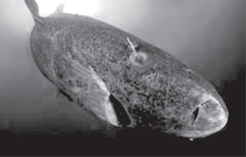
They can be as big as great white sharks, but that’s
about as far as the comparison goes. Their maximum
speed is a lethargic 1.7 miles per hour, many are almost
blind, and they are happy to eat rotting carcasses. They
[5] may be common throughout the ocean, but you’ve
probably never heard of them. Meet the Greenland
shark. Looking like nothing so much as a chunk of
weather-beaten rock, Greenland sharks (Somniosus
microcephalus) can grow up to 7.3 metres (24 feet) long,
[10] making them one of the largest of all fish, and the biggest
in the Arctic. But they prefer to live in deep, cold water,
so humans rarely see them.
Studies in the Arctic have revealed a few snippets
of information about Greenland sharks, and more data
[15] is now starting to come in from elsewhere. It turns out
that Greenland sharks are bizarre, and may be crucially
important for the ocean ecosystem.
Greenland sharks only come close to the surface
in places where the shallow water is frigid enough for
[20] them — primarily in the Arctic. They are most easily
seen around Greenland and Iceland. As a result, they
were long thought of as purely polar animals, as were
the closely-related Pacific sleeper shark and southern
sleeper shark.
[25] But they have been reported on the coasts of
Canada, Portugal, France, Scotland and Scandinavia.
Some researchers think they live in many other areas
too but just haven’t been spotted in them yet. “They may
be everywhere that’s cold enough and deep enough,”
[30] says Aaron MacNeil of the Australian Institute of Marine
Science, in Townsville, Queensland.
The obvious way to see a Greenland shark in the
wild is to dive into the deep sea. For instance, in 2001 a
remotely operated vehicle in the Gulf of Mexico captured
[35] footage of either a Greenland shark or a sleeper shark in
over 2,600 meters (8,530ft) of water. Two years later, a
pilot and a scientist from the Harbor Branch
Oceanographic Institution in Fort Pierce, Florida, became
the first people to come face to face with a Greenland
[40] shark in the deep sea. The shark, which was five meters
(16ft) long, bumped into their submersible vessel 1,000
meters (3,280ft) down in the Gulf of Maine. But hardly
anyone dives that deep. So these rare encounters can’t
tell us how widespread and important the Greenland
[45] sharks are.
The Greenland shark. Disponível em: www.bbc.com/earth/20141028- the-mystery-shark-of-the-arctic. Acesso em: 12 out. 2014.
The only piece of information that does not fit the Greenland sharks is that
Questão 32 756298
UEFS Caderno 1 2015/1TEXTO:
A climate of agreement
In the not-too-distant past, the tobacco industry
funded scientists who raised the shadow of a doubt that
the shadows on people’s lungs were cancers caused by
smoking. There were other causes, they said. And many
[5] people who wanted to believe them did so, kept smoking,
and died. Today those who don’t want to believe that
climate change is caused by human activities keep
saying there’s no consensus among scientists. Well,
that’s just not true. It’s been proven again and again that
[10] a great majority of scientists have concluded there is a
casual connection between human activity and global
warming. Now the journal Environmental Research
Letters has published a careful new study of thousands
of peer-reviewed papers showing that when scientists
[15] take a position on the issue, a full 97 percent blame
human causes. This is important because press reports
that cite doubters representing “the other side of the
question,” without saying how minuscule the proportion,
have convinced the public there’s an even split. There
[20] are many issues on which scientists really do disagree,
like the specific link, or lack of it, between global warming
and killer tornados. But about the general cause of the
warming itself, there’s barely any dissent at all.
DICKEY, Christopher. A climate of agreement.In Around the world in five ideas, Newsweek, Jun 3, 2013, p.9
The sentence “there’s an even split” (l. 19) means that there’s
Questão 29 756294
UEFS Caderno 1 2015/1TEXTO:
A climate of agreement
In the not-too-distant past, the tobacco industry
funded scientists who raised the shadow of a doubt that
the shadows on people’s lungs were cancers caused by
smoking. There were other causes, they said. And many
[5] people who wanted to believe them did so, kept smoking,
and died. Today those who don’t want to believe that
climate change is caused by human activities keep
saying there’s no consensus among scientists. Well,
that’s just not true. It’s been proven again and again that
[10] a great majority of scientists have concluded there is a
casual connection between human activity and global
warming. Now the journal Environmental Research
Letters has published a careful new study of thousands
of peer-reviewed papers showing that when scientists
[15] take a position on the issue, a full 97 percent blame
human causes. This is important because press reports
that cite doubters representing “the other side of the
question,” without saying how minuscule the proportion,
have convinced the public there’s an even split. There
[20] are many issues on which scientists really do disagree,
like the specific link, or lack of it, between global warming
and killer tornados. But about the general cause of the
warming itself, there’s barely any dissent at all.
DICKEY, Christopher. A climate of agreement.In Around the world in five ideas, Newsweek, Jun 3, 2013, p.9
Fill in the parentheses with T (True) or F (False).
Considering the connection between human activity and global warming, the text says:
( ) Some people have doubts about that, taking as a basis the fact that there’s no unanimity among scientists about it.
( ) The author tries to prove throughout the text that it’s more than likely that man is to blame for climate change.
( ) Almost ninety percent of the scientists involved in the study about climate change deny that happens due to human activity.
( ) Some reports in the media give unreliable information about the exact number of doubters.
The correct sequence, from top to bottom, is
Questão 23 756279
UEFS Caderno 1 2015/1
SIFFERLIN, Alexandra. Gacsifferiin - TIME - Jul 17, 2014.
Fill in the parentheses with T (True) or F (False).
As far as the difference between organic and conventional crops goes, the text says:
( ) Organic food should be produced with fewer pesticides and chemical fertilizers.
( ) Conventional food has less of the antioxidant compounds linked to better health than organic food.
( ) Conventional farming can take advantage of scientific and technological developments to promote plant growth.
( ) An organic farmer can only collect a crop from the fields after a three-year period free from any exposure to chemical products.
The correct sequence, from top to bottom, is
Questão 21 756273
UEFS Caderno 1 2015/1
SIFFERLIN, Alexandra. Gacsifferiin - TIME - Jul 17, 2014.
Considering the nature of food labels nowadays, the author affirms that they can be
Questão 37 748542
UEFS Caderno 1 2015/2TEXTO:
Nowhere to hide
How retailers can find — and up-sell — you in the aisles
Thanks to GPS, the apps on your phone have long
been able to determine your general location. But what
if they could do so with enough precision that a
supermarket, say, could tempt you with digital coupons
[5] depending on whether you were hovering near the white
bread or bagels?
It may sound far-fetched, but there’s a good chance
the technology is already built into your iPhone or Android
device. All it takes for retailers to tap into it are small,
[10] inexpensive transmitters called beacons. Here’s how it
works: using Bluetooth technology, handsets can
pinpoint their position to within as little as 2 cm by receiving
signals from the beacons stores install. Apple’s version
of the concept is called iBeacon; it’s in use at its own
[15] stores and is being tested by Macy’s, American Eagle,
Safeway, the National Football League and Major League
Baseball.
Companies can then use your location to pelt you
with special offers or simply monitor your movements.
[20] But just as with GPS, they won’t see you unless you’ve
installed their apps and granted them access. By melding
your physical position with facts they’ve already collected
about you from rewards programs, brick-and-mortar
businesses can finally get the potentially profitable insight
[25] into your shopping habits that online merchants now take
for granted.
The possibilities go beyond coupons. PayPal is
readying a beacon that will let consumers pay for goods
without swiping a card or removing a phone from their
[30] pocket. Dough Thompson of industry site Beek.net
predicts the technology will become an everyday reality
by year’s end. But don’t look for stores or venues to call
attention to the devices. “People won’t know theses
beacons are there,” he says. “They’ll just know their app
[35] has suddenly become smarter.”
Four Ways Beacons Could Change Shopping and Leisure
1. LINE HINTS AT BALLPARKS OR STADIUMS
When you step away to buy a hot dog, an app directs you to the closest concession stand with the shortest line.
2. INSTANT COUPONS IN DEPARTMENT STORES
Linger in the jewelry department without buying anything and a coupon will pop up on your phone.
3. MORE CONTEXT AT MUSEUMS AND GALLERIES
An app tells you historical information about each piece of art as you walk through the room.
4. REMINDERS AT GROCERY STORES
An app reminds you of each item on your list when you’re in the right aisle to pick it up.
MCCRACKEN, Harry. Time, Mar 31, 2014, p.12.
brick-and-mortar businesses” (l. 23-24): traditional businesses that do not operate on the Internet.
The word “up-sell” (subtitle) should be understood as
06