


![[Marketing] Questao Topo - deslogado](https://storage.estuda.com.br/banners/0_6b7ebee90b03af1c560c73bb8bcce34a_banner_deslogado_70_dias.png)
Questões de Inglês
19.971 Questões
Questão 54 820542
FIP-Moc Medicina 2015/2Chronic Traumatic Encephalopathy
Concussions are brain injuries hat occur when a person receives a blow to the head, face, or neck. Although most people who suffer a concussion experience initial bouts of dizziness, nausea, and drowsiness, these symptoms often disappear after a few days. The long-term effects of concussions, however, are less understood and far more severe. Recent studies suggest that people who suffer multiple concussions are at a significant risk for developing chronic traumatic encephalopathy (CTE), a degenerative brain disorder that causes a variety of dangerous mental and emotional problems to arise weeks, months,or even years after the initial injury. These psychological problems can include depression, anxiety, memory loss, inability to concentrate, and aggression. In extreme cases, people suffering from CTE have even committed suicide or homicide. The majority of people who develop these issues are athletes who participate in popular high-impact sports, especially football. Although both new sports regulations and improvements in helmet technology can help protect players, the sports media and fans alike bear some of the responsibility for reducing the incidence of these devastating injuries.
Perhaps the most important factor in reducing the number of traumatic brain injuries, however, lies not with the players, coaches, or the administrators, but with the media and fans. Sports media producers have become used to showcasing the most aggressive tackles and the most intense plays. BFL broadcasts often replay especially violent collisions, while the commentators marvel at the physical prowess of the players involved. Some sports programs even feature weekly countdowns of the hardest hits. When the media exalts such hazardous behavior,professionals are rewarded for injuring each other on the field,and amateurs become more likely to try to imitate their favorite NFL athletes. Announcers, commentators, television producers, and sportswriters should engage in a collective effort to cease glorifying brutal plays. In turn,fans should stop expecting their favorite players to put their lives on the line for the purposes of entertainment. Players must stop being encouraged to trade their careers, health, happiness, and their lives for the sake of a game.
Source: Copyright Read Theory LLC
The author apparently believes that...
Questão 39 756321
UEFS Caderno 1 2015/1TEXTO:
The Greenland shark
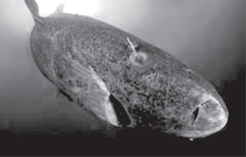
They can be as big as great white sharks, but that’s
about as far as the comparison goes. Their maximum
speed is a lethargic 1.7 miles per hour, many are almost
blind, and they are happy to eat rotting carcasses. They
[5] may be common throughout the ocean, but you’ve
probably never heard of them. Meet the Greenland
shark. Looking like nothing so much as a chunk of
weather-beaten rock, Greenland sharks (Somniosus
microcephalus) can grow up to 7.3 metres (24 feet) long,
[10] making them one of the largest of all fish, and the biggest
in the Arctic. But they prefer to live in deep, cold water,
so humans rarely see them.
Studies in the Arctic have revealed a few snippets
of information about Greenland sharks, and more data
[15] is now starting to come in from elsewhere. It turns out
that Greenland sharks are bizarre, and may be crucially
important for the ocean ecosystem.
Greenland sharks only come close to the surface
in places where the shallow water is frigid enough for
[20] them — primarily in the Arctic. They are most easily
seen around Greenland and Iceland. As a result, they
were long thought of as purely polar animals, as were
the closely-related Pacific sleeper shark and southern
sleeper shark.
[25] But they have been reported on the coasts of
Canada, Portugal, France, Scotland and Scandinavia.
Some researchers think they live in many other areas
too but just haven’t been spotted in them yet. “They may
be everywhere that’s cold enough and deep enough,”
[30] says Aaron MacNeil of the Australian Institute of Marine
Science, in Townsville, Queensland.
The obvious way to see a Greenland shark in the
wild is to dive into the deep sea. For instance, in 2001 a
remotely operated vehicle in the Gulf of Mexico captured
[35] footage of either a Greenland shark or a sleeper shark in
over 2,600 meters (8,530ft) of water. Two years later, a
pilot and a scientist from the Harbor Branch
Oceanographic Institution in Fort Pierce, Florida, became
the first people to come face to face with a Greenland
[40] shark in the deep sea. The shark, which was five meters
(16ft) long, bumped into their submersible vessel 1,000
meters (3,280ft) down in the Gulf of Maine. But hardly
anyone dives that deep. So these rare encounters can’t
tell us how widespread and important the Greenland
[45] sharks are.
The Greenland shark. Disponível em: www.bbc.com/earth/20141028- the-mystery-shark-of-the-arctic. Acesso em: 12 out. 2014.
Considering language use in the text, it’s correct to say:
Questão 38 756319
UEFS Caderno 1 2015/1TEXTO:
The Greenland shark
They can be as big as great white sharks, but that’s
about as far as the comparison goes. Their maximum
speed is a lethargic 1.7 miles per hour, many are almost
blind, and they are happy to eat rotting carcasses. They
[5] may be common throughout the ocean, but you’ve
probably never heard of them. Meet the Greenland
shark. Looking like nothing so much as a chunk of
weather-beaten rock, Greenland sharks (Somniosus
microcephalus) can grow up to 7.3 metres (24 feet) long,
[10] making them one of the largest of all fish, and the biggest
in the Arctic. But they prefer to live in deep, cold water,
so humans rarely see them.
Studies in the Arctic have revealed a few snippets
of information about Greenland sharks, and more data
[15] is now starting to come in from elsewhere. It turns out
that Greenland sharks are bizarre, and may be crucially
important for the ocean ecosystem.
Greenland sharks only come close to the surface
in places where the shallow water is frigid enough for
[20] them — primarily in the Arctic. They are most easily
seen around Greenland and Iceland. As a result, they
were long thought of as purely polar animals, as were
the closely-related Pacific sleeper shark and southern
sleeper shark.
[25] But they have been reported on the coasts of
Canada, Portugal, France, Scotland and Scandinavia.
Some researchers think they live in many other areas
too but just haven’t been spotted in them yet. “They may
be everywhere that’s cold enough and deep enough,”
[30] says Aaron MacNeil of the Australian Institute of Marine
Science, in Townsville, Queensland.
The obvious way to see a Greenland shark in the
wild is to dive into the deep sea. For instance, in 2001 a
remotely operated vehicle in the Gulf of Mexico captured
[35] footage of either a Greenland shark or a sleeper shark in
over 2,600 meters (8,530ft) of water. Two years later, a
pilot and a scientist from the Harbor Branch
Oceanographic Institution in Fort Pierce, Florida, became
the first people to come face to face with a Greenland
[40] shark in the deep sea. The shark, which was five meters
(16ft) long, bumped into their submersible vessel 1,000
meters (3,280ft) down in the Gulf of Maine. But hardly
anyone dives that deep. So these rare encounters can’t
tell us how widespread and important the Greenland
[45] sharks are.
The Greenland shark. Disponível em: www.bbc.com/earth/20141028- the-mystery-shark-of-the-arctic. Acesso em: 12 out. 2014.
“hardly anyone dives that deep.” (l. 42-43).
This sentence can be exactly rephrased as
Questão 37 756317
UEFS Caderno 1 2015/1TEXTO:
The Greenland shark
They can be as big as great white sharks, but that’s
about as far as the comparison goes. Their maximum
speed is a lethargic 1.7 miles per hour, many are almost
blind, and they are happy to eat rotting carcasses. They
[5] may be common throughout the ocean, but you’ve
probably never heard of them. Meet the Greenland
shark. Looking like nothing so much as a chunk of
weather-beaten rock, Greenland sharks (Somniosus
microcephalus) can grow up to 7.3 metres (24 feet) long,
[10] making them one of the largest of all fish, and the biggest
in the Arctic. But they prefer to live in deep, cold water,
so humans rarely see them.
Studies in the Arctic have revealed a few snippets
of information about Greenland sharks, and more data
[15] is now starting to come in from elsewhere. It turns out
that Greenland sharks are bizarre, and may be crucially
important for the ocean ecosystem.
Greenland sharks only come close to the surface
in places where the shallow water is frigid enough for
[20] them — primarily in the Arctic. They are most easily
seen around Greenland and Iceland. As a result, they
were long thought of as purely polar animals, as were
the closely-related Pacific sleeper shark and southern
sleeper shark.
[25] But they have been reported on the coasts of
Canada, Portugal, France, Scotland and Scandinavia.
Some researchers think they live in many other areas
too but just haven’t been spotted in them yet. “They may
be everywhere that’s cold enough and deep enough,”
[30] says Aaron MacNeil of the Australian Institute of Marine
Science, in Townsville, Queensland.
The obvious way to see a Greenland shark in the
wild is to dive into the deep sea. For instance, in 2001 a
remotely operated vehicle in the Gulf of Mexico captured
[35] footage of either a Greenland shark or a sleeper shark in
over 2,600 meters (8,530ft) of water. Two years later, a
pilot and a scientist from the Harbor Branch
Oceanographic Institution in Fort Pierce, Florida, became
the first people to come face to face with a Greenland
[40] shark in the deep sea. The shark, which was five meters
(16ft) long, bumped into their submersible vessel 1,000
meters (3,280ft) down in the Gulf of Maine. But hardly
anyone dives that deep. So these rare encounters can’t
tell us how widespread and important the Greenland
[45] sharks are.
The Greenland shark. Disponível em: www.bbc.com/earth/20141028- the-mystery-shark-of-the-arctic. Acesso em: 12 out. 2014.
Fill in the parentheses with T (True) or F (False).
The last paragraph has answers to the following questions:
( ) How can you see a Greenland shark in its natural environment?
( ) When was the first time that a Greenland shark was captured alive?
( ) What did a special vehicle manage to film in 2001?
( ) How deep was the Greenland shark spotted in the Gulf of Mexico?
The correct sequence, from top to bottom, is
Questão 36 756316
UEFS Caderno 1 2015/1TEXTO:
The Greenland shark
They can be as big as great white sharks, but that’s
about as far as the comparison goes. Their maximum
speed is a lethargic 1.7 miles per hour, many are almost
blind, and they are happy to eat rotting carcasses. They
[5] may be common throughout the ocean, but you’ve
probably never heard of them. Meet the Greenland
shark. Looking like nothing so much as a chunk of
weather-beaten rock, Greenland sharks (Somniosus
microcephalus) can grow up to 7.3 metres (24 feet) long,
[10] making them one of the largest of all fish, and the biggest
in the Arctic. But they prefer to live in deep, cold water,
so humans rarely see them.
Studies in the Arctic have revealed a few snippets
of information about Greenland sharks, and more data
[15] is now starting to come in from elsewhere. It turns out
that Greenland sharks are bizarre, and may be crucially
important for the ocean ecosystem.
Greenland sharks only come close to the surface
in places where the shallow water is frigid enough for
[20] them — primarily in the Arctic. They are most easily
seen around Greenland and Iceland. As a result, they
were long thought of as purely polar animals, as were
the closely-related Pacific sleeper shark and southern
sleeper shark.
[25] But they have been reported on the coasts of
Canada, Portugal, France, Scotland and Scandinavia.
Some researchers think they live in many other areas
too but just haven’t been spotted in them yet. “They may
be everywhere that’s cold enough and deep enough,”
[30] says Aaron MacNeil of the Australian Institute of Marine
Science, in Townsville, Queensland.
The obvious way to see a Greenland shark in the
wild is to dive into the deep sea. For instance, in 2001 a
remotely operated vehicle in the Gulf of Mexico captured
[35] footage of either a Greenland shark or a sleeper shark in
over 2,600 meters (8,530ft) of water. Two years later, a
pilot and a scientist from the Harbor Branch
Oceanographic Institution in Fort Pierce, Florida, became
the first people to come face to face with a Greenland
[40] shark in the deep sea. The shark, which was five meters
(16ft) long, bumped into their submersible vessel 1,000
meters (3,280ft) down in the Gulf of Maine. But hardly
anyone dives that deep. So these rare encounters can’t
tell us how widespread and important the Greenland
[45] sharks are.
The Greenland shark. Disponível em: www.bbc.com/earth/20141028- the-mystery-shark-of-the-arctic. Acesso em: 12 out. 2014.
The pilot and the scientist from Harbor Branch Oceanographic Institution in Florida __________________
The alternative that completes this blank correctly is
Questão 35 756314
UEFS Caderno 1 2015/1TEXTO:
The Greenland shark
They can be as big as great white sharks, but that’s
about as far as the comparison goes. Their maximum
speed is a lethargic 1.7 miles per hour, many are almost
blind, and they are happy to eat rotting carcasses. They
[5] may be common throughout the ocean, but you’ve
probably never heard of them. Meet the Greenland
shark. Looking like nothing so much as a chunk of
weather-beaten rock, Greenland sharks (Somniosus
microcephalus) can grow up to 7.3 metres (24 feet) long,
[10] making them one of the largest of all fish, and the biggest
in the Arctic. But they prefer to live in deep, cold water,
so humans rarely see them.
Studies in the Arctic have revealed a few snippets
of information about Greenland sharks, and more data
[15] is now starting to come in from elsewhere. It turns out
that Greenland sharks are bizarre, and may be crucially
important for the ocean ecosystem.
Greenland sharks only come close to the surface
in places where the shallow water is frigid enough for
[20] them — primarily in the Arctic. They are most easily
seen around Greenland and Iceland. As a result, they
were long thought of as purely polar animals, as were
the closely-related Pacific sleeper shark and southern
sleeper shark.
[25] But they have been reported on the coasts of
Canada, Portugal, France, Scotland and Scandinavia.
Some researchers think they live in many other areas
too but just haven’t been spotted in them yet. “They may
be everywhere that’s cold enough and deep enough,”
[30] says Aaron MacNeil of the Australian Institute of Marine
Science, in Townsville, Queensland.
The obvious way to see a Greenland shark in the
wild is to dive into the deep sea. For instance, in 2001 a
remotely operated vehicle in the Gulf of Mexico captured
[35] footage of either a Greenland shark or a sleeper shark in
over 2,600 meters (8,530ft) of water. Two years later, a
pilot and a scientist from the Harbor Branch
Oceanographic Institution in Fort Pierce, Florida, became
the first people to come face to face with a Greenland
[40] shark in the deep sea. The shark, which was five meters
(16ft) long, bumped into their submersible vessel 1,000
meters (3,280ft) down in the Gulf of Maine. But hardly
anyone dives that deep. So these rare encounters can’t
tell us how widespread and important the Greenland
[45] sharks are.
The Greenland shark. Disponível em: www.bbc.com/earth/20141028- the-mystery-shark-of-the-arctic. Acesso em: 12 out. 2014.
The Greenland sharks are not easily seen because
06