


![[Marketing] Questao Topo - deslogado](https://storage.estuda.com.br/banners/0_6b7ebee90b03af1c560c73bb8bcce34a_banner_deslogado_70_dias.png)
Questões de Inglês
19.971 Questões
Questão 18 366454
UNIMONTES 2° Etapa 2016Our weird lack of hair may be the key to our success
[1] Look closely at your friends, family and even strangers. Spot anything strange?
Ignore any large noses or unusually-shaped brows. Instead, look at their hair – or rather, the lack of it.
It might not seem strange, because we are used to having relatively little hair covering our bodies. But
when we compare ourselves to the rest of the mammals, and our closest living ape cousins, it is downright
[5] bizarre that we are the only large-bodied mammal with so little of it.
Unlike hairy chimpanzees and bonobos – and all other primates – most of our skin is on display. We
have evolved this way, even though fur is beneficial: it insulates and protects the skin, and in some cases
acts as a useful camouflage. So if it is so advantageous, why did we lose so much of it?
It was Charles Darwin who first taught the public that humans are descended from an ape-like
[10] ancestor. He also wondered why we had so little hair.
“No one supposes that the nakedness of the skin is any direct advantage to man; his body, therefore,
cannot have been divested of hair through natural selection,” Darwin wrote in The Descent of Man.
He proposed that we lost much of our fur due to sexual selection: we preferred hairless mates, and that
is why hairlessness became common.
[15] But that cannot be the whole picture. Before a preference
for hairlessness began, we first had to start losing hair.
Our earliest human-like ancestors, known as hominins, were
ape-like. For them, fur would have been useful, keeping them
warm on cold nights.
[20] Something must have created an evolutionary pressure for
these hominins to lose their fur.
A few million years ago, there were several hominin species
roaming the Earth. These included the famous fossil known as “Lucy”, an Australopithecus afarensis from
3.2 million years ago.
[25] These hominins were ape-like. Lucy was a lot like a chimpanzee, except that she could walk upright
and had a slightly bigger brain. Her skin was not preserved, but she was probably covered with fur.
However, between two and three millions years ago our ancestors began to inhabit more open
savannahs. This meant they were out in the Sun’s glaring heat for many more hours each day.
Around the same time, they also started to hunt and eat more meat – and game animals were more
[30] abundant in the open. This move into open spaces offered an explanation for our lack of hair.
In the 1990s, Peter Wheeler of Liverpool John Moores University in the UK came up with a
mathematical model showing how much excess heat hominins would need to lose in open habitats in order
to function. If their brains got too hot, their thought processes would be impaired.
If the hominins were covered in hair, they could not have lost heat fast enough. Wheeler reasoned that
[35] two related changes happened that allowed our ancestors to keep cool.
One was an upright gait. Walking on two legs meant that only the tops of their bodies were under
direct sunlight.
But the hominins also started running long distances. This meant they could bring down large game
animals by running them to exhaustion, but it also put them at risk of over-heating. To cope with that, they
[40] needed to lose their fur – in order to help them sweat. [...]

Fonte: HOGENBOOM, Melissa. Our weird lack of hair may be the key to our sucess. 2 ago. 2016. Disponível em: http://www.bbc.com/earth/story/20160801-our-weird-lack-of-hair-may-be-the-key-to-our-sucess. Acesso em: 15 set. 2016. Adaptado.
Assinale a alternativa cujo fragmento de texto NÃO tem a função de topic sentence:
Questão 18 363996
UNIMONTES 1° Etapa 2016Zika linked to baby joint deformities
[1] Zika infection during pregnancy may cause limb joint deformities in the baby, experts now fear.
Brazilian researchers from Recife, the city at the centre of the Zika epidemic, describe seven suspect cases
in the journal The BMJ.
The virus, which has been spreading across much of the Americas and has deterred some people
[5] from visiting the Olympic host country, is already known to cause a serious baby brain defect.
Mothers-to-be are urged to be vigilant. Pregnant women should not travel to areas with Zika, and
those living in Zika zones should avoid the biting mosquitoes that carry and spread the disease.
Experts now agree that Zika is capable of causing lasting brain damage to babies in the womb. The
virus can cross the placenta from the mother to her unborn child. And there is growing evidence that it can
[10] trigger a rare, weakening condition of the nerves, called Guillian-Barre syndrome, in adults.
Dr. Vanessa van der Linden and her team in Brazil say they are now seeing limb joint problems in
newborn babies that might be caused by Zika too. The seven babies with suspected Zika infection that they
studied in hospital had been born with hip, knee, ankle, elbow, wrist and/or finger joint problems that fit
with a medical diagnosis called arthrogryposis.
[15] The deformities of arthrogryposis, or crooked joints, are caused by faulty muscles – some too tight
or contracted and some too flaccid – that have pulled and held the baby’s growing body in unnatural
positions.
Dr. Linden’s team suspect the Zika virus attacks brain nerve centres supplying the muscles around
the joints, rather than the joints themselves. Scans of the babies’ brains appear to support this idea.
[20] All of the seven babies they examined tested negative for other
congenital (pre-birth) infections, such as rubella and HIV, that might have
been a possible cause of their deformities. Most had microcephaly as well as
the limb deformities. Dr. Linden says that, since writing up her findings, she
has seen 14 more babies with similar problems and is running more tests.
[25] Prof. Jimmy Whitworth, from the London School of Hygiene and
Tropical Medicine, said that while not concrete proof, the evidence that Zika might be to blame was “pretty
compelling”. “Microcephaly is the most obvious sign of congenital infection with Zika, but it’s becoming
clear that’s just part of the whole spectrum of damage that can be caused by the virus.” He said the
challenge was stopping the spread of the infection and caring for those who will be affected in the long as
[30] well as the short term.
“Studies suggest the current epidemic could go on for three or four years,” Prof. Whitworth said.
“We think there’s going to be tens of thousands of babies who could be affected by Zika. Meeting their
physical and psychosocial needs will be the real challenge.”
Fonte: ROBERTS, Michelle. Zika linked to baby joint deformities. 10 ago. 2016. Disponível em: http://www.bbc.com/news/health-37010221. Acesso em: 17 set. 2016. Adaptado.
Os termos destacados no trecho “The deformities of arthrogryposis, or crooked joints, are caused by faulty muscles – some too tight or contracted and some too flaccid [...]” (linhas 15-16) classificam-se, respectivamente, em:
Questão 30 342905
UNICENTRO 2016Read the following advertisement.
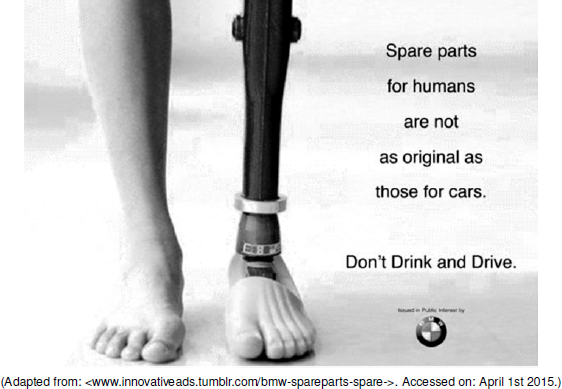
Based on the advertisement, assign T (true) or F (false) to the following statements.
( ) The ad intends to raise awareness of the severe consequences of making use of alcohol and driving.
( ) It is possible to infer that both body parts and car parts are easily replaceable items.
( ) Despite advances in technology, prostheses will never compare to real body parts.
( ) We may conclude that prostheses have developed so much that they look just like real body parts.
( ) The ad implies that, in car crashes, the most frequently injured body parts are the feet and legs.
Choose the alternative that shows, top-down, the correct sequence.
Questão 29 342904
UNICENTRO 2016Read the following text and answer question.
Southern Europe’s Immigration
Test Immigrants have been making their way to Europe for tens of thousands of years. The first modern humans – the first real immigrants – came north from Africa through the Middle East. Since then, periodic waves of migrants have helped redefine Europe’s population, its food, its knowledge. After World War II, most migrants headed to northern Europe but as the south has prospered over the past 20 years, it has drawn in growing numbers of people looking for a better life. By the mid-2000s, migrants headed for southern Europe accounted for more than 60% of the continent’s new arrivals. They swung the hammers during Spain’s construction boom, changed diapers in Greece and worked Italy’s fields. European immigration policy has become more bureaucratic over the years. In south, where enforcement of rules has been more lax and informal economies are large, working illegally is often easier than getting proper permits. The economic crisis will slow the flow but is unlikely to undo the demographic shift, not least because the birthrate among immigrants is much higher than the general population’s. “If there’s a lesson that can be learned from the northern European experience, it’s that temporary migrants tend to remain,” says Joaquín Arango, professor of sociology at the Complutense University of Madrid. Here’s another: when a society marginalizes its newest members, trouble ensues. Southern Europe needed its immigrants. Now it needs to find a place for them.
(Adapted from: <www.content.time.com/article/0,28804,1964957_1964>. Accessed on: April 1st 2015.)
In “By the mid-2000s, migrants headed for southern Europe accounted for more than 60% of the continent’s new arrivals”, the expression underlined is in meaning equivalent to
Questão 28 342901
UNICENTRO 2016Read the following text and answer question.
Southern Europe’s Immigration
Test Immigrants have been making their way to Europe for tens of thousands of years. The first modern humans – the first real immigrants – came north from Africa through the Middle East. Since then, periodic waves of migrants have helped redefine Europe’s population, its food, its knowledge. After World War II, most migrants headed to northern Europe but as the south has prospered over the past 20 years, it has drawn in growing numbers of people looking for a better life. By the mid-2000s, migrants headed for southern Europe accounted for more than 60% of the continent’s new arrivals. They swung the hammers during Spain’s construction boom, changed diapers in Greece and worked Italy’s fields. European immigration policy has become more bureaucratic over the years. In south, where enforcement of rules has been more lax and informal economies are large, working illegally is often easier than getting proper permits. The economic crisis will slow the flow but is unlikely to undo the demographic shift, not least because the birthrate among immigrants is much higher than the general population’s. “If there’s a lesson that can be learned from the northern European experience, it’s that temporary migrants tend to remain,” says Joaquín Arango, professor of sociology at the Complutense University of Madrid. Here’s another: when a society marginalizes its newest members, trouble ensues. Southern Europe needed its immigrants. Now it needs to find a place for them.
(Adapted from: <www.content.time.com/article/0,28804,1964957_1964>. Accessed on: April 1st 2015.)
Choose the alternative in which the information about the words underlined is correct.
Questão 26 342896
UNICENTRO 2016Read the following text and answer question.
Southern Europe’s Immigration
Test Immigrants have been making their way to Europe for tens of thousands of years. The first modern humans – the first real immigrants – came north from Africa through the Middle East. Since then, periodic waves of migrants have helped redefine Europe’s population, its food, its knowledge. After World War II, most migrants headed to northern Europe but as the south has prospered over the past 20 years, it has drawn in growing numbers of people looking for a better life. By the mid-2000s, migrants headed for southern Europe accounted for more than 60% of the continent’s new arrivals. They swung the hammers during Spain’s construction boom, changed diapers in Greece and worked Italy’s fields. European immigration policy has become more bureaucratic over the years. In south, where enforcement of rules has been more lax and informal economies are large, working illegally is often easier than getting proper permits. The economic crisis will slow the flow but is unlikely to undo the demographic shift, not least because the birthrate among immigrants is much higher than the general population’s. “If there’s a lesson that can be learned from the northern European experience, it’s that temporary migrants tend to remain,” says Joaquín Arango, professor of sociology at the Complutense University of Madrid. Here’s another: when a society marginalizes its newest members, trouble ensues. Southern Europe needed its immigrants. Now it needs to find a place for them.
(Adapted from: <www.content.time.com/article/0,28804,1964957_1964>. Accessed on: April 1st 2015.)
The main objective of the text is to
06