


![[Marketing] Questao Topo - deslogado](https://storage.estuda.com.br/banners/0_6b7ebee90b03af1c560c73bb8bcce34a_banner_deslogado_70_dias.png)
Questões de Inglês
19.971 Questões
Questão 10 4652362
Unilago 2016/2Leia o texto a seguir e responda à questão.
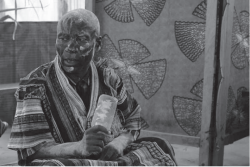
(A community health worker takes on the role of the traditional healer in a play warning of the dangers of traditional medicine)
12 November 2015
Worlds AIDS day (1st December) is fast approaching and with it we have a number of activities planned here in the South Kivu province of Democratic Republic of Congo.
In this part of the world public understanding of the disease is minimal and stigmatisation is a huge. Many diseases caused by bacteria and viruses are seen to be the work of magic or poisoning and HIV is no exception.
The first port of call for most people when they fall sick is the traditional healer or the prayer room. Both warn against the dangers of western medicine and urge people to stop taking the hospitals drugs. The effect of this is very damaging and we often see HIV patients arriving in a terrible state having abandoned their treatment for these alternative healings.
Stigmatisation here is the worst I have worked with, but living with HIV anywhere in the world is difficult.
Taking a taxi in Amsterdam, while attending my mission briefings, my driver made it clear that he believed getting HIV meant certain death. It’s not the 90s anymore and this is no longer the case.
Modern treatment means that people living with this infection, while they cannot be cured, can live a long, healthy life and have a family without infecting them. If this is still poorly understood in the west, then imagine the understanding here, deep in Eastern DRC.
Here, most people are too afraid even to tell their partners of their status for fear of rejection.
Of course the partners are likely positive themselves and may be the source of the infection. Often when people do disclose, families are broken apart and human beings are marginalised.
And it is in that context that we approach World AIDS day with a number of events aimed at improving public knowledge over the next month.
Our teams are visiting schools, putting on theatre productions, speaking on local radio and, most excitingly, we will be hearing public testimony from people living with HIV.
Three of our patients have volunteered to speak out about their disease, to share their story with their community.
This has never been done before here and the courage involved is huge. Each has their own story which they have consented to be published on this blog and in the coming weeks I will share these with you.
(Adaptado de: VERRECHIA, R. The slow battle against stigma and misunderstanding. Congo, in Colour Blog In Medecines sans frontieres. Disponível em: http://blogs.msf.org/en/staff/blogs/congo-in-colour/the-slow-battle-against-stigma-andmisunderstanding. Acesso em: 23 abr. 2016.)
Com base no texto, considere as afirmativas a seguir.
I. Entre os eventos programados para o Dia Mundial da AIDS, está o testemunho de três pacientes portadores de HIV.
II. South Kivu é a província no Congo onde o autor afirma ter presenciado maior preconceito contra portadores de HIV.
III. Nos anos 90, foram desenvolvidos tratamentos que controlam a infecção causada pelo HIV e evitam contágio.
IV. Todos os eventos programados para a celebração do Dia Mundial da AIDS acontecerão no dia 1º de dezembro.
Assinale a alternativa correta.
Questão 11 4626013
Unilago 2016/1Leia o texto a seguir e responda à questão.
What is behind a student’s choice for becoming a doctor?
Purpose: To determine the reasons for choosing the medical profession by interviewing freshmen medical students from the Faculty of Medicine, University of São Paulo and investigating their socio-economic and psychological profiles, as well as to determine whether there are gender differences.
Method: One hundred and sixty three freshmen medical students answered a questionnaire regarding their socio-economical profile. Of those, 30 female and 30 male students underwent a face-to-face interview regarding the career choice, the Thematic Apperception Test (TAT) and the 16 Personality Factor Questionnaire (16 PF). The results were analyzed qualitatively and by Mann-Whitney, X2, Fisher’s Exact, and rp coefficient tests.
Results: Most students were middle class, catholic, and had physicians in their families. Students of both genders had made an: early choice of the medical career and persistence in taking exams many times, even after being discouraged. They also showed an awareness of the difficulties and limitations in developing their careers. The study revealed a strong valuation of the humanistic aspects of medicine; openness to new experiences; a deep personal identification with the choice of profession; a critical need for fulfillment in their careers; and conscious and unconscious desires to help people, without being narcissistic. Female students were more sensitive (P < 0.001) and less imaginative (P = 0.005) than male students, who were more utilitarian and less grounded; female students tended to present greater emotional maturity while male students presented a greater tendency towards competition, and were more ambitious.
Conclusions: Students of both genders have similar socio-economical profiles and features regarding their motivations for choosing the medical profession. Slight differences were found regarding some psychological aspects.
Keywords: Medical students. Personality. Career choice. Gender. Education.
(Adaptado de: MILLAN, L. R. et al. What is behind a student’s choice for becoming a doctor? Clinics. v.60. n.2. p.143-150. apr. 2005. Disponível em: http://www.scielo.br/scielo.php?script=sci_arttext&pid=S1807-59322005000200011&lng=en&nrm=iso. Acesso em: 31 maio 2015.)
Em relação ao texto, assinale a alternativa correta.
Questão 58 3155487
UNIPAM 2016Read the text below and answer the question.
How ‘Human’ Is This Newly Discovered Species?
Justin Worland @justinworland (Sept. 10, 2015)
The discovery of a new human-related species, named Homo naledi, has thrown the evolutionary biology world for a loop. The newfound species, uncovered in a South African cave system, appears to be an odd combination of primitive and modern features not previously seen together.
From the remains of at least 15 individuals, scientists assembled the skeletal system of Homo naledi and published the findings in the journal eLife. The new species has some remarkably human-like similarities, namely its hands and feet—though its brain is much smaller, as is its frame. Human hands have played a key role in the evolution of Homo sapiens, and that’s one of the similarities between humans and Homo naledi. Individuals of the Homo naledi species had opposable thumbs much like our own that would have allowed them dexterity somewhat like that of humans. The curved nature of the hands also suggests that the species may have had climbing abilities. Many of our close ancestors, including chimpanzees and apes, have opposable thumbs.
Perhaps the most significant similarity is not anatomical. Scientists say the cave location the Homo naledi remains were found appears to be a burial chamber. Burying the dead was a practice previously thought to be a unique human trait.
These similarities carry significance from an evolutionary perspective, but a number of traits make humans stand out from our predecessors. Human brains are typically between 1,100 and 1,200 cubic centimeters. Scientists estimated that the brain in Homo naledi would have been about half that size. Brain size isn’t everything when it comes to intelligent life and evolution, of course, but the structure of the brain in Homo naledi, revealed by the shape of the skull, also suggests a more primitive brain. Together, when comparing humans to a direct ancestor, the brain does suggest some distance between humans and Homo naledi.
The frame, including the shoulders and pelvis, also bears closer resemblance to early hominin species. Overall, scientists believe Homo naledi individuals weigh less than their human counterparts.
The differences between humans and Homo naledi are significant, but that doesn’t diminish the significance of the finding. The discovery of a human-related species just underscores how little we know about the life forms that preceded ours’ millions of years ago.
(Adapted from: http://time.com/4029312/how-human-is-homo-naledi).
According to the text, we can say that the human-related species
Questão 56 3155465
UNIPAM 2016Read the text below and answer question.
The process of evolution
The process of evolution involves a series of natural changes that cause species (populations of different organisms) to arise, adapt to the environment, and become extinct. All species or organisms have originated through the process of biological evolution. In animals that reproduce sexually, including humans, the term species refers to a group whose adult members regularly interbreed, resulting in fertile offspring -- that is, offspring themselves capable of reproducing. Scientists classify each species with a unique, two-part scientific name. In this system, modern humans are classified as Homo sapiens.
Evolution occurs when there is change in the genetic material -- the chemical molecule, DNA -- which is inherited from the parents, and especially in the proportions of different genes in a population. Genes represent the segments of DNA that provide the chemical code for producing proteins. Information contained in the DNA can change by a process known as mutation. The way particular genes are expressed – that is, how they influence the body or behavior of an organism -- can also change. Genes affect how the body and behavior of an organism develop during its life, and this is why genetically inherited characteristics can influence the likelihood of an organism’s survival and reproduction.
Evolution does not change any single individual. Instead, it changes the inherited means of growth and development that typify a population (a group of individuals of the same species living in a particular habitat). Parents pass adaptive genetic changes to their offspring, and ultimately these changes become common throughout a population. As a result, the offspring inherit those genetic characteristics that enhance their chances of survival and ability to give birth, which may work well until the environment changes. Over time, genetic change can alter a species' overall way of life, such as what it eats, how it grows, and where it can live. Human evolution took place as new genetic variations in early ancestor populations favored new abilities to adapt to environmental change and so altered the human way of life.
(Adapted from: http://humanorigins.si.edu/education/intro-human-evolution)
According to the process of evolution, we can say that
Questão 60 1564182
MULTIVIX 2016Na questão, selecione as alternativas que completam, correta e adequadamente, as lacunas do texto.
Most people know what an iPod is, but (03) According to one theory, it’s an acronym for “Interface Protocol Option Devices”. (04), “i” stands for “internet”, while Pod stands for “portable device”. A pod also refers to a container provided by nature: peas grow in a pod, and an iPod contains music. Podcasting, on the other hand, is a variation of broadcasting. (…)
(Speak Up, n° 231)
Questão 59 1564176
MULTIVIX 2016Na questão, selecione as alternativas que completam, correta e adequadamente, as lacunas do texto.
Most people know what an iPod is, but (03) According to one theory, it’s an acronym for “Interface Protocol Option Devices”. (04), “i” stands for “internet”, while Pod stands for “portable device”. A pod also refers to a container provided by nature: peas grow in a pod, and an iPod contains music. Podcasting, on the other hand, is a variation of broadcasting. (…)
(Speak Up, n° 231)
06