


![[Marketing] Questao Topo - deslogado](https://storage.estuda.com.br/banners/0_6b7ebee90b03af1c560c73bb8bcce34a_banner_deslogado_70_dias.png)
Questões de Inglês
19.971 Questões
Questão 42 136814
ESPM 2017/1The comfort food that took over the world
Every year, tens of billions of instant ramen noodles are enjoyed – a simple meal that only needs the addition of boiling water. Veronique Greenwood looks at the invention of a food revolution.
By Veronique Greenwood
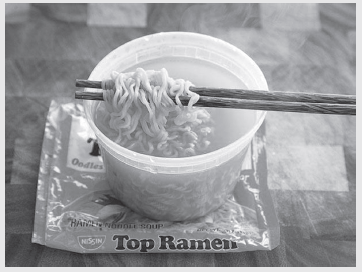
There was a time in my life when I ate a bowl of instant ramen every single day. When you’re a moody 13-year-old, sources of reliable satisfaction are in short supply, and when I wrote about it, I learned that I was not alone in relying on ramen to keep me afloat. Many readers wrote that it’s a comfort food for them too – easy to make, consistent, and surprisingly delicious.
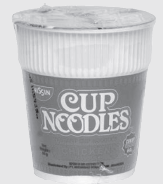
At the International Museum of Ramen in Osaka, hordes of people come each year to pay homage. The museum features a timeline of hundreds of Nissin products, from Chikin Ramen to Spagheny to Cheese Curry Cup. The main attraction is an enormous hall where you can design and purchase your own Cup Noodles. My favorite oddity is a sculpture depicting— embedded in stone so as to suggest future archaeology—fossils, a cell phone, and a brilliantly colored Cup Noodles open and ready to eat, its noodles already held aloft by a plastic fork. A placard gives the sculpture’s title: “Eternal.”
Instant ramen can seem so elemental that it’s almost surprising to learn that it required inventing. But coming up with a shelf-stable, quick-cooking noodle soup was far from simple, or intuitive. The oft-told story of Momofuku Ando suggests it was difficult: the struggling Osaka businessman experimented for months in his backyard shed before launching Nissin in 1958.
The catalyzing insight was flash-frying the noodles after they had been boiled, seasoned, and dried. Frying them zaps away any remaining water, increasing their shelf life. But it also leaves the noodles threaded with a warren of empty space. The production technique also allows the noodles to be stored for up to six months without being refrigerated because the lack of water in the dried ramen prevents the spread of germs. When they’re tossed into boiling water again, the water rushes in, cooking them quickly and thoroughly in a few minutes. Ando was a colorful character, a middle-aged tinkerer who gradually became a sort of legend, as the price of instant ramen came down to more budgetfriendly levels. “
Ando promoted his product with a nearly religious zeal, as though he were on a crusade to feed the world – to end hunger with ramen,” wrote Karen Leibowitz in an essay about Ando for Lucky Peach. In 2000, when a Tokyo think tank put out poll for the most important Japanese innovation of the 20th Century, instant ramen won the title, leaving the Walkman, the bullet train, the digital camera, the fuel-efficient car, and the karaoke behind. (Pokemon was number eight, if you’re curious.)
Traditional Japanese cuisine is in many ways the polar opposite of instant noodles. At an old-fashioned inn in Kyoto I stayed at recently, dinner was nine small dishes brought out one-by-one, beginning with a tiny collage of octopus suckers and red beans. Slippery jellies, exquisitely fresh seafood, and crisply grilled fish followed. It was delicious, and could not have been farther from the ramen of my youth. But despite this, the convenient noodles are a national symbol.
They have blossomed abroad as well, with nearly 98 billion packages consumed globally in 2015, according to the World Instant Noodles Association. For years, Top Ramen, Maruchan Ramen, and Cup Noodles were almost the only varieties available in many Western markets, but that has changed. There has been an explosion in the types of noodles available in supermarkets and Asian groceries – you can get vegan instant noodles now, and there are flavors catering especially to the Mexican market.
Of course, some old habits die hard. At the museum in Osaka, thousands of people queue up to plop a brick of noodles into a Styrofoam cup, choose their own broth powder and dried toppings – everything from beef cubes, peas, carrots and dried fried onions – and have the whole thing sealed up to eat later. While no one would mistake it for high cuisine, it hits all those old, comforting notes— peculiarly satisfying.
(Adaptado de www.bbc.com, 27 de julho de 2016)
International
According to the information presented in the article, at the Museum of Ramen in Osaka:
Questão 41 136813
ESPM 2017/1The comfort food that took over the world
Every year, tens of billions of instant ramen noodles are enjoyed – a simple meal that only needs the addition of boiling water. Veronique Greenwood looks at the invention of a food revolution.
By Veronique Greenwood
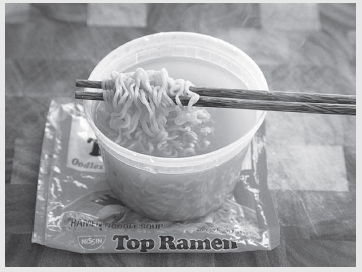
There was a time in my life when I ate a bowl of instant ramen every single day. When you’re a moody 13-year-old, sources of reliable satisfaction are in short supply, and when I wrote about it, I learned that I was not alone in relying on ramen to keep me afloat. Many readers wrote that it’s a comfort food for them too – easy to make, consistent, and surprisingly delicious.
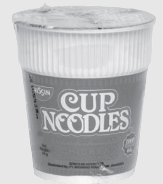
At the International Museum of Ramen in Osaka, hordes of people come each year to pay homage. The museum features a timeline of hundreds of Nissin products, from Chikin Ramen to Spagheny to Cheese Curry Cup. The main attraction is an enormous hall where you can design and purchase your own Cup Noodles. My favorite oddity is a sculpture depicting— embedded in stone so as to suggest future archaeology—fossils, a cell phone, and a brilliantly colored Cup Noodles open and ready to eat, its noodles already held aloft by a plastic fork. A placard gives the sculpture’s title: “Eternal.”
Instant ramen can seem so elemental that it’s almost surprising to learn that it required inventing. But coming up with a shelf-stable, quick-cooking noodle soup was far from simple, or intuitive. The oft-told story of Momofuku Ando suggests it was difficult: the struggling Osaka businessman experimented for months in his backyard shed before launching Nissin in 1958.
The catalyzing insight was flash-frying the noodles after they had been boiled, seasoned, and dried. Frying them zaps away any remaining water, increasing their shelf life. But it also leaves the noodles threaded with a warren of empty space. The production technique also allows the noodles to be stored for up to six months without being refrigerated because the lack of water in the dried ramen prevents the spread of germs. When they’re tossed into boiling water again, the water rushes in, cooking them quickly and thoroughly in a few minutes. Ando was a colorful character, a middle-aged tinkerer who gradually became a sort of legend, as the price of instant ramen came down to more budgetfriendly levels. “
Ando promoted his product with a nearly religious zeal, as though he were on a crusade to feed the world – to end hunger with ramen,” wrote Karen Leibowitz in an essay about Ando for Lucky Peach. In 2000, when a Tokyo think tank put out poll for the most important Japanese innovation of the 20th Century, instant ramen won the title, leaving the Walkman, the bullet train, the digital camera, the fuel-efficient car, and the karaoke behind. (Pokemon was number eight, if you’re curious.)
Traditional Japanese cuisine is in many ways the polar opposite of instant noodles. At an old-fashioned inn in Kyoto I stayed at recently, dinner was nine small dishes brought out one-by-one, beginning with a tiny collage of octopus suckers and red beans. Slippery jellies, exquisitely fresh seafood, and crisply grilled fish followed. It was delicious, and could not have been farther from the ramen of my youth. But despite this, the convenient noodles are a national symbol.
They have blossomed abroad as well, with nearly 98 billion packages consumed globally in 2015, according to the World Instant Noodles Association. For years, Top Ramen, Maruchan Ramen, and Cup Noodles were almost the only varieties available in many Western markets, but that has changed. There has been an explosion in the types of noodles available in supermarkets and Asian groceries – you can get vegan instant noodles now, and there are flavors catering especially to the Mexican market.
Of course, some old habits die hard. At the museum in Osaka, thousands of people queue up to plop a brick of noodles into a Styrofoam cup, choose their own broth powder and dried toppings – everything from beef cubes, peas, carrots and dried fried onions – and have the whole thing sealed up to eat later. While no one would mistake it for high cuisine, it hits all those old, comforting notes— peculiarly satisfying.
(Adaptado de www.bbc.com, 27 de julho de 2016)
According to the information presented in the article, one can say about the author that:
Questão 80 135258
IFMT Vestibular 2017TEXTO II
NASA to make all its research available free on the Internet
David Millward, US CORRESPONDENT
22 AUGUST 2016
[1] The American space agency, NASA, is to make all its research available free of charge. It is a move which will
delight science enthusiasts and aspiring astronauts. Normally such material is hidden behind a paywall, meaning
that it is often out of reach for the lay enthusiast.
The EU has also said it hopes to make all its research available free from 2020. “At NASA, we are celebrating
[5] this opportunity to extend access to our extensive portfolio of scientific and technical publications,” said Dava
Newman, NASA’s Deputy Administrator.
“Through open access and innovation we invite the global community to join us in exploring Earth, air and
space.”
The Obama administration has been pressing its science agencies to make its research more accessible
[10] believing it increase the popularity of science and advance public knowledge.
In 2013, the White House Office of Science and Technology Policy directed a number of agencies, including
NASA, to increase access to their research.
Under the plans, the research will be made available by a web portal. Any research funded by NASA will have to
be posted on Pubspace within a year of publication. “Making our research data easier to access will greatly
[15] magnify the impact of our research,” NASA Chief
Scientist Ellen Stofan said. “As scientists and engineers, we work by building upon a foundation laid by others.”
Os termos destacados, no parágrafo abaixo, referem-se respectivamente, à/aos:
The American space agency, NASA, is to make all its research available free of charge. It is a move which will delight science enthusiasts and aspiring astronauts. Normally such material is hidden behind a paywall, meaning that it is often out of reach for the lay enthusiast.
Questão 31 131011
FAMEMA 2017Read books, live longer?
Nicholas Bakalar
August 3, 2016

Reading books is tied to a longer life, according to a new report. Researchers used data on 3,635 people over 50 participating in a larger health study who had answered questions about reading. The scientists divided the sample into three groups: those who read no books, those who read books up to three and a half hours a week, and those who read books more than three and a half hours.
The study, in Social Science & Medicine, found that book readers tended to be female, college-educated and in higher income groups. So, researchers controlled for those factors as well as age, race, self-reported health, depression, employment and marital status.
Compared with those who did not read books, those who read for up to three and a half hours a week were 17 percent less likely to die over 12 years of follow-up, and those who read more than that were 23 percent less likely to die. Book readers lived an average of almost two years longer than those who did not read at all.
They found a similar association among those who read newspapers and periodicals, but it was weaker.
(http://well.blogs.nytimes.com. Adaptado.)
Segundo o texto, os pesquisadores
Questão 54 130635
UEMG 2017How a young student’s innovative idea hopes to boost response times for EMTs
By Woody Brown on June 1, 2015
Drones have been at the forefront of the national conversation for years now. As the components needed to create them grow smaller and more affordable, many companies and organizations have started exploring the potential that drones could have to improve our daily lives. Whether by delivering a product with unprecedented speed or taking photographs and video from new heights, drones have many capabilities, most of which we have yet to discover. One young man, however, has envisioned a new way to use drones that could save thousands of lives.
One of the greatest obstacles facing first responders and emergency medical technicians [EMTs] when it comes to the difficult business of saving lives is time. Think of your daily commute: people in the United States spend an average of 25.5 minutes traveling one-way to work every day. In bumperto-bumper traffic, blaring sirens and flashing lights are often not enough to clear a fast path for an ambulance to reach someone in need. During cardiac arrest, there are, at most, a few minutes to save a person’s life. After that, the mortality rate rises steeply. With stakes this high, every second counts.
Alec Momont, a graduate student in engineering at Delft University of Technology in the Netherlands, recognized this problem and saw a way to significantly reduce deaths that result from delayed emergency care. What if ambulances could fly? Or rather, what if we could make a drone that functioned like a stripped-down, lightweight automatic external defibrillator [AED]? AEDs, which can be found in schools, sports arenas and many government buildings, are significantly more effective than cardiopulmonary resuscitation [CPR] at preventing fatalities resulting from cardiac arrest. CPR can be helpful, but an AED is better, and very few people have AEDs in their cars or homes.
As his master’s degree project, Momont built a prototype of this lifesaving drone. It contained an AED, a microphone and speakers. The average travel time, according to him, could be cut by 90 percent. Here’s how it works: In the event of cardiac arrest, a paramedic would respond to a call by flying the drone at a speed of 60 mph to the scene of the emergency. The paramedic would then give instructions to someone near the victim,
who would position the AED. Once in place, the AED would operate automatically. The paramedic would be able to see through the camera whether or not the pads on the AED have been correctly positioned, and how the victim responds.
A dramatized video released by Momont’s university demonstrates all of this functionality. In it, a young woman calls emergency services in a panic because her father has had a heart attack. A calm-voiced EMT answers and guides her through the surprisingly simple process of finding and using the drone. Fewer than two minutes after she makes the call, her father sits up and hugs her.
The ambulance drone can increase the chances of surviving cardiac arrest from eight percent to 80 percent, Momont says in the video. The drone’s ability to travel as the crow flies frees it from infrastructural limitations that currently impede road-bound ambulances. “Using advanced production techniques such as 3D printed microstructures and carbon fiber frame construction, we were able to achieve a very lightweight design,” Momont says. “The result is an integrated solution that is clear in its orientation and friendly in appearance.”
Momont’s aim is to rapidly expand the existing framework of emergency services by constructing many of these drones over the next five years. Expenses are low: each drone is relatively cheap to make, about $18,600. By comparison, a typical ambulance costs more than $100,000, and a ride in one usually costs more than $1,000.
The ambulance drones can even fly autonomously (though legislation in many countries does not permit this yet). Several emergency service providers have already expressed interest. If the technology continues to receive financial support from other parties in the healthcare industry, Momont’s dream could very easily become a reality.
We live in a world where drones have, so far, been used mostly in armed conflict. Momont, however, has a different vision. In the near future that he describes, tens of thousands of needless deaths will be prevented with his ingenious invention. That is certainly welcome news, especially in the United States, which deals with skyrocketing numbers of heart-related ailments and disabilities. “Let’s use drones for a good purpose,” Momont says. “Let us use drones to save lives.”
Adapted from: http://www.verizonwireless.com/news/article/2015/05/ambulance-dronescould-save-thousands-of-lives.html. Access on: 03 Oct. 2016.
The following statements are based on the information presented in the text:
I- Life-saving drones are more economically viable than ordinary ambulances.
II- As ambulance drones are lightweight, they can fly autonomously.
III- Drones reach an average speed of 60mph, because their frame is made of carbon fiber.
IV- Once drones are able to travel as the crow flies, they can escape from the traffic jams and arrive fast at the emergency scene.
The correct statements are
Questão 18 130244
FCM PB Medicina 2017/1TEXTO II
You mean I don’t have to show up? The promise of telemedicine
“Aside from whatever a visit to the doctor costs you in money, it also costs you in time. A lot of it!
End to end, the travel and waiting time for a doctor’s appointment can take several hours — often disrupting work or school. Only 17 percent of it — 20 minutes, on average — is spent actually seeing the doctor, according to a study by the University of Pittsburgh, physician Kristin Ray and colleagues at the Harvard Medical School and the RAND Corporation.
In a year, Americans spend 2.4 billion hours making doctor visits. Valued at average wage rates, that’s worth more than $52 billion — equivalent to the total working time and income of 1.2 million people. On average, we pay $32 when visiting a doctor. But separately, the value of our time adds up to more, $43, according to Dr. Ray’s study.
For certain kinds of health care, there is a better way. Long after electronic communication and technology have revolutionized other services (like preparing taxes, booking travel and banking), emails, phone calls, video chats and other telemedicine applications are gradually supplementing or replacing some types of office visits.
Telemedicine holds the promise of giving some of our time back. And it may have other advantages. Care delivered in this way requires no travel, and if one waits at all it’s at home or work, not at a doctor’s office. In an era of FaceTime and Skype, patients are starting to expect more convenient access to doctors. The vast majority of patients report that they want to be able to communicate with their doctors by email. Perhaps for this reason, the market for telemedicine is growing rapidly.
In a passionate commentary on the establishment’s hesitancy to embrace telemedicine, David Asch, a University of Pennsylvania physician, pointed out that the inconvenience of face-to-face care limits its use, but arbitrarily and invisibly. The costs of waiting and travel time and those borne by rural populations with poor access to in-person care don’t appear on the books. “The innovation that telemedicine promises is not just doing the same thing remotely,” Dr. Asch wrote, “but awakening us to the many things that we thought required face-to-face contact but actually do not. ”
(Adapted from: http://www.nytimes.com/2016/05/17/upshot/you-mean-i-dont-have-to-show-up-the-promise-of-telemedicine.html?ref=policy)
Mark either T (true) or F (false) according to the text:
( ) According to a study conducted by the University of Pittsburgh, only 20 minutes (on average) is spent actually seeing the doctor, although, it can take several hours of traveling and waiting time for a doctor’s appointment.
( ) The vast majority of the patients report that they want to be able to communicate with their doctors face-to-face.
( ) Long after electronic communication and technology have revolutionized other services (like preparing taxes, booking travel and banking), emails, phone calls, video chats and other telemedicine applications are gradually supplementing or replacing some types of office visits.
The correct sequence from top to bottom is:
06