


![[Marketing] Questao Topo - deslogado](https://storage.estuda.com.br/banners/0_6b7ebee90b03af1c560c73bb8bcce34a_banner_deslogado_70_dias.png)
Questões de Inglês
19.971 Questões
Questão 79 6332784
UECE 1ª Fase 2020/2T E X T
The World’s Largest Tropical Wetland Has Become an Inferno
This year, roughly a quarter of the vast Pantanal wetland in Brazil, one of the most biodiverse places on Earth, has burned in wildfires worsened by climate change. What happens to a rich and unique biome when so much is destroyed?
The unprecedented fires in the wetland have attracted less attention than blazes in Australia, the Western United States and the Amazon, its celebrity sibling to the north. But while the Pantanal is not a global household name, tourists in the know flock there because it is home to exceptionally high concentrations of breathtaking wildlife: Jaguars, tapirs, endangered giant otters and bright blue hyacinth macaws. Like a vast tub, the wetland swells with water during the rainy season and empties out during the dry months. Fittingly, this rhythm has a name that evokes a beating heart: the flood pulse.
The wetland, which is larger than Greece and stretches over parts of Brazil, Paraguay and Bolivia, also offers unseen gifts to a vast swath of South America by regulating the water cycle upon which life depends. Its countless swamps, lagoons and tributaries purify water and help prevent floods and droughts. They also store untold amounts of carbon, helping to stabilize the climate.
For centuries, ranchers have used fire to clear fields and new land. But this year, drought worsened by climate change turned the wetlands into a tinderbox and the fires raged out of control. “The extent of fires is staggering,” said Douglas C. Morton, who leads the Biospheric Sciences Laboratory at the NASA Goddard Space Flight Center and studies fire and food production in South America. “When you wipe out a quarter of a biome, you create all kinds of unprecedented circumstances.” His analysis showed that at least 22 percent of the Pantanal in Brazil has burned since January, with the worst fires, in August and September, blazing for two months straight.
Naturally occurring fire plays a role in the Pantanal, in addition to the burning by ranchers. The flames are usually contained by the landscape’s mosaic of water. But this year’s drought sucked these natural barriers dry. The fires are far worse than any since satellite records began.
The Brazilian federal police are investigating the fires, some of which appear to have been illegally targeting forests.
Because ecosystems are interconnected, the well-being of the wetland is at the mercy of the booming agriculture in the surrounding highlands. The huge fields of soy, other grains and cattle — commodities traded around the world — cause soil erosion that flows into the Pantanal, clogging its rivers so severely that some have become accidental dams, robbing the area downstream of water.
But perhaps the most ominous danger comes from even further afield: climate change. The effects that models have predicted, a much hotter Pantanal alternating between severe drought and extreme rainfall, are already being felt, scientists say. A study published this year found that climate change poses “a critical threat” to the ecosystem, damaging biodiversity and impairing its ability to help regulate water for the continent and carbon for the world. In less than 20 years, it found that the northern Pantanal may turn into a savanna or even an arid zone. “We are digging our grave,” said Karl-Ludwig Schuchmann, an ecologist with Brazil’s National Institute of Science and Technology in Wetlands and one of the study’s authors. T
To save the Pantanal, scientists offer solutions: Reduce climate change immediately. Practice sustainable agriculture in and around the wetland. Pay ranchers to preserve forests and other natural areas on their land. Increase ecotourism. Do not divert the Pantanal’s waters, because its flood pulse is its life.
Adapted from: https://www.nytimes.com/2020/10/13.
The text mentions that the reason tourists are so attracted to the Pantanal is the
Questão 80 6330092
UECE 1ª Fase 2020/1T E X T
I Used to Fear Being a Nobody. Then I Left Social Media.
By Bianca Brooks
What’s happening?”
I stare blankly at the little box as I try to think of something clever for my first tweet. I settle on what’s at the top of my mind: “My only #fear is being a nobody.” How could I know this exchange would begin a dialogue that would continue nearly every day for the next nine years of my life?
I began using Twitter in 2010 as a newly minted high school freshman. Though it began as a hub for my quirky adolescent thoughts, over the years it became an archive of my emotional and intellectual voice — a kind of virtual display for the evolution of my politics and artistic identity. But after nine years, it was time to close the archive. My wanting to share my every waking thought became eclipsed by a desire for an increasingly rare commodity — a private life.
Though I thought disappearing from social media would be as simple as logging off, my refusal to post anything caused a bit of a stir among my small but loyal following. I began to receive emails from strangers asking me where I had gone and when I would return. One message read: “Not to be over familiar, but you have to come back eventually. You’re a writer after all. How will we read your writing?” Another follower inquired, “Where will you go?”
The truth is I have not gone anywhere. I am, in fact, more present than ever.
Over time, I have begun to sense these messages reveal more than a lack of respect for privacy. I realize that to many millennials, a life without a social media presence is not simply a private life; it is no life at all: We possess a widespread, genuine fear of obscurity.
When I consider the near-decade I have spent on social media, this worry makes sense. As with many in my generation, Twitter was my entry into conversations happening on a global scale; long before my byline graced any publication, tweeting was how I felt a part of the world. Twitter functions much like an echo chamber dependent on likes and retweets, and gaining notoriety is as easy as finding someone to agree with you. For years I poured my opinions, musings and outrage onto my timeline, believing I held an indispensable place in a vital sociopolitical experiment.
But these passionate, public observations were born of more than just a desire to speak my mind — I was measuring my individual worth in constant visibility. Implicit in my follower’s question “Where will you go?” is the resounding question “How will we know where you’ve gone?” Privacy is considered a small exchange for the security of being well known and well liked.
After all, a private life boasts no location markers or story updates. The idea that the happenings of our lives would be constrained to our immediate families, friends and real-life communities is akin to social death in a world measured by followers, views, likes and shares.
I grow weary when I think of this as the new normal for what is considered to be a fruitful personal life. Social media is no longer a mere public extension of our private socialization; it has become a replacement for it. What happens to our humanity when we relegate our real lives to props for the performance of our virtual ones?
For one, a predominantly online existence can lull us into a dubious sense of having enacted concrete change, simply because of a tweet or Instagram post. As “hashtag activism” has obscured longstanding traditions of assembly and protest, there’s concern that a failure to transition from the keyboard to in-person organization will effectively stall or kill the momentum of political movements. (See: Occupy Wall Street.)
The sanctity of our most intimate experiences is also diminished. My grandfather Charles Shaw — a notable musician whose wisdoms and jazz scene tales I often shared on Twitter — passed away last year. Rather than take adequate time to privately mourn the loss of his giant influence in my life alongside those who loved him most, I quickly posted a lengthy tribute to him to my followers. At the time I thought, “How will they remember him if I don’t acknowledge his passing?”
Perhaps at the root of this anxiety over being forgotten is an urgent question of how one ought to form a legacy; with the rise of automation, a widening wealth gap and an unstable political climate, it is easy to feel unimportant. It is almost as if the world is too big and we are much too small to excel in it in any meaningful way. We feel we need as many people as possible to witness our lives, so as not to be left out of a story that is being written too fast by people much more significant than ourselves.
“The secret of a full life is to live and relate to others as if they might not be there tomorrow, as if you might not be there tomorrow,” the writer Anais Nin said. “This feeling has become a rarity, and rarer every day now that we have reached a hastier and more superficial rhythm, now that we believe we are in touch with a greater amount of people. This is the illusion which might cheat us of being in touch deeply with the one breathing next to us.”
I think of those words and at once any fear of obscurity is eclipsed by much deeper ones — the fear of forgoing the sacred moments of life, of never learning to be completely alone, of not bearing witness to the incredible lives of those who surround me.
I observe the world around me. It is big and moving fast. “What’s happening?” I think to myself.
I’m just beginning to find out.
From:www.nytimes.com/Oct. 1, 2019
As a concluding note, the author acknowledges that, after leaving social media, she
Questão 79 6330081
UECE 1ª Fase 2020/1T E X T
I Used to Fear Being a Nobody. Then I Left Social Media.
By Bianca Brooks
What’s happening?”
I stare blankly at the little box as I try to think of something clever for my first tweet. I settle on what’s at the top of my mind: “My only #fear is being a nobody.” How could I know this exchange would begin a dialogue that would continue nearly every day for the next nine years of my life?
I began using Twitter in 2010 as a newly minted high school freshman. Though it began as a hub for my quirky adolescent thoughts, over the years it became an archive of my emotional and intellectual voice — a kind of virtual display for the evolution of my politics and artistic identity. But after nine years, it was time to close the archive. My wanting to share my every waking thought became eclipsed by a desire for an increasingly rare commodity — a private life.
Though I thought disappearing from social media would be as simple as logging off, my refusal to post anything caused a bit of a stir among my small but loyal following. I began to receive emails from strangers asking me where I had gone and when I would return. One message read: “Not to be over familiar, but you have to come back eventually. You’re a writer after all. How will we read your writing?” Another follower inquired, “Where will you go?”
The truth is I have not gone anywhere. I am, in fact, more present than ever.
Over time, I have begun to sense these messages reveal more than a lack of respect for privacy. I realize that to many millennials, a life without a social media presence is not simply a private life; it is no life at all: We possess a widespread, genuine fear of obscurity.
When I consider the near-decade I have spent on social media, this worry makes sense. As with many in my generation, Twitter was my entry into conversations happening on a global scale; long before my byline graced any publication, tweeting was how I felt a part of the world. Twitter functions much like an echo chamber dependent on likes and retweets, and gaining notoriety is as easy as finding someone to agree with you. For years I poured my opinions, musings and outrage onto my timeline, believing I held an indispensable place in a vital sociopolitical experiment.
But these passionate, public observations were born of more than just a desire to speak my mind — I was measuring my individual worth in constant visibility. Implicit in my follower’s question “Where will you go?” is the resounding question “How will we know where you’ve gone?” Privacy is considered a small exchange for the security of being well known and well liked.
After all, a private life boasts no location markers or story updates. The idea that the happenings of our lives would be constrained to our immediate families, friends and real-life communities is akin to social death in a world measured by followers, views, likes and shares.
I grow weary when I think of this as the new normal for what is considered to be a fruitful personal life. Social media is no longer a mere public extension of our private socialization; it has become a replacement for it. What happens to our humanity when we relegate our real lives to props for the performance of our virtual ones?
For one, a predominantly online existence can lull us into a dubious sense of having enacted concrete change, simply because of a tweet or Instagram post. As “hashtag activism” has obscured longstanding traditions of assembly and protest, there’s concern that a failure to transition from the keyboard to in-person organization will effectively stall or kill the momentum of political movements. (See: Occupy Wall Street.)
The sanctity of our most intimate experiences is also diminished. My grandfather Charles Shaw — a notable musician whose wisdoms and jazz scene tales I often shared on Twitter — passed away last year. Rather than take adequate time to privately mourn the loss of his giant influence in my life alongside those who loved him most, I quickly posted a lengthy tribute to him to my followers. At the time I thought, “How will they remember him if I don’t acknowledge his passing?”
Perhaps at the root of this anxiety over being forgotten is an urgent question of how one ought to form a legacy; with the rise of automation, a widening wealth gap and an unstable political climate, it is easy to feel unimportant. It is almost as if the world is too big and we are much too small to excel in it in any meaningful way. We feel we need as many people as possible to witness our lives, so as not to be left out of a story that is being written too fast by people much more significant than ourselves.
“The secret of a full life is to live and relate to others as if they might not be there tomorrow, as if you might not be there tomorrow,” the writer Anais Nin said. “This feeling has become a rarity, and rarer every day now that we have reached a hastier and more superficial rhythm, now that we believe we are in touch with a greater amount of people. This is the illusion which might cheat us of being in touch deeply with the one breathing next to us.”
I think of those words and at once any fear of obscurity is eclipsed by much deeper ones — the fear of forgoing the sacred moments of life, of never learning to be completely alone, of not bearing witness to the incredible lives of those who surround me.
I observe the world around me. It is big and moving fast. “What’s happening?” I think to myself.
I’m just beginning to find out.
From:www.nytimes.com/Oct. 1, 2019
Considering the idea of living a “full life”, Bianca Brooks believes that the fast and superficial rhythm of today’s reality may prevent us from
Questão 76 6330066
UECE 1ª Fase 2020/1T E X T
I Used to Fear Being a Nobody. Then I Left Social Media.
By Bianca Brooks
What’s happening?”
I stare blankly at the little box as I try to think of something clever for my first tweet. I settle on what’s at the top of my mind: “My only #fear is being a nobody.” How could I know this exchange would begin a dialogue that would continue nearly every day for the next nine years of my life?
I began using Twitter in 2010 as a newly minted high school freshman. Though it began as a hub for my quirky adolescent thoughts, over the years it became an archive of my emotional and intellectual voice — a kind of virtual display for the evolution of my politics and artistic identity. But after nine years, it was time to close the archive. My wanting to share my every waking thought became eclipsed by a desire for an increasingly rare commodity — a private life.
Though I thought disappearing from social media would be as simple as logging off, my refusal to post anything caused a bit of a stir among my small but loyal following. I began to receive emails from strangers asking me where I had gone and when I would return. One message read: “Not to be over familiar, but you have to come back eventually. You’re a writer after all. How will we read your writing?” Another follower inquired, “Where will you go?”
The truth is I have not gone anywhere. I am, in fact, more present than ever.
Over time, I have begun to sense these messages reveal more than a lack of respect for privacy. I realize that to many millennials, a life without a social media presence is not simply a private life; it is no life at all: We possess a widespread, genuine fear of obscurity.
When I consider the near-decade I have spent on social media, this worry makes sense. As with many in my generation, Twitter was my entry into conversations happening on a global scale; long before my byline graced any publication, tweeting was how I felt a part of the world. Twitter functions much like an echo chamber dependent on likes and retweets, and gaining notoriety is as easy as finding someone to agree with you. For years I poured my opinions, musings and outrage onto my timeline, believing I held an indispensable place in a vital sociopolitical experiment.
But these passionate, public observations were born of more than just a desire to speak my mind — I was measuring my individual worth in constant visibility. Implicit in my follower’s question “Where will you go?” is the resounding question “How will we know where you’ve gone?” Privacy is considered a small exchange for the security of being well known and well liked.
After all, a private life boasts no location markers or story updates. The idea that the happenings of our lives would be constrained to our immediate families, friends and real-life communities is akin to social death in a world measured by followers, views, likes and shares.
I grow weary when I think of this as the new normal for what is considered to be a fruitful personal life. Social media is no longer a mere public extension of our private socialization; it has become a replacement for it. What happens to our humanity when we relegate our real lives to props for the performance of our virtual ones?
For one, a predominantly online existence can lull us into a dubious sense of having enacted concrete change, simply because of a tweet or Instagram post. As “hashtag activism” has obscured longstanding traditions of assembly and protest, there’s concern that a failure to transition from the keyboard to in-person organization will effectively stall or kill the momentum of political movements. (See: Occupy Wall Street.)
The sanctity of our most intimate experiences is also diminished. My grandfather Charles Shaw — a notable musician whose wisdoms and jazz scene tales I often shared on Twitter — passed away last year. Rather than take adequate time to privately mourn the loss of his giant influence in my life alongside those who loved him most, I quickly posted a lengthy tribute to him to my followers. At the time I thought, “How will they remember him if I don’t acknowledge his passing?”
Perhaps at the root of this anxiety over being forgotten is an urgent question of how one ought to form a legacy; with the rise of automation, a widening wealth gap and an unstable political climate, it is easy to feel unimportant. It is almost as if the world is too big and we are much too small to excel in it in any meaningful way. We feel we need as many people as possible to witness our lives, so as not to be left out of a story that is being written too fast by people much more significant than ourselves.
“The secret of a full life is to live and relate to others as if they might not be there tomorrow, as if you might not be there tomorrow,” the writer Anais Nin said. “This feeling has become a rarity, and rarer every day now that we have reached a hastier and more superficial rhythm, now that we believe we are in touch with a greater amount of people. This is the illusion which might cheat us of being in touch deeply with the one breathing next to us.”
I think of those words and at once any fear of obscurity is eclipsed by much deeper ones — the fear of forgoing the sacred moments of life, of never learning to be completely alone, of not bearing witness to the incredible lives of those who surround me.
I observe the world around me. It is big and moving fast. “What’s happening?” I think to myself.
I’m just beginning to find out.
From:www.nytimes.com/Oct. 1, 2019
The author states that people are so much into social media that it has
Questão 75 6330064
UECE 1ª Fase 2020/1T E X T
I Used to Fear Being a Nobody. Then I Left Social Media.
By Bianca Brooks
What’s happening?”
I stare blankly at the little box as I try to think of something clever for my first tweet. I settle on what’s at the top of my mind: “My only #fear is being a nobody.” How could I know this exchange would begin a dialogue that would continue nearly every day for the next nine years of my life?
I began using Twitter in 2010 as a newly minted high school freshman. Though it began as a hub for my quirky adolescent thoughts, over the years it became an archive of my emotional and intellectual voice — a kind of virtual display for the evolution of my politics and artistic identity. But after nine years, it was time to close the archive. My wanting to share my every waking thought became eclipsed by a desire for an increasingly rare commodity — a private life.
Though I thought disappearing from social media would be as simple as logging off, my refusal to post anything caused a bit of a stir among my small but loyal following. I began to receive emails from strangers asking me where I had gone and when I would return. One message read: “Not to be over familiar, but you have to come back eventually. You’re a writer after all. How will we read your writing?” Another follower inquired, “Where will you go?”
The truth is I have not gone anywhere. I am, in fact, more present than ever.
Over time, I have begun to sense these messages reveal more than a lack of respect for privacy. I realize that to many millennials, a life without a social media presence is not simply a private life; it is no life at all: We possess a widespread, genuine fear of obscurity.
When I consider the near-decade I have spent on social media, this worry makes sense. As with many in my generation, Twitter was my entry into conversations happening on a global scale; long before my byline graced any publication, tweeting was how I felt a part of the world. Twitter functions much like an echo chamber dependent on likes and retweets, and gaining notoriety is as easy as finding someone to agree with you. For years I poured my opinions, musings and outrage onto my timeline, believing I held an indispensable place in a vital sociopolitical experiment.
But these passionate, public observations were born of more than just a desire to speak my mind — I was measuring my individual worth in constant visibility. Implicit in my follower’s question “Where will you go?” is the resounding question “How will we know where you’ve gone?” Privacy is considered a small exchange for the security of being well known and well liked.
After all, a private life boasts no location markers or story updates. The idea that the happenings of our lives would be constrained to our immediate families, friends and real-life communities is akin to social death in a world measured by followers, views, likes and shares.
I grow weary when I think of this as the new normal for what is considered to be a fruitful personal life. Social media is no longer a mere public extension of our private socialization; it has become a replacement for it. What happens to our humanity when we relegate our real lives to props for the performance of our virtual ones?
For one, a predominantly online existence can lull us into a dubious sense of having enacted concrete change, simply because of a tweet or Instagram post. As “hashtag activism” has obscured longstanding traditions of assembly and protest, there’s concern that a failure to transition from the keyboard to in-person organization will effectively stall or kill the momentum of political movements. (See: Occupy Wall Street.)
The sanctity of our most intimate experiences is also diminished. My grandfather Charles Shaw — a notable musician whose wisdoms and jazz scene tales I often shared on Twitter — passed away last year. Rather than take adequate time to privately mourn the loss of his giant influence in my life alongside those who loved him most, I quickly posted a lengthy tribute to him to my followers. At the time I thought, “How will they remember him if I don’t acknowledge his passing?”
Perhaps at the root of this anxiety over being forgotten is an urgent question of how one ought to form a legacy; with the rise of automation, a widening wealth gap and an unstable political climate, it is easy to feel unimportant. It is almost as if the world is too big and we are much too small to excel in it in any meaningful way. We feel we need as many people as possible to witness our lives, so as not to be left out of a story that is being written too fast by people much more significant than ourselves.
“The secret of a full life is to live and relate to others as if they might not be there tomorrow, as if you might not be there tomorrow,” the writer Anais Nin said. “This feeling has become a rarity, and rarer every day now that we have reached a hastier and more superficial rhythm, now that we believe we are in touch with a greater amount of people. This is the illusion which might cheat us of being in touch deeply with the one breathing next to us.”
I think of those words and at once any fear of obscurity is eclipsed by much deeper ones — the fear of forgoing the sacred moments of life, of never learning to be completely alone, of not bearing witness to the incredible lives of those who surround me.
I observe the world around me. It is big and moving fast. “What’s happening?” I think to myself.
I’m just beginning to find out.
From:www.nytimes.com/Oct. 1, 2019
For the author herself, Twitter was the platform for important things in her life, including the
Questão 26 6319944
UNICENTRO 2020Some Schooling on Backpacks
Dr. Ian K. Smith
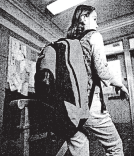
Doctors are concerned that looking cool could be hurting kids.
Here are some ideas to avoid injury.
Like many kids now heading back to school, I used
one of those fashionable single-strap, over-the-shoulder
bags to carry my books around when I was studying in
New York City. But at Dartmouth Medical School, my
[5] city bag turned out to be totally inadequate for lugging
heavy medical texts. I’d lose valuable minutes at the
start of a lecture rubbing an aching arm and shoulder
before I could start writing down what the prof said.
Taking a cue from classmates, I finally got a large, wide
[10] strapped bag with a third strap that wrapped around
the hips. It wasn’t chic but it did wonders for my sore
muscles — and note taking.
That was a first-hand lesson in how the wrong
backpack, or carrying one improperly, can lead to
[15] serious problems. According to the U.S. Consumer
Product Safety Commission, 5,900 kids were treated
at hospital emergency rooms, clinics and doctors’
offices last year for sprains and strains directly caused
by backpacks. Indeed, such injuries are so widespread
[20] that more than 70% of physicians surveyed by the
American Academy of Orthopedic Surgeons listed
backpacks as a potential clinical problem for children,
and 58% said they had treated patients for pain caused
by heavy backpacks.
[25] How to avoid such problems? Like my classmates,
you can choose bags that have wide, padded straps
and a belt. That will help transfer some of the weight
from the back and shoulders to the hips. You should also
tighten both straps firmly, so the pack rests about 5 cm above
[30] your waist. Also, remember to pack your bag with
the heaviest items closest to your back and to bend
both knees when you pick it up.
Have a question? You can e-mail Dr. Ian at ianmedical@aol.com.
Backpacs” (title) - a large bag carried on the back.
“strap” (l. 2) - a strip of leather, cloth or other flexible material.
“lugging” (l. 5) - carrying something with great effort.
“prof” (l. 8) - professor.
“sprains” (l. 18) - injuries.
“strains” (l. 18) - severe demands on physical strengh.
The adjective that is in the superlative form is
06