


![[Marketing] Questao Topo - deslogado](https://storage.estuda.com.br/banners/0_6b7ebee90b03af1c560c73bb8bcce34a_banner_deslogado_70_dias.png)
Questões de Inglês
19.971 Questões
Questão 17 182981
UEFS Caderno 1 2017/1TEXTO:

[1] According to a study published in the Journal of
Nutrition, the caffeine in coffee might offer not just a
momentary mental boost but also longer-term effects on
thinking skills.
[5] In the study, researchers compared scores on
various tests of thinking skills and memory with caffeine,
alcohol, and nutrient intake in 727 men and women. The
reason you get a quick wakeup call after chugging a
mug of coffee has to do with the way caffeine tricks your
[10] brain. Not only is caffeine a brain stimulant, but it also
blocks receptors for a chemical called adenosine, which
normally prevents the release of excitatory brain
chemicals. With adenosine out of the way, these
brain-sparking chemicals can flow more freely — giving
[15] you a surge of energy and potentially improving mental
performance and slowing age-related mental decline.
The study showed that people—particularly those
who were ages 70 and over—who took in more caffeine
scored better on tests of mental function, but not on
[20] memory tests or other measures of mental ability.
When it comes to alcohol, its effects on memory
and thinking skills may depend on how they are measured
and how much you’re drinking. In this study, moderate
alcohol use appeared to improve working memory and
[25] attention — especially in women and in those ages 70
and over. But those benefits could come at the expense
of declines in skills like executive function and global
thinking.
Excessive drinking, defined as more than two drinks
[30] a day for men or more than one a day for women, is
known to harm the brain. Over time, excessive drinking
can cause everything from short-term memory lapses to
more permanent problems.
The study also looked at the connection between
[35] diet and mental performance. People who ate foods with
plenty of healthful nutrients had better attention and
memory than participant with poorer diets. A healthy diet
was also linked to good thinking skills in women and
participants under age 70. In particular, foods that are
[40] part of the Mediterranean diet — fruits, vegetables, nuts,
fish, olive oil, and whole grains — show promise for
preserving memory and preventing Alzheimer’s and other
forms of dementia.
WATSON,Women’s health watch.Disponível em: . Acesso em:12 out. 2016.
The study says that alcohol has shown to
Questão 36 182525
UDESC Manhã 2017/2TEXT 3
Before the wall: life along the U.S. - Mexico border
President´s Trump executive order to begin the construction of a wall between the United States and Mexico has left many wondering what it will mean for them and the future.
For nearly 700 miles along the American border with Mexico, a wall already exists.
It passes through the silt deserts of Sonora, where cacti grow like organ pipes. Farther east, heavy steel X-frames cut through the flat miles of sun-bleached grass like battlefield markers. In Texas, the red-tinged beams that make up parts of the border fence are cold, hard and rough to the touch. In Tijuana, two fences – one old, the other more recent – plunge all the way into the ocean, where waves corrode the stanchioned metal.
The border spans 1,900 miles across four states – California, New Mexico, Arizona and Texas. Where a fence already stands, the surrounding dirt and grass tell the stories of those who try to cross it, those who patrol it and those who live next to it.
There are old cell phones between the beams. Wind-torn plastic bags with toothpaste and toothbrushes inside. Discarded clothing. Scattered sunflower seeds, spit out by Border Patrol agents sitting in their vehicles as they watch, and watch, and watch.
About 40 miles past Ciudad Juárez, the wall of metal mesh abruptly ends, like a half-finished thought. The remaining border is marked by the Rio Grande. But hundreds of miles in rural Texas, including Big Bend National Park, are unfenced and lack any man-made barriers or walls whatsoever.
by Azam Ahmed, Manny Fernandez and Paulina Villegas. Avaiable at: www.nytimes.com. (accessed on March 27th, 2017)
The Text talks about
Questão 34 182522
UDESC Manhã 2017/2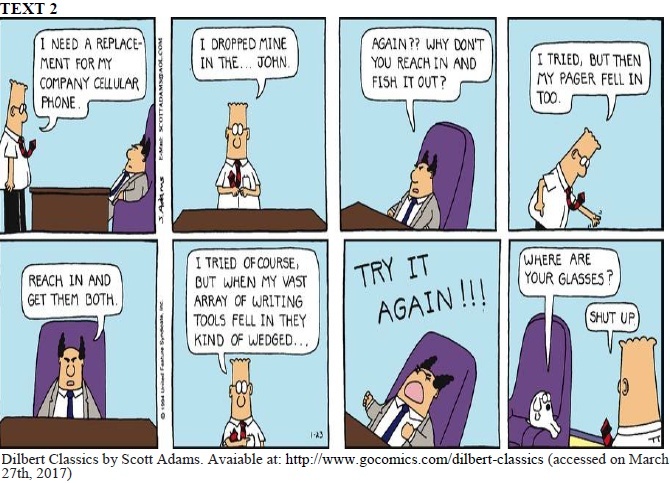
Mark the alternative which best represents his feelings at the very end.
Questão 32 182520
UDESC Manhã 2017/2
Answer the question, according to Text 2.
Mark the correct alternative.
Questão 31 182519
UDESC Manhã 2017/2TEXT 1
Fruit Juice, in Moderation, Not Tied to Obesity in Children
…………………….experts believe that drinking fruit juice may lead to obesity in children, but a new review has found that juice in moderation does not cause excess weight gain in children under 18.
Researchers pooled data……………… eight prospective observational studies of the association between regular 100 percent fruit juice consumption and weight gain. The analysis, published in Pediatrics, includes 34,470 boys and girls under 18.
The studies used something called the B.M.I. z score, …………………….statistically adjusts body mass index according to age. Changes in these scores of 0.25 to 0.50 are generally considered to put the child at risk for obesity.
After controlling for total energy intake, birth weight, ethnicity and other factors, a 6- to 8-ounce daily serving of 100 percent fruit juice was associated with a 0.087 unit average increase in B.M.I. z score in children 1 to 6 — equivalent to about 0.3 pounds. In those 7 to 18, there was no link ……………….. all between drinking fruit juice and weight gain.
The lead author, Dr. Brandon J. Auerbach, an acting instructor in medicine at the University of Washington, said that based ……………………. the current evidence, “consuming one daily serving of fruit juice is not associated with weight gain in children. So fruit juice in moderation, not more than a serving a day, is safe.”
By NICHOLAS BAKALAR. Avaiable at: www.nytimes.com/section/health. (accessed on March 27th, 2017)
Mark the question which can be answered by the Text 1.
Questão 29 182517
UDESC Manhã 2017/2TEXT 1
Fruit Juice, in Moderation, Not Tied to Obesity in Children
…………………….experts believe that drinking fruit juice may lead to obesity in children, but a new review has found that juice in moderation does not cause excess weight gain in children under 18.
Researchers pooled data……………… eight prospective observational studies of the association between regular 100 percent fruit juice consumption and weight gain. The analysis, published in Pediatrics, includes 34,470 boys and girls under 18.
The studies used something called the B.M.I. z score, …………………….statistically adjusts body mass index according to age. Changes in these scores of 0.25 to 0.50 are generally considered to put the child at risk for obesity.
After controlling for total energy intake, birth weight, ethnicity and other factors, a 6- to 8-ounce daily serving of 100 percent fruit juice was associated with a 0.087 unit average increase in B.M.I. z score in children 1 to 6 — equivalent to about 0.3 pounds. In those 7 to 18, there was no link ……………….. all between drinking fruit juice and weight gain.
The lead author, Dr. Brandon J. Auerbach, an acting instructor in medicine at the University of Washington, said that based ……………………. the current evidence, “consuming one daily serving of fruit juice is not associated with weight gain in children. So fruit juice in moderation, not more than a serving a day, is safe.”
By NICHOLAS BAKALAR. Avaiable at: www.nytimes.com/section/health. (accessed on March 27th, 2017)
Answer the question, according to Text 1.
Mark the correct alternative
06