


![[Marketing] Questao Topo - deslogado](https://storage.estuda.com.br/banners/0_6b7ebee90b03af1c560c73bb8bcce34a_banner_deslogado_70_dias.png)
Questões de Inglês
19.971 Questões
Questão 34 308861
FASA 1° Dia 2017/1Eastern Europe opposed to EU refugee plan
Ahead of the EU-Turkey summit, Chancellor Merkel of Germany continues to aim for a pan-European solution to the refugee crisis. But some Eastern EU states have rejected the agreement – they don’t want to accept any refugees.
Hungarian Prime Minister Viktor Orban still spearheads the Visegrad states’ battle against a common EU refugee policy. In his speech to the country on Hungary’s national holiday, two days before the EU summit, Orban reiterated his position on the refugee crisis. He said he would not accept a redistribution of migrants from Turkey to Europe. About two-thirds of the population now supports his tough stance on refugee policy. Orban wants to decide in a referendum whether the Hungarians agree to the EU allocation quotas.

No illusions about political agenda
Other eastern European countries share the same view, especially the Czech Republic and Slovakia. That is why Gerald Knaus, an Austrian expert on Eastern Europe, told DW in interview that he was concerned about the upcoming EU summit. There will be a limited European solution to the refugee crisis, said Knaus, head of the think tank European Stability Initiative (ESI). In particular, the Hungarian prime minister’s lobbying means that several countries have now adopted his policy.
“If Orban and the others stand on the edge and want to sabotage this because they have a different political vision of the future of refugee law, the future of Europe, then you can only remind yourself of this in the future and must not have illusions about the political agenda behind it; but that should not stop anyone”, said Knaus.
Romania hesitantly willing
Brussels is still hoping for a compromise. Some eastern EU countries, such as Romania and Bulgaria, do not want to support Orban’s position. However, their situation is different. Romania has not proven to be an El Dorado for refugees. The country does not belong to the Schengen area and the standard of living there is relatively low. Romania also is not on the standard Balkan route and not appealing as a potential transit country. Nevertheless, there are plans to boost border security, just in case the refugees themselves should look for new a detour on the way to Western Europe after other borders have been closed.
In September last year, Romania – just like the four Visegrad countries Poland, Hungary, Czech Republic and Slovakia – voiced its opposition to a mandatory refugee quota, but is not generally against receiving refugees. Romanian Prime Minister Dacian Ciolos would like the distribution mechanism to work on a voluntary basis, regardless of a state’s actual potential for accepting migrants and integrating them.
In early March, the first 15 refugees arrived in Romania via a “hotspot” in Greece. Overall, the country has promised to accept 6,351 refugees. This is not without controversy in the population. In a survey conducted last year, 75 percent of respondents were against the policy. On the other hand, the majority would agree to provide humanitarian assistance to war refugees from Syria.
Available at: http://www.dw.com/en/eastern-europeopposed-to-eu-refugee-plan/a-19121054. Accessed on: Sept. 18th, 2016 (Edited).
According to the text, Romania is:
Questão 32 308857
FASA 1° Dia 2017/1Eastern Europe opposed to EU refugee plan
Ahead of the EU-Turkey summit, Chancellor Merkel of Germany continues to aim for a pan-European solution to the refugee crisis. But some Eastern EU states have rejected the agreement – they don’t want to accept any refugees.
Hungarian Prime Minister Viktor Orban still spearheads the Visegrad states’ battle against a common EU refugee policy. In his speech to the country on Hungary’s national holiday, two days before the EU summit, Orban reiterated his position on the refugee crisis. He said he would not accept a redistribution of migrants from Turkey to Europe. About two-thirds of the population now supports his tough stance on refugee policy. Orban wants to decide in a referendum whether the Hungarians agree to the EU allocation quotas.
No illusions about political agenda
Other eastern European countries share the same view, especially the Czech Republic and Slovakia. That is why Gerald Knaus, an Austrian expert on Eastern Europe, told DW in interview that he was concerned about the upcoming EU summit. There will be a limited European solution to the refugee crisis, said Knaus, head of the think tank European Stability Initiative (ESI). In particular, the Hungarian prime minister’s lobbying means that several countries have now adopted his policy.
“If Orban and the others stand on the edge and want to sabotage this because they have a different political vision of the future of refugee law, the future of Europe, then you can only remind yourself of this in the future and must not have illusions about the political agenda behind it; but that should not stop anyone”, said Knaus.
Romania hesitantly willing
Brussels is still hoping for a compromise. Some eastern EU countries, such as Romania and Bulgaria, do not want to support Orban’s position. However, their situation is different. Romania has not proven to be an El Dorado for refugees. The country does not belong to the Schengen area and the standard of living there is relatively low. Romania also is not on the standard Balkan route and not appealing as a potential transit country. Nevertheless, there are plans to boost border security, just in case the refugees themselves should look for new a detour on the way to Western Europe after other borders have been closed.
In September last year, Romania – just like the four Visegrad countries Poland, Hungary, Czech Republic and Slovakia – voiced its opposition to a mandatory refugee quota, but is not generally against receiving refugees. Romanian Prime Minister Dacian Ciolos would like the distribution mechanism to work on a voluntary basis, regardless of a state’s actual potential for accepting migrants and integrating them.
In early March, the first 15 refugees arrived in Romania via a “hotspot” in Greece. Overall, the country has promised to accept 6,351 refugees. This is not without controversy in the population. In a survey conducted last year, 75 percent of respondents were against the policy. On the other hand, the majority would agree to provide humanitarian assistance to war refugees from Syria.
Available at: http://www.dw.com/en/eastern-europeopposed-to-eu-refugee-plan/a-19121054. Accessed on: Sept. 18th, 2016 (Edited).
The Hungarian Prime Minister declared that:
Questão 20 306461
FCM PB 2017/2TEXTO II
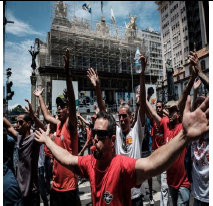
"Firefighters shouting slogans during a public servants’ demonstration against austerity measures in Rio de Janeiro in December.” (CreditYasuyoshi Chiba/Agence France- Presse — Getty Images)
Brazil’s Leaders Tout Austerity
Brazil’s sickly economy is hemorrhaging thousands of jobs a day, States are scrambling to pay police officers and teachers, and money for subsidized meals is in such short supply that one legislator suggested that the poor could “eat every other day.” Still, not everyone is suffering. Civil servants in the judicial branch are enjoying a 41 percent raise. Legislators here in São Paulo, Brazil’s largest city, voted to increase their own salaries by more than 26 percent. And Congress, which is preparing to cut pension benefits around the country, is now allowing its members to retire with lifelong pensions after just two years in office.
Brazil is struggling to pull out of its worst economic crisis in decades, and President Michel Temer says the country needs to curb public spending to do so. Yet, it did not help his dismal approval ratings when he hosted a lavish taxpayerfunded banquet to persuade members of Congress to support his budget cuts, with 300 guests eating shrimp and filet mignon. Outside such rarefied circles, Mr. Temer’s austerity measures are igniting a fierce debate over how the richest and most powerful Brazilians are protecting their wealth and privileges at a time when much of the country is enduring a harrowing economic decline.
economic decline.
“This government talks about austerity for everyone, but of course forces the costs on society’s most vulnerable people,” said Giovana Santos Pereira, 25, a schoolteacher. “It’s ridiculous to the point of being tragic.” Much of the ire revolves around the centerpiece of Mr. Temer’s austerity drive: his success in persuading the scandal-ridden Congress to impose a cap on federal spending for the next 20 years.
Mr. Temer, who rose to power last year after supporting the impeachment of his predecessor, Dilma Rousseff, says the cap, which would limit the growth in spending to the rate of inflation, is needed to scale back ballooning budget deficits. Investors have applauded the measure as a turning point for Latin America’s largest economy. But critics are lashing out at the spending cap, saying it could harm the poor for decades to come, especially in areas like education. Philip Alston, the United Nations special rapporteur on extreme poverty and human rights, said the spending cap placed Brazil “in a socially retrogressive category all of its own.”
The debate is all the more caustic because Mr. Temer’s government is resisting calls to raise taxes on wealthy Brazilians, who still enjoy what some economists describe as one of the most generous tax systems for the rich among major economies. For instance, Brazilians remain exempt from paying any taxes at all on dividends from stock holdings, and they can easily use loopholes to significantly lower taxes on other sources of income.
Economists at the government’s Institute of Applied
Economic Research said in a 2016 study that a 15 percent tax on dividends could generate nearly $17 billion in revenue a year, but such proposals have failed to gain traction in a government that has shifted to the right. “The system is engineered to perpetuate inequality, and Temer is doubling down on bets that Brazil needs Greek-style austerity,” said Pedro Paulo Zahluth Bastos, an economist at the Universidade de Campinas, drawing parallels between Brazil’s multiyear slowdown and Greece’s seemingly interminable economic crisis.
Mr. Temer has not been a popular president, and his approval ratings stand at just 10 percent. But his supporters point out that his leftist predecessor, Ms. Rousseff, sought her own austerity measures before her ouster last year, and that his government has promised to maintain some widely popular antipoverty programs expanded by her party years ago.
Mr. Temer’s government says it is reversing the freespending ways of previous governments. Brazil’s economy shrank about 4 percent in 2016, when its political class was consumed by infighting over the impeachment. But last month, the finance minister, Henrique Meirelles claimed, “the recession has ended.”
Some promising signs of a recovery may be emerging. Foreign investment has increased and, after performing poorly, Brazil’s stock market was one of the best performing in the world in 2016, creating a windfall for the relatively prosperous Brazilians who put money into equities. Mr. Temer is especially bullish, predicting that the economy will grow 3 percent next year. But, the conditions on the streets of cities around Brazil tell a different story, reflecting devilishly complex structural challenges as millions of Brazilians fall into poverty.
Given this scenario, the Brazilian States are facing crippling strikes by public employees over unpaid or inadequate salaries. In the State of Espírito Santo, in Southeast Brazil, a police strike last month produced an anarchic week marked by looting and a surge in homicides.
(Adapted from: https://www.nytimes.com/2017/03/03/world/americas)
According to the text, the austerity measures are:
Questão 17 306457
FCM PB 2017/2TEXTO II
"Firefighters shouting slogans during a public servants’ demonstration against austerity measures in Rio de Janeiro in December.” (CreditYasuyoshi Chiba/Agence France- Presse — Getty Images)
Brazil’s Leaders Tout Austerity
Brazil’s sickly economy is hemorrhaging thousands of jobs a day, States are scrambling to pay police officers and teachers, and money for subsidized meals is in such short supply that one legislator suggested that the poor could “eat every other day.” Still, not everyone is suffering. Civil servants in the judicial branch are enjoying a 41 percent raise. Legislators here in São Paulo, Brazil’s largest city, voted to increase their own salaries by more than 26 percent. And Congress, which is preparing to cut pension benefits around the country, is now allowing its members to retire with lifelong pensions after just two years in office.
Brazil is struggling to pull out of its worst economic crisis in decades, and President Michel Temer says the country needs to curb public spending to do so. Yet, it did not help his dismal approval ratings when he hosted a lavish taxpayerfunded banquet to persuade members of Congress to support his budget cuts, with 300 guests eating shrimp and filet mignon. Outside such rarefied circles, Mr. Temer’s austerity measures are igniting a fierce debate over how the richest and most powerful Brazilians are protecting their wealth and privileges at a time when much of the country is enduring a harrowing economic decline.
economic decline.
“This government talks about austerity for everyone, but of course forces the costs on society’s most vulnerable people,” said Giovana Santos Pereira, 25, a schoolteacher. “It’s ridiculous to the point of being tragic.” Much of the ire revolves around the centerpiece of Mr. Temer’s austerity drive: his success in persuading the scandal-ridden Congress to impose a cap on federal spending for the next 20 years.
Mr. Temer, who rose to power last year after supporting the impeachment of his predecessor, Dilma Rousseff, says the cap, which would limit the growth in spending to the rate of inflation, is needed to scale back ballooning budget deficits. Investors have applauded the measure as a turning point for Latin America’s largest economy. But critics are lashing out at the spending cap, saying it could harm the poor for decades to come, especially in areas like education. Philip Alston, the United Nations special rapporteur on extreme poverty and human rights, said the spending cap placed Brazil “in a socially retrogressive category all of its own.”
The debate is all the more caustic because Mr. Temer’s government is resisting calls to raise taxes on wealthy Brazilians, who still enjoy what some economists describe as one of the most generous tax systems for the rich among major economies. For instance, Brazilians remain exempt from paying any taxes at all on dividends from stock holdings, and they can easily use loopholes to significantly lower taxes on other sources of income.
Economists at the government’s Institute of Applied
Economic Research said in a 2016 study that a 15 percent tax on dividends could generate nearly $17 billion in revenue a year, but such proposals have failed to gain traction in a government that has shifted to the right. “The system is engineered to perpetuate inequality, and Temer is doubling down on bets that Brazil needs Greek-style austerity,” said Pedro Paulo Zahluth Bastos, an economist at the Universidade de Campinas, drawing parallels between Brazil’s multiyear slowdown and Greece’s seemingly interminable economic crisis.
Mr. Temer has not been a popular president, and his approval ratings stand at just 10 percent. But his supporters point out that his leftist predecessor, Ms. Rousseff, sought her own austerity measures before her ouster last year, and that his government has promised to maintain some widely popular antipoverty programs expanded by her party years ago.
Mr. Temer’s government says it is reversing the freespending ways of previous governments. Brazil’s economy shrank about 4 percent in 2016, when its political class was consumed by infighting over the impeachment. But last month, the finance minister, Henrique Meirelles claimed, “the recession has ended.”
Some promising signs of a recovery may be emerging. Foreign investment has increased and, after performing poorly, Brazil’s stock market was one of the best performing in the world in 2016, creating a windfall for the relatively prosperous Brazilians who put money into equities. Mr. Temer is especially bullish, predicting that the economy will grow 3 percent next year. But, the conditions on the streets of cities around Brazil tell a different story, reflecting devilishly complex structural challenges as millions of Brazilians fall into poverty.
Given this scenario, the Brazilian States are facing crippling strikes by public employees over unpaid or inadequate salaries. In the State of Espírito Santo, in Southeast Brazil, a police strike last month produced an anarchic week marked by looting and a surge in homicides.
(Adapted from: https://www.nytimes.com/2017/03/03/world/americas)
Analyze the following verbs obtained from the text and give their CORRECT classification.
Questão 16 306452
FCM PB 2017/2TEXTO II
"Firefighters shouting slogans during a public servants’ demonstration against austerity measures in Rio de Janeiro in December.” (CreditYasuyoshi Chiba/Agence France- Presse — Getty Images)
Brazil’s Leaders Tout Austerity
Brazil’s sickly economy is hemorrhaging thousands of jobs a day, States are scrambling to pay police officers and teachers, and money for subsidized meals is in such short supply that one legislator suggested that the poor could “eat every other day.” Still, not everyone is suffering. Civil servants in the judicial branch are enjoying a 41 percent raise. Legislators here in São Paulo, Brazil’s largest city, voted to increase their own salaries by more than 26 percent. And Congress, which is preparing to cut pension benefits around the country, is now allowing its members to retire with lifelong pensions after just two years in office.
Brazil is struggling to pull out of its worst economic crisis in decades, and President Michel Temer says the country needs to curb public spending to do so. Yet, it did not help his dismal approval ratings when he hosted a lavish taxpayerfunded banquet to persuade members of Congress to support his budget cuts, with 300 guests eating shrimp and filet mignon. Outside such rarefied circles, Mr. Temer’s austerity measures are igniting a fierce debate over how the richest and most powerful Brazilians are protecting their wealth and privileges at a time when much of the country is enduring a harrowing economic decline.
economic decline.
“This government talks about austerity for everyone, but of course forces the costs on society’s most vulnerable people,” said Giovana Santos Pereira, 25, a schoolteacher. “It’s ridiculous to the point of being tragic.” Much of the ire revolves around the centerpiece of Mr. Temer’s austerity drive: his success in persuading the scandal-ridden Congress to impose a cap on federal spending for the next 20 years.
Mr. Temer, who rose to power last year after supporting the impeachment of his predecessor, Dilma Rousseff, says the cap, which would limit the growth in spending to the rate of inflation, is needed to scale back ballooning budget deficits. Investors have applauded the measure as a turning point for Latin America’s largest economy. But critics are lashing out at the spending cap, saying it could harm the poor for decades to come, especially in areas like education. Philip Alston, the United Nations special rapporteur on extreme poverty and human rights, said the spending cap placed Brazil “in a socially retrogressive category all of its own.”
The debate is all the more caustic because Mr. Temer’s government is resisting calls to raise taxes on wealthy Brazilians, who still enjoy what some economists describe as one of the most generous tax systems for the rich among major economies. For instance, Brazilians remain exempt from paying any taxes at all on dividends from stock holdings, and they can easily use loopholes to significantly lower taxes on other sources of income.
Economists at the government’s Institute of Applied
Economic Research said in a 2016 study that a 15 percent tax on dividends could generate nearly $17 billion in revenue a year, but such proposals have failed to gain traction in a government that has shifted to the right. “The system is engineered to perpetuate inequality, and Temer is doubling down on bets that Brazil needs Greek-style austerity,” said Pedro Paulo Zahluth Bastos, an economist at the Universidade de Campinas, drawing parallels between Brazil’s multiyear slowdown and Greece’s seemingly interminable economic crisis.
Mr. Temer has not been a popular president, and his approval ratings stand at just 10 percent. But his supporters point out that his leftist predecessor, Ms. Rousseff, sought her own austerity measures before her ouster last year, and that his government has promised to maintain some widely popular antipoverty programs expanded by her party years ago.
Mr. Temer’s government says it is reversing the freespending ways of previous governments. Brazil’s economy shrank about 4 percent in 2016, when its political class was consumed by infighting over the impeachment. But last month, the finance minister, Henrique Meirelles claimed, “the recession has ended.”
Some promising signs of a recovery may be emerging. Foreign investment has increased and, after performing poorly, Brazil’s stock market was one of the best performing in the world in 2016, creating a windfall for the relatively prosperous Brazilians who put money into equities. Mr. Temer is especially bullish, predicting that the economy will grow 3 percent next year. But, the conditions on the streets of cities around Brazil tell a different story, reflecting devilishly complex structural challenges as millions of Brazilians fall into poverty.
Given this scenario, the Brazilian States are facing crippling strikes by public employees over unpaid or inadequate salaries. In the State of Espírito Santo, in Southeast Brazil, a police strike last month produced an anarchic week marked by looting and a surge in homicides.
(Adapted from: https://www.nytimes.com/2017/03/03/world/americas)
By addressing the expression “eat every other day” (1st paragraph), what have the legislator suggested with this expression?
Questão 13 306447
FCM PB 2017/2TEXT I

"A new crop of potential antibiotics may soon help fighting antibiotic-resistant infections, such as this batch of methicillinresistant Staphylococcus aureus bacteria.”
"Antibiotics have been taking it on the chin lately. Not only has resistance to the medications been growing, but also drug companies have been dropping antibiotic research programs because the drugs are difficult and expensive to make. Now, help is on the way. Researchers report today that they’ve found a way to churn out new members of one of the most widely used classes of antibiotics, called macrolides. The work could lead to new weapons against antibiotic-resistant infections, and possibly save millions of lives.
Macrolides, drugs that include erythromycin and azithromycin, were first developed in the 1950s. Since then they’ve become a safeguard against bacterial and fungal infections. Chemically, macrolides are giant rings containing 14 to 16 carbon atoms, with one or more sugar appendages dangling off the side. Bacteria synthesize them to fight off their neighbors. Yet, bacteria didn’t evolve to make macrolides good drugs in people. So, medicinal chemists — the group of researchers that actually build new drugs — start with the natural versions and tweak their bonds one at a time in an effort to make them safer and more effective. But, in most cases, it’s impossible to confine the changes to just one bond on a large molecule. When multiple bonds react, the result is an unwanted broad mixture of end products, none of which contain just the one specific change desired for making a better drug.
To solve that problem, Harvard University chemist Andrew Myers and colleagues adapted a divide-and-conquer strategy that they had applied to tetracycline antibiotics back in 2005. They started with three basic macrolide ring structures and broke each one down into eight molecular “modules.” They then carefully mapped out reactions needed to put the pieces back together. For two such linkers, they even invented new chemical reactions to forge the bonds. This allowed them to tinker with the modules individually, and then reassemble them. By repeating the strategy over and over, they forged more than 300 entirely new macrolides.
When given to a panel of bacterial lab cultures, several of these compounds showed potent antibiotic activity against antibiotic-resistant microbes, including methicillin resistant Staphylococcus aureus and vancomycin-resistant Enterococcus, the team reports online today in Nature. Perhaps equally important, Myers says, is that all the reactions used for the assembly produce high yields of the final products. That’s essential, he notes, because bacteria don’t produce the starting material for the new compounds. So, if any of them proves a valuable medicine, chemists will be able to synthesize large quantities of it cheaply from scratch.
“This is a great example of beautiful chemistry that will have a tangible societal benefit,” says Phil Baran, a synthetic organic chemist at the Scripps Research Institute in San Diego, California.”
(Adapted from: https://www.sciencemag.org/news/2016/05/new-way-makepowerful- antibiotics)
Choose the CORRECT proposition about the text.
06