


![[Marketing] Questao Topo - deslogado](https://storage.estuda.com.br/banners/0_6b7ebee90b03af1c560c73bb8bcce34a_banner_deslogado_70_dias.png)
Questões de Inglês
19.971 Questões
Questão 13 485825
FAG Demais Cursos 2017/1Text
Technology plays a key role in teenage romance from initial encounters to eventual break-ups, says a US study.
Teenagers rarely meet online but do use technology for flirting, asking out, meeting up and parting, American think tank, the Pew Research Center, found. A survey of 1,060 US teenagers aged 13 to 17 revealed that technology brings them closer but also breeds jealousy. "Digital platforms are powerful tools for teens," said Amanda Lenhart, lead author of the report from Pew. "But even as teens enjoy greater closeness with partners and a chance to display their relationships for others to see, mobile and social media can also be tools for jealousy, meddling and even troubling behaviour."
Digital romance, broken down
Of the 1,060 teenagers surveyed: • 35% said they were currently dating and 59% of that group said technology made them feel closer to their partner • For boys who were dating, 65% said social media made them more connected to a significant other while it was 52% for girls • 27% of dating teenagers thought social media made them feel jealous or insecure in relationships • 50% of all teens surveyed, dating or not, said they had indicated interest by friending someone on Facebook or other social media and 47% expressed attraction by likes and comments • Texting is king - 92% of teens who were dating said they texted a partner, assuming the partner would check in with "great regularity" • Jealousy happens, but not as much as flirting does - 11% of teenage daters reported accessing a partner's online accounts and 16% reported having a partner asking them to de-friend someone What gets discussed during all those frequent social media enabled check-ins? According to the survey, it is mostly "funny stuff" followed by "things you're thinking about" as well as other information such as where they are and what their friends have been doing. And forget having to meet up to resolve a conflict - 48% of dating teenagers said that could be done by texting or talking online. Online tools, with their accessibility and ease of use, also showed some signs of giving this group relationship anxiety. Females are more likely to be subject to unwanted flirting and 25% of teenagers surveyed said they have blocked or unfriended someone because of uncomfortable flirting. And 15% of teenage daters said a partner had used the internet to pressure them into unwanted sexual activity.
'More than emojis'
Nearly half the respondents admitted to concentrating on their phone ahead of their partner when together with 43% of dating teens saying that had happened to them. "I don't think this survey reveals much that is surprising. But it is affirming. Humans are social animals and we build tools to connect with each other,"wrote Julie Beck, an associate editor at The Atlantic news site, of the survey's findings. "It's not all heart emojis all the time, no, but the tools that facilitate relationships facilitate all aspects of them, good and bad. "Connecting with others is scary, hard, sometimes dangerous, but usually, hopefully, good. The teens get it."
(Fonte: http://www.bbc.com/news/technology-34416989.)
De acordo com o texto, é CORRETO afirmar:
Questão 4 480376
FMO 1° Dia 2017/2Read the text below and answer the following question based on it.
Could a placebo help heal a broken heart?
The placebo effect is an amazing phenomenon. As we have previously reported, placebos can help with everything from losing weight to improving your vision. And, according to this study, they may even help mend a broken heart. Here, researchers recruited participants who had been dumped in the last six months, and gave them a saline nose-spray that they claimed either was “effective in reducing emotional pain” (the placebo group) or a routine part of fMRI (Functional Magnetic Resonance Imaging) imaging (the control group). Next, the researchers conducted fMRI imaging of the subjects’ brains while showing them photos of their ex-boyfriend/girlfriend, and asking the subjects to recall their breakups. The result? Subjects in the placebo nose spray group experienced less social pain when remembering their exes compared with those in the control. Let’s just hope those participants were well compensated!
Adaptado de: http://blogs.discovermagazine.com/seriouslyscience/2017/05/04/c ould-a-placebo-help-heal-a-broken-heart/#.WRNtsdLyvIU Acessado em 7 de maio de 2017.
The research project has shown that
Questão 19 479433
UNEB Medicina 2017/1TEXTO:
All for one and one for all is what we all should be.
But instead we go and fight each other.
Now, that wasn’t meant to be.
You know, the sun is there to light the day.
[5] The night is lit by the moon.
If we don’t come together, my brother, it all can end
[very soon.
It’s your world now.
The future is plain to see.
(Sing it, yeah. Sing it, yeah, yeah, yeah.).
[10] Give love right now.
We need the harmony.
Disponível em: jackson-five>. Acesso em: 19 mar. 2017.
In the line “But instead we go and fight each other.” (v. 2), the song writer criticizes people’s
Questão 45 473687
IFRS Superior 2017/2De acordo com o cartum abaixo, o dilema do consumidor é
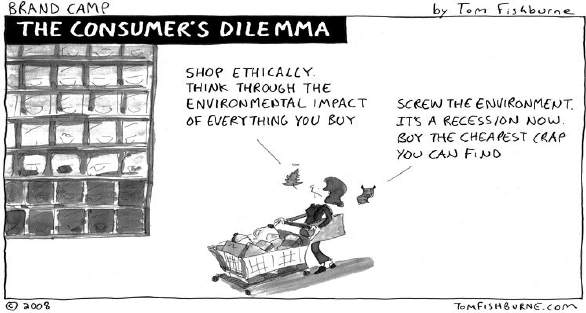
Source: <http://www.collings.co.za/2008/06/>.
Acessed on September 1st, 2016.
Questão 41 473669
IFRS Superior 2017/2The role of consumerism in climate change
[1] Money doesn’t buy happiness. Neither does materialism: research shows that people who place
[2] a high value on wealth, status, and stuff are more depressed and anxious and less sociable than those
[3] who do not. Now new research shows that materialism is not just a personal problem. It’s also
[4] environmental.
[5] A study published in the Journal of Industrial Ecology shows that the stuff we consume — from
[6] food to knick-knacks — is responsible for up to 60 percent of global greenhouse gas emissions and
[7] between 50 and 80 percent of total land, material, and water use. “We all like to put the blame on
[8] someone else, the government, or businesses, but between 60-80 percent of the impacts on the planet
[9] come from household consumption. If we change our consumption habits, this would have a drastic
[10] effect on our environmental footprint as well,” Diana Ivanova, a PhD candidate at the Norwegian
[11] University of Science and Technology and lead author on the study, said in a press release. According
[12] to the study, about four-fifths of the environmental impact of consumerism comes not from direct
[13] behaviors like driving cars or taking long showers, but rather from sources further down our products’
[14] supply chains. The amount of water that goes into a hamburger or frozen pizza, for example, proved
[15] much more significant than showering and dish washing habits.
[16] To figure this all out, Ivanova and her colleagues used economic data from most of the world
[17] and looked at different product sectors, including supply chain information.They found
[18] that consumerism was much higher in rich countries than in poor countries (surprise!) and that those
[19] with the highest rates of consumerism had up to 5.5 times the environmental impact as the world
[20] average. The U.S., they reported, had the highest per capita emissions with 18.6 tonnes CO2
[21] equivalent (“CO2 equivalent” is a metric that rolls multiple types greenhouse gas emissions into one).
[22] Luxembourg had 18.5 tonnes, and Australia came in third with 17.7 tonnes. The world average, for
[23] comparison, was 3.4 tonnes, and China had just 1.8 tonnes.
[24] So if you’re like me and occasionally use the individual-action-doesn’t-matter rationale, it’s time
[25] to face the music: Consumerism is killing the planet (and our souls).
Adapted from:< http://www.psychologicalscience.org/index.php/news/releases/consumerism-and-its-antisocial-effects-can-beturned-
onor-off.html> and < http://grist.org/living/consumerism-plays-a-huge-role-in-climate-change/>
Acessed on September 1st, 2016.
O principal objetivo do autor do texto é
Questão 44 472293
IFRS Superior 2017/1[1] The ideas began with what seemed to be a minor difference of opinion between John and me on
[2] a matter of small importance: how much one should maintain one's own motorcycle. It seems natural
[3] and normal to me to make use of the small tool kits and instruction booklets supplied with each
[4] machine, and keep it tuned and adjusted myself. John demurs. He prefers to let a competent mechanic
[5] take care of these things so that they are done right. Neither viewpoint is unusual, and this minor
[6] difference would never have become magnified if we didn't spend so much time riding together and
[7] sitting in country roadhouses drinking beer and talking about whatever comes to mind. What comes to
[8] mind, usually, is whatever we've been thinking about in the half hour or forty-five minutes since we last
[9] talked to each other. When it's roads or weather or people or old memories or what's in the newpapers,
[10] the conversation just naturally builds pleasantly. But whenever the performance of the machines has been
[11] on my mind and gets into the conversation, the building stops. The conversation no longer moves
[12] forward. There is a silence and a break in the continuity. It is as though two old friends, a Catholic and
[13] Protestant, were sitting drinking beer, enjoying life, and the subject of birth control somehow came up.
[14] Big freeze-out.
[15] (…)
[16] When you're talking birth control, what blocks it and freezes it out is that it's not a matter of more
[17] or fewer babies being argued. That's just on the surface. What's underneath is a conflict of faith, of faith
[18] in empirical social planning versus faith in the authority of God as revealed by the teachings of the
[19] Catholic Church. You can prove the practicality of planned parenthood till you get tired of listening to
[20] yourself and it's going to go nowhere because your antagonist isn't buying the assumption that
[21] anything socially practical is good per se. Goodness for him has other sources which he values as
[22] much as or more than social practicality.
(Excerpt from Zen and the Art of Motorcycle Maintenance, By Robert M. Pirsig. New York: Harpertorch, 1974)
O substantivo “matter”, com o sentido que apresenta no trecho “on a matter of small importance” (l. 01-02), tem como sinônimo o substantivo.
06