


![[Marketing] Questao Topo - deslogado](https://storage.estuda.com.br/banners/0_6b7ebee90b03af1c560c73bb8bcce34a_banner_deslogado_70_dias.png)
Questões de Inglês
19.971 Questões
Questão 20 184539
ITA 2018AUGMENTATION OF BRAIN FUNCTION: FACTS, FICTION AND CONTROVERSY
[1] Augmentation of brain function is no longer just a theme of science fiction. __________(I) advances in
neural sciences, it has become a matter of reality that a person may consider at some point in life, for example
as a treatment of a neurodegenerative disease. Currently, several approaches offer enhancements for sensory,
motor and cognitive brain functions,__________(II) for mood and emotions. Such enhancements may be
[5] achieved pharmacologically, using brain implants for recordings, stimulation and drug delivery,__________(III)
employing brain-machine interfaces, or even by ablation of certain brain areas.
In this Research Topic, we welcome papers critically evaluating the existing methods of brain
augmentation, introducing new approaches and probing particular parts of brain circuitry and particular
neuronal mechanisms as candidates for an enhancement. We welcome scientists from different fields: from
[10] neuroscience of microcircuits to systems neuroscience of large-scale networks and neural engineering. The
work can be experimental or computational. Reviews and papers on philosophical and ethical issues are
__________(IV) welcome.
While the scope of possible relevant topics is broad, the authors are encouraged to clearly indicate how
their studies address the announced theme of brain augmentation.
[15]
Important Note: All contributions to this Research Topic must be within the scope of the section and
journal to which they are submitted, as defined in their mission statements. Frontiers reserves the right to guide
an out-of-scope manuscript to a more suitable section or journal at any stage of peer review.
Fonte: . Acesso em: 15 jul. 2017.
Marque a opção que indica a que it se refere no seguinte excerto: "...it has become a matter of reality…" (linha 2).
Questão 17 184535
ITA 2018AUGMENTATION OF BRAIN FUNCTION: FACTS, FICTION AND CONTROVERSY
[1] Augmentation of brain function is no longer just a theme of science fiction. __________(I) advances in
neural sciences, it has become a matter of reality that a person may consider at some point in life, for example
as a treatment of a neurodegenerative disease. Currently, several approaches offer enhancements for sensory,
motor and cognitive brain functions,__________(II) for mood and emotions. Such enhancements may be
[5] achieved pharmacologically, using brain implants for recordings, stimulation and drug delivery,__________(III)
employing brain-machine interfaces, or even by ablation of certain brain areas.
In this Research Topic, we welcome papers critically evaluating the existing methods of brain
augmentation, introducing new approaches and probing particular parts of brain circuitry and particular
neuronal mechanisms as candidates for an enhancement. We welcome scientists from different fields: from
[10] neuroscience of microcircuits to systems neuroscience of large-scale networks and neural engineering. The
work can be experimental or computational. Reviews and papers on philosophical and ethical issues are
__________(IV) welcome.
While the scope of possible relevant topics is broad, the authors are encouraged to clearly indicate how
their studies address the announced theme of brain augmentation.
[15]
Important Note: All contributions to this Research Topic must be within the scope of the section and
journal to which they are submitted, as defined in their mission statements. Frontiers reserves the right to guide
an out-of-scope manuscript to a more suitable section or journal at any stage of peer review.
Fonte: . Acesso em: 15 jul. 2017.
O texto é um(a):
Questão 34 182987
UDESC Manhã 2018/1TEXT 2

I have a confession. I’m addicted to reality TV. I can’t get enough of it.
Very soon the new series of ITV’s Love Island will be starting and I’m literally counting down the days until it’s on my TV screen. It’s a show that sends single people abroad to live in a luxurious villa in the sun. The audience at home then watches their highs and lows, their arguments and how their relationships and friendships form and fall apart.
Love Island is just the tip of a huge reality TV iceberg. Other popular British programmes (which I also love) include I’m a Celebrity ... Get me Out of Here!, Big Brother and Geordie Shore. All these shows have something in common: people seem to either love them or hate them.
Perhaps we love them so much because they actually use real people instead of characters. Series and films with actors are great to watch but they aren’t real and we’re aware of that. With reality TV we can become more invested and more interested because the ‘characters’ are real and (usually) not acting.
Maybe we love reality TV because the people featured more often than not show the extremes of our society. Shows featuring ‘normal’ people or non-celebrities often include people with intense personalities who are bound to clash. Big Brother, which follows the lives of people living in a house together away from the outside world, always includes contestants with a range of personalities. It can be fascinating for us viewers to watch real people who perhaps wouldn’t usually interact with each other as they try to live together.
However, reality TV isn’t popular with everyone. Some people consider it sad to watch it. I’ve often heard people say that if you watch reality TV, it’s a sign that your own life is boring. Why watch someone else’s life when you have your own to live? Why would you want to sit at home and watch someone else arguing about silly things on the TV?
Some people don’t like reality TV because they believe it doesn’t show true reality. The people in these programmes are regularly accused of acting and you often see a phrase flash up somewhere during the opening or closing credits informing that parts are scripted or set up. Viewers can feel cheated that the ‘reality’ they are watching isn’t completely real after all.
Whether you love or hate reality TV, it cannot be denied that this genre has increased in popularity over time, and while I understand it can be set up sometimes, I’m still so excited for Love Island to be back on our screens!
(Accessed on August 14th, 2017) http://learnenglishteens.britishcouncil.org/magazine By Megan Blogger
Mark the question which can be answered by the Text.
Questão 33 182986
UDESC Manhã 2018/1TEXT 2

I have a confession. I’m addicted to reality TV. I can’t get enough of it.
Very soon the new series of ITV’s Love Island will be starting and I’m literally counting down the days until it’s on my TV screen. It’s a show that sends single people abroad to live in a luxurious villa in the sun. The audience at home then watches their highs and lows, their arguments and how their relationships and friendships form and fall apart.
Love Island is just the tip of a huge reality TV iceberg. Other popular British programmes (which I also love) include I’m a Celebrity ... Get me Out of Here!, Big Brother and Geordie Shore. All these shows have something in common: people seem to either love them or hate them.
Perhaps we love them so much because they actually use real people instead of characters. Series and films with actors are great to watch but they aren’t real and we’re aware of that. With reality TV we can become more invested and more interested because the ‘characters’ are real and (usually) not acting.
Maybe we love reality TV because the people featured more often than not show the extremes of our society. Shows featuring ‘normal’ people or non-celebrities often include people with intense personalities who are bound to clash. Big Brother, which follows the lives of people living in a house together away from the outside world, always includes contestants with a range of personalities. It can be fascinating for us viewers to watch real people who perhaps wouldn’t usually interact with each other as they try to live together.
However, reality TV isn’t popular with everyone. Some people consider it sad to watch it. I’ve often heard people say that if you watch reality TV, it’s a sign that your own life is boring. Why watch someone else’s life when you have your own to live? Why would you want to sit at home and watch someone else arguing about silly things on the TV?
Some people don’t like reality TV because they believe it doesn’t show true reality. The people in these programmes are regularly accused of acting and you often see a phrase flash up somewhere during the opening or closing credits informing that parts are scripted or set up. Viewers can feel cheated that the ‘reality’ they are watching isn’t completely real after all.
Whether you love or hate reality TV, it cannot be denied that this genre has increased in popularity over time, and while I understand it can be set up sometimes, I’m still so excited for Love Island to be back on our screens!
(Accessed on August 14th, 2017) http://learnenglishteens.britishcouncil.org/magazine By Megan Blogger
The Text says that:
Questão 31 182982
UDESC Manhã 2018/1TEXT 1
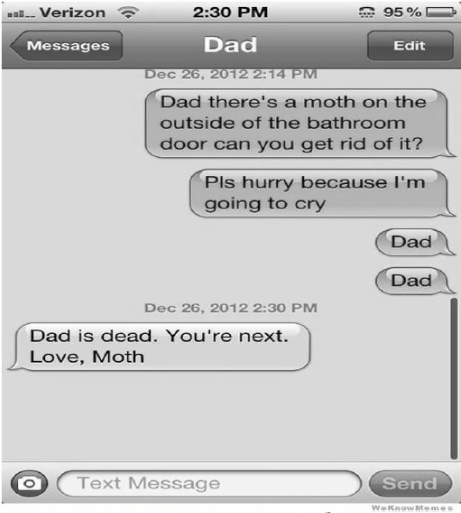
www.buzzfeed.com/awesomer (Acessed on August 14th, 2017
Mark the right alternative according to the use of the words in the text
Questão 29 179677
FATEC 2018/1Technology brought us fake news — and it will help us kill it
“Fake news” - websites disseminating news stories that are false but are believed to be true – was a major feature of the U.S. election season. Some observers believe that it determined the outcome of the election, although there is no way to definitively ascertain its effect on voting.
Fake news is news that affects the digital universe profoundly. Fake news grew because of the ease of creating and disseminating websites and stories that look and read as credible as real news sites (at least to many people). It is disseminated on social media platforms just because dissemination of information without vetting has always been a feature of those platforms. This was designed tofacilitate communication - no one removes a negative comment about a restaurant on Facebook.
On the positive side, this means that everyone’s opinion can be disseminated. The awareness of fake news, though, reveals a downside – or perhaps a loophole – of the freedom to post. And fake news may beget1 fake news. Facebook is not the only media company to be an inadvertent host for fake news, but it is by far the largest, with roughly 2 billion users each month.
Forbes indicates that the fallout2 from fake news during the election cycle may cause advertisers topull back from Facebook, as it is less “brand safe” than formerly. If unchecked, fake news could impact the perceived credibility of online sites where fake news runs. Since the election, Facebook has announced plans to refine and increase automated detection of fake news and to make reporting of suspected stories easier for Facebook users. It has also indicated that the current ad system will be changed, to interfere with fake news sites receiving revenue from Facebook.
https://tinyurl.com/y8jfq2t4 Acesso em: 07.11.2017. Adaptado.
Glossáriobeget1: gerar, criar, produzir.
fallout 2: efeitos negativos.
A palavra unchecked, presente no quarto parágrafo, é formada por meio da adição do prefixo un- ao termo checked.
A alternativa que apresenta uma palavra gramaticalmente correta e formada pelo processo de prefixação, tal como unchecked, é
06