


![[Marketing] Questao Topo - deslogado](https://storage.estuda.com.br/banners/0_6b7ebee90b03af1c560c73bb8bcce34a_banner_deslogado_70_dias.png)
Questões de Inglês
19.971 Questões
Questão 49 275127
UniCesumar Medicina 2018A Tale of Two Epidemics - HCV Treatment among Native Americans and Veterans
Brigg Reilley, M.P.H., and Jessica Leston, M.P.H.
In light of ongoing debates about health care budgets and rising drug prices, a current public health crisis can provide useful insights. For patients who get their health care through two separate federal agencies, the hepatitis C virus (HCV) epidemic is unfolding in vastly different ways. In recent years, the Department of Veterans Affairs (VA) health care system has mounted a response to HCV that should be the envy of any health system, public or private  , the Indian Health Service (IHS), an agency that serves American Indians and Alaska Natives, is struggling to meet the needs of its patients with HCV.
Hepatitis C is a chronic viral infection that affects an estimated 3.5 million Americans. The majority of these people were exposed to the virus decades ago, and many of them still don’t know they are infected, since HCV often remains asymptomatic for many years as it silently damages the liver. Risk factors for HCV infection include injection-drug use and historical medical exposures (such as through blood transfusion prior to 1996). The virus is the driving force behind increasing rates of liver cancer in the United States, and it kills more Americans than 60 other notifiable infectious diseases, including HIV, combined. In recent years, breakthroughs have resulted in medications that can reliably cure HCV, often by means of a single pill taken once a day for just 12 weeks. These new medications allow primary care providers to take an active role in the elimination of HCV infection. Now the biggest barrier is cost: the retail price of each pill is more than $1,000.
(Adapted from: New England Journal of Medicine, August 31, 2017)
A lacuna I no texto é preenchida por
Questão 48 275124
UniCesumar Medicina 2018Parental mental illness is a family matter
A family-focused approach enables early identification and intervention to prevent mental illness in children and their families
Since we first wrote in the Medical Journal of Australia - MJA - about children of parents with mental illness in 1995, there have been substantial developments in our knowledge of, and responses to, these families. At that time, prevalence rates for children living with a parent with mental illness were unknown, and there was minimal identification of the needs of these children and their parents, with little research evidence on which to base interventions. This article contributes to a growing evidence base. Prevalence rates are now known, and the impact on children of parental mental illness is well recognised, as is the impact of parenting on mental illness symptoms.
The role of general practitioners is pivotal as a first point of contact for potentially affected children and their parents and families. Effective multidisciplinary relationships between GPs and community and mental health practitioners are essential. These relationships are an important component of interventions for pregnant women with severe mental illness, may involve clinical and community-based services, and may begin during pregnancy or earlier. A multidisciplinary approach at this point is an opportunity to assess the interrelationship between impending parenting responsibility and mental illness.
While assessment of risk and protective factors is advisable for children in all age groups, the developmental vulnerability of infants, toddlers and preschool children makes it a priority. As well as physical health and psychosocial functioning, assessment of the relationship between young children and their parents may lead to an intervention that enhances parents’ capacity to feel more secure in their role and enjoy their young children. This may be an individual or group intervention. Groups for parents with mental illness offer a safe environment for them to become more confident as parents, and the Positive Parenting Program has been enhanced for delivery to parents with mental illness, and has been shown to reduce the number of dysfunctional parenting strategies.
A parent’s mental illness also impacts severely on adolescents. This too has only recently begun to receive serious attention. The advent of more accessible mental health services for young people may bring this issue more strongly into focus.
Intervention programs for children often include psychoeducation, which is a core component of family-intervention programs for families where a parent has depression. Knowledge of mental health is also important in the context of goal setting for children and parents when making family care plans.
Until recently, fathers with mental illness have been overlooked, but practitioners in health and mental health services can, with positive effect, ask fathers about their parenting role, and the degree to which it may be affected by their mental illness. Grandparents who are primary care providers for their grandchildren have also been overlooked. This role can affect their physical and mental health, and social and financial status.
(Adapted from: www.mja.com.au)
No texto,
Questão 19 269495
Unit-AL 2018TEXTO:
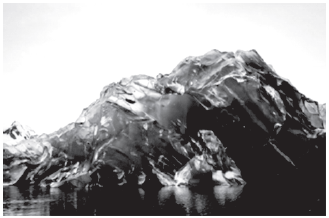
While on vacation with his family, designer and
filmmaker Alex Cornell captured the exquisite beauty of
the underbelly of an iceberg. Last month, Cornell traveled
with his mother and sister on a National Geographic
[5] expedition in Antarctica. “A landscape peppered with
icebergs is a special one indeed,” he wrote to The
Washington Post. “I think the most overwhelming thing
about them is their scale. … The thought of ice towering
over you is pretty remarkable.” As impressive as icebergs
[10] are, many of them look the same. But when
Cornell reached Ciera Cove, he saw something
different — an iceberg of a deep, blue color: “I didn’t know
what I was looking at — after all, I was still acclimating
to the typical icebergs. The naturalist on-board was
[15] thankfully very quick to explain to us how lucky we were
to spot such an unusual looking specimen. His
excitement quickly translated to the rest of us.”
He explained that glacial ice becomes blue when it
becomes very dense: “Years of compression gradually
[20] make the ice denser over time, forcing out the tiny air
pockets between crystals. When glacier ice becomes
extremely dense, the ice absorbs a small amount of red
light, leaving a bluish tint in the reflected light, which is
what we see. When glacier ice is white, that usually
[25] means that there are many tiny air bubbles still in the
ice.” Cornell believes the iceberg flipped over recently due
to the lack of snow on top of it. It’s not a rare occurrence,
but it is indeed a beautiful one. “I took a substantial amount
of photos as we made our way around, and I’m glad I
[30] did,” he said.
KIRKPATRICK, Nick . Disponível em: . Acesso em: 12 out. 2017. Adaptado.
Fill in the parentheses with T (True) or F (False).
Glacial ice has a deep blue color when
( ) it is not closely compacted.
( ) it is free of air bubbles.
( ) light can penetrate the ice.
( ) it is filled with minuscule air bubbles.
The correct sequence, from top to bottom, is
Questão 18 269493
Unit-AL 2018TEXTO:
While on vacation with his family, designer and
filmmaker Alex Cornell captured the exquisite beauty of
the underbelly of an iceberg. Last month, Cornell traveled
with his mother and sister on a National Geographic
[5] expedition in Antarctica. “A landscape peppered with
icebergs is a special one indeed,” he wrote to The
Washington Post. “I think the most overwhelming thing
about them is their scale. … The thought of ice towering
over you is pretty remarkable.” As impressive as icebergs
[10] are, many of them look the same. But when
Cornell reached Ciera Cove, he saw something
different — an iceberg of a deep, blue color: “I didn’t know
what I was looking at — after all, I was still acclimating
to the typical icebergs. The naturalist on-board was
[15] thankfully very quick to explain to us how lucky we were
to spot such an unusual looking specimen. His
excitement quickly translated to the rest of us.”
He explained that glacial ice becomes blue when it
becomes very dense: “Years of compression gradually
[20] make the ice denser over time, forcing out the tiny air
pockets between crystals. When glacier ice becomes
extremely dense, the ice absorbs a small amount of red
light, leaving a bluish tint in the reflected light, which is
what we see. When glacier ice is white, that usually
[25] means that there are many tiny air bubbles still in the
ice.” Cornell believes the iceberg flipped over recently due
to the lack of snow on top of it. It’s not a rare occurrence,
but it is indeed a beautiful one. “I took a substantial amount
of photos as we made our way around, and I’m glad I
[30] did,” he said.
KIRKPATRICK, Nick . Disponível em: . Acesso em: 12 out. 2017. Adaptado.
When Cornell saw the blue iceberg, he
Questão 17 269491
Unit-AL 2018TEXTO:
While on vacation with his family, designer and
filmmaker Alex Cornell captured the exquisite beauty of
the underbelly of an iceberg. Last month, Cornell traveled
with his mother and sister on a National Geographic
[5] expedition in Antarctica. “A landscape peppered with
icebergs is a special one indeed,” he wrote to The
Washington Post. “I think the most overwhelming thing
about them is their scale. … The thought of ice towering
over you is pretty remarkable.” As impressive as icebergs
[10] are, many of them look the same. But when
Cornell reached Ciera Cove, he saw something
different — an iceberg of a deep, blue color: “I didn’t know
what I was looking at — after all, I was still acclimating
to the typical icebergs. The naturalist on-board was
[15] thankfully very quick to explain to us how lucky we were
to spot such an unusual looking specimen. His
excitement quickly translated to the rest of us.”
He explained that glacial ice becomes blue when it
becomes very dense: “Years of compression gradually
[20] make the ice denser over time, forcing out the tiny air
pockets between crystals. When glacier ice becomes
extremely dense, the ice absorbs a small amount of red
light, leaving a bluish tint in the reflected light, which is
what we see. When glacier ice is white, that usually
[25] means that there are many tiny air bubbles still in the
ice.” Cornell believes the iceberg flipped over recently due
to the lack of snow on top of it. It’s not a rare occurrence,
but it is indeed a beautiful one. “I took a substantial amount
of photos as we made our way around, and I’m glad I
[30] did,” he said.
KIRKPATRICK, Nick . Disponível em: . Acesso em: 12 out. 2017. Adaptado.
When they got to Ciera Cove, they happened to see
Questão 59 259630
CESUPA 2018READ THE TEXT BELOW, THEN ANSWER THE FOLLOWING QUESTIONS.
Multitasking undermines our efficiency

A study indicates that multitasking may actually be less efficient, especially for complicated or unfamiliar tasks, because it takes extra time to shift mental gears every time a person switches between the two tasks.
Researchers conducted four experiments that measured the amount of time lost when young adults repeatedly switched between two tasks. The tasks, such as solving math problems or classifying geometric objects, were either familiar or unfamiliar and simple or complex. For all types of tasks, participants lost time when they switched back and forth. Moreover, the time loss increased with the complexity and the unfamiliarity of the tasks.
Drawing from their research, researchers propose two stages for executive mental control in which the brain must make two separate preparatory decisions to switch tasks. The first, called goal shifting, involves choosing to switch to a new task. The second, rule activation, requires the brain to turn off the cognitive rules of the old task and turn on the cognitive rules of the new task.
Accessing the rules for the new task and activating them can take several tenths of a second, a significant amount of time for some tasks. For example, a mere half-second lost to task switching can be disastrous for a driver using a cell phone while maneuvering on a busy freeway. Those lost seconds can also build up for air traffic controllers, pilots and office workers surfing the Web while writing a report.
(Source: http://www.apa.org/monitor/oct01/multitask.aspx)
Glossary:
shift: mudar.
gears: engrenagens.
switch: alternar.
draw: extrair.
Goal shifting and rule activation
06