


![[Marketing] Questao Topo - deslogado](https://storage.estuda.com.br/banners/0_6b7ebee90b03af1c560c73bb8bcce34a_banner_deslogado_70_dias.png)
Questões de Inglês
19.971 Questões
Questão 18 648201
FPS Demais Cursos 2018/1TEXT
World Health Officials Describe Progress Against Tetanus, H.I.V. and Malaria
Infant and maternal tetanus was officially eliminated from the Americas this year, the Pan American Health Organization announced on Thursday. At one time, the infection killed about 10,000 newborns annually in the Western Hemisphere; tetanus still kills about 35,000 infants around the world. It was one of several significant global health advances, including new programs against malaria and H.I.V., announced last week in conjunction with the meeting of the United Nations General Assembly in New York.
Haiti was the last country in the Americas to eliminate neonatal tetanus. That does not mean complete eradication, because the bacteria that cause tetanus exist everywhere in soil and animal droppings. Rather, elimination means that — thanks to vaccination of mothers and clean birth procedures — less than one case occurs per 1,000 live births.
The Americas have generally led the world in eliminating diseases for which vaccines exist. In this hemisphere, smallpox was eliminated in 1971, polio in 1994, rubella in 2015 and measles in 2016 (the diseases are sometimes reintroduced, as measles was at Disneyland in 2014, but outbreaks are usually brought quickly under control).
Also this week, the President’s Malaria Initiative said it would expand its work to new countries in West and Central Africa, protecting 90 million more people. The initiative, founded in 2005 as part of the United States Agency for International Development, has been a major force in driving down worldwide malaria deaths by about 40 percent in the past decade. The disease most often kills young children and pregnant women. The expansion in Cameroon, Ivory Coast, Niger, Sierra Leone and Burkina Faso was made possible because Congress increased funding for the initiative in fiscal year 2017, a representative said.
In his speech to the United Nations on Tuesday, President Trump praised the malaria initiative and the President’s Emergency Plan for AIDS Relief as examples of leadership in humanitarian assistance by the United States.
A combination of aid agencies, drug companies and governments also announced that a new three-in-one antiretroviral cocktail to treat H.I.V. would soon be available to 92 countries, including virtually all of Africa, for about $75 a year. The new AIDS cocktail is the first available in poor countries to contain dolutegravir, which is widely used in wealthy countries because it is highly effective and has few side effects. The pill also contains lamivudine, an older but still effective drug, and tenofovir disoproxil fumarate, another modern drug whose inclusion years ago in drug cocktails for poor countries lowered the risk of side effects and resistance.
Almost 37 million people in the world have H.I.V., according to Unaids, the U.N.’s AIDS fighting agency, but fewer than 20 million are now on antiretroviral medicine, which not only saves their lives but prevents them from passing on the disease.
McNEIL Jr., Donald. Disponível em: < https://www.nytimes.com/2017/09/22/health/world-health-tetanus-infants.html mcubz=1>. Acesso em:22/09/2017.
In “President Trump praised the malaria initiative and the President’s Emergency Plan for AIDS Relief as examples of leadership in humanitarian assistance by the United States” (paragraph 5), the word “praised” could be replaced, with no change in meaning, by all the words below BUT:
Questão 60 603158
FACERES 2018/2Use the comic strip bellow to answer question:
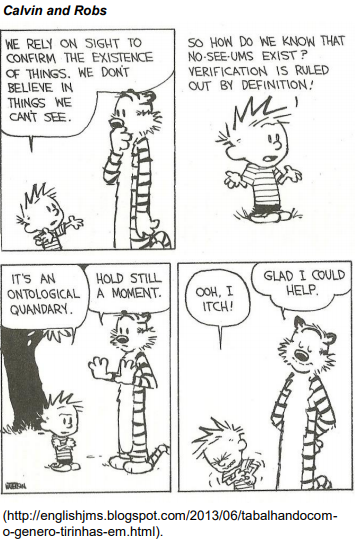
In the stretch “It’s an ontological quandary” and “hold still a moment” the words “ontological” and “still” are, respectively:
Questão 12 601467
EBMSP Medicina 2018/2 The aim of mindfulness is not quieting the mind, or attempting to achieve a state of eternal calm. The goal is simple: we’re aiming to pay attention to the present moment, without judgment. Easier said than done, we know. When we notice judgments arise during our practice, we can make a mental note of them, and let them pass. Return to observing the present moment as it is. That’s the practice. The work is to just keep doing it. Results will accrue.
Disponível em: <https://www.mindful.org/what-is-mindfulness/>. Acesso em: abr. 2018. Adaptado.
According to the text, mindfulness emphasizes that we should try to
Questão 11 601466
EBMSP Medicina 2018/2 Big U.S. tobacco companies are all developing e-cigarettes. The battery-powered gadgets feature a glowing tip and a heating element that turns liquid nicotine and flavorings into a cloud of vapor that users inhale. Some past research has suggested that using e-cigarettes may help smokers cut down on use of traditional tobacco products, or even transition entirely away from tobacco – an idea aggressively marketed by e-cigarette and tobacco companies.
But a recent European study says that smokers who also use e-cigarettes may be half as likely to give up tobacco as smokers who never vape at all.
Researchers analyzed data from a 2014 survey of more than 13,000 current or former smokers in the European Union. About 2,500 had tried vaping at least once; 46% of the participants were former smokers and 19% currently or previously used e-cigarettes. The study revealed that people smoked an average of about 14 cigarettes a day when they didn’t vape, and around 16 cigarettes a day when they did.
“This is important because e-cigarettes are widely promoted as a smoking cessation tool”, said senior author Stanton Glantz of California, San Francisco. “And, while there is no question that some smokers do successfully quit with e-cigarettes, they keep many more people smoking”, he added.
“Most adult smokers express a desire to quit, and many try and fail”, said Samir Soneji, a health policy researcher in New Hampshire. “E-cigarettes might seem like an appealing cessation tool because the devices in some ways mimic the smoking, but nicotine gum or patches may be more effective.”
RAPAPORT, Lisa. Disponível em: <www.foxnews.com>. Acesso em: abr. 2018. Adaptado.
About the role of e-cigarettes as a smoking cessation tool, the study has found out that e-cigarette users
Questão 9 601464
EBMSP Medicina 2018/2 Big U.S. tobacco companies are all developing e-cigarettes. The battery-powered gadgets feature a glowing tip and a heating element that turns liquid nicotine and flavorings into a cloud of vapor that users inhale. Some past research has suggested that using e-cigarettes may help smokers cut down on use of traditional tobacco products, or even transition entirely away from tobacco – an idea aggressively marketed by e-cigarette and tobacco companies.
But a recent European study says that smokers who also use e-cigarettes may be half as likely to give up tobacco as smokers who never vape at all.
Researchers analyzed data from a 2014 survey of more than 13,000 current or former smokers in the European Union. About 2,500 had tried vaping at least once; 46% of the participants were former smokers and 19% currently or previously used e-cigarettes. The study revealed that people smoked an average of about 14 cigarettes a day when they didn’t vape, and around 16 cigarettes a day when they did.
“This is important because e-cigarettes are widely promoted as a smoking cessation tool”, said senior author Stanton Glantz of California, San Francisco. “And, while there is no question that some smokers do successfully quit with e-cigarettes, they keep many more people smoking”, he added.
“Most adult smokers express a desire to quit, and many try and fail”, said Samir Soneji, a health policy researcher in New Hampshire. “E-cigarettes might seem like an appealing cessation tool because the devices in some ways mimic the smoking, but nicotine gum or patches may be more effective.”
RAPAPORT, Lisa. Disponível em: <www.foxnews.com>. Acesso em: abr. 2018. Adaptado.
About e-cigarettes, it’s correct to say that they
Questão 49 601035
FMC 2018/2Instant messaging in the workplace is no substitute for a professional conversation
By: Sadie Mullin
November 14, 2017
1 Instant messaging poses a significant threat to effective communication in the workplace. NHS’s view on use of instant messaging by medical professionals to discuss patients is clear. Due to the potential risk to confidential data, it is currently banned. However, recent research shows that it is widely used amongst professionals.
2 Most medical and surgical firms now communicate through a communal instant messaging group. Throughout the day, questions are asked predominantly by junior members and answered by seniors. Places to meet and ward rounds are also discussed. How do we train ourselves to consistently separate the wheat from the chaff in terms of information received?
3 Detailed conversations among medical professionals are paramount to patient safety. They always have been. They are how we have been trained to communicate with each other. They represent core values of our profession and yet they are becoming obsolete. An instant message is no substitute; it does not possess the communicative vigor to keep patients safe. Furthermore, all opportunity for tone of voice, body language and a platform for prudent questions to be asked is lost. We underestimate how the dynamism in our exchange has the potential to directly enhance or hinder patient care.
4 Finally, instant messaging regarding, for example, an unwell patient is inappropriate. In reality, we open our devices at an opportune moment and are faced with a selection of messages, some from family and friends, some from the workplace, most largely unimportant. We are desensitized by the volume and speed at which we are contactable. But a patient’s clinical state is of vital importance. We cannot expect ourselves to be able to sift for clinical gold amongst the barrage of communication from our smartphones.
5 Psychiatrists have demonstrated that we aren’t even aware of the vast extent of time we spend using our smartphones. Cognitive bias results in an average 40% underestimate of self-reported vs. real usage time.
6 It would be wrong to imply advancement in Information Technology hasn’t enhanced patient safety—it has. But we need to be mindful of what patients stand to lose if the way we communicate with each other continues to shift so rapidly.
Sadie Mullin is an ST1 in Obstetrics and Gynaecology in Bristol.
Adapted from: http://blogs.bmj.com/bmj/2017/11/14/sadie-mullininstant-messaging-in-the-workplace-is-no-substitute-for-aprofessional-conversation/. Access: 17 March 2018.
Glossary: threat: ameaça; NHS: National Health Service (o servico público de saúde do Reino Unido); ward rounds: turnos hospitalares; the wheat from the chaff: joio do trigo; enhance: melhorar; bias: tendência subjetiva; hinder: prejudicar; understimate: subestimar; sift: peneirar; mindful: alertas
“To separate the wheat from the chaff “(paragraph 2) is a metaphor which, in the text, refers to the ability to
06