


![[Marketing] Questao Topo - deslogado](https://storage.estuda.com.br/banners/0_6b7ebee90b03af1c560c73bb8bcce34a_banner_deslogado_70_dias.png)
Questões de Inglês
19.971 Questões
Questão 48 10778482
UFN Verão 2019By Reuben Fischer-Baum for The Washington Post
1 In the past three decades, the United States has seen staggering technological changes. In 1984,
just 8 percent of households had a personal computer, the World Wide Web was still five years
away, and cell phones were enormous. Americans born that year are only 34 years old.
Here’s how some key parts of our technological lives have shifted, split loosely into early,
[5] middle and current stages.
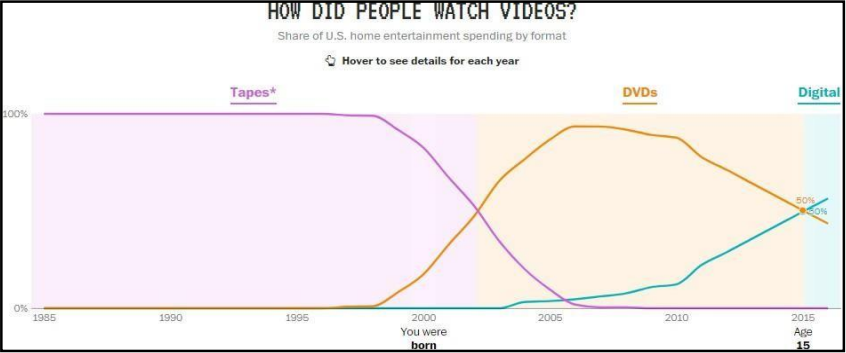
Blockbuster isn’t quite dead yet — as of April there were at least 10 U.S. locations still in operation, mostly in Alaska. But the era of physical videos is on its way out. Children today may never
know the swelling music of a DVD menu that’s looped back to the beginning. And they certainly
will never have to rewind a VHS tape.
[10] But this is just one slice of how home entertainment has changed over the past 30 years. Thanks
to plummeting prices, most Americans now own (large!) HD TVs that were once reserved for the
very wealthy. During the same era, cable overtook network television in profitability and prestige.
Both are now threatened by the twin specters of cord-cutting and streaming.
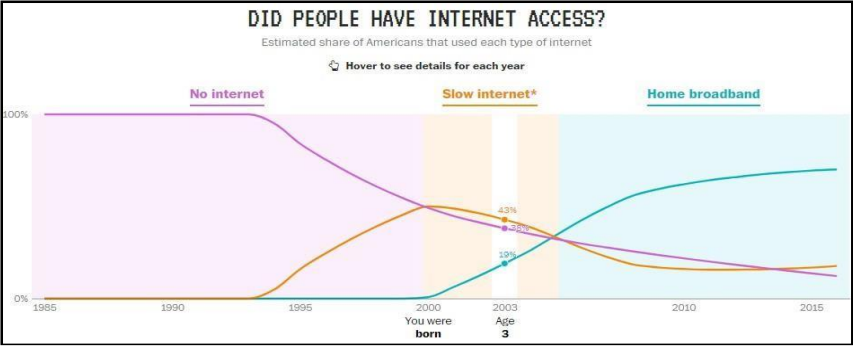
Twenty years ago the Internet was still mostly for play — Geocities was one of the most popular
[15] sites on the Web.
And it was slow! Dial-up — which uses pre-existing telephone lines to connect to the Internet
— was the primary internet technology throughout the ’90s, until faster Broadband services began
to take hold. Dial-up had a max speed of 56 kilobits per second, and could be interrupted by an
incoming phone call
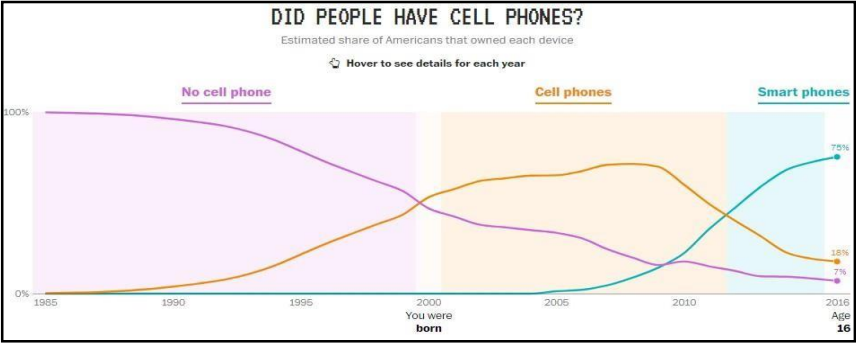
[20] While the first mobile phone call was made in 1973, it took the technology a while to reach the
masses. In the late ’80s, cellphones were still an extravagance, notably used by Gordon Gecko in
1987’s “Wall Street.”
A decade a half later, Nokia and other manufacturers had developed much cheaper models. In
particular, the nearly indestructible Nokia 3310 affectionately known as the “brick” — has a special
[25] place in U.S. mobile history as the first cell phone for many younger Americans.
(Fonte: https://www.washingtonpost.com/adaptado)
Considere o fragmento do texto que apresenta o ‘presente perfeito’: “Here’s how some key parts of our technological lives have shifted, split loosely into early, middle and current stages” (l.5).
A alternativa que apresenta o uso adequado de um tempo verbal que indica ação ou evento já ocorrido e finalizado é
Questão 47 10778479
UFN Verão 2019By Reuben Fischer-Baum for The Washington Post
1 In the past three decades, the United States has seen staggering technological changes. In 1984,
just 8 percent of households had a personal computer, the World Wide Web was still five years
away, and cell phones were enormous. Americans born that year are only 34 years old.
Here’s how some key parts of our technological lives have shifted, split loosely into early,
[5] middle and current stages.
Blockbuster isn’t quite dead yet — as of April there were at least 10 U.S. locations still in operation, mostly in Alaska. But the era of physical videos is on its way out. Children today may never
know the swelling music of a DVD menu that’s looped back to the beginning. And they certainly
will never have to rewind a VHS tape.
[10] But this is just one slice of how home entertainment has changed over the past 30 years. Thanks
to plummeting prices, most Americans now own (large!) HD TVs that were once reserved for the
very wealthy. During the same era, cable overtook network television in profitability and prestige.
Both are now threatened by the twin specters of cord-cutting and streaming.
Twenty years ago the Internet was still mostly for play — Geocities was one of the most popular
[15] sites on the Web.
And it was slow! Dial-up — which uses pre-existing telephone lines to connect to the Internet
— was the primary internet technology throughout the ’90s, until faster Broadband services began
to take hold. Dial-up had a max speed of 56 kilobits per second, and could be interrupted by an
incoming phone call
[20] While the first mobile phone call was made in 1973, it took the technology a while to reach the
masses. In the late ’80s, cellphones were still an extravagance, notably used by Gordon Gecko in
1987’s “Wall Street.”
A decade a half later, Nokia and other manufacturers had developed much cheaper models. In
particular, the nearly indestructible Nokia 3310 affectionately known as the “brick” — has a special
[25] place in U.S. mobile history as the first cell phone for many younger Americans.
(Fonte: https://www.washingtonpost.com/adaptado)
Os gráficos estão presentes para auxiliar a compreensão do texto. Ao fazer a leitura do texto verbal e não-verbal sobre a evolução tecnológica, é possível afirmar:
I. Os telefones celulares se tornaram populares muito rapidamente, desde sua criação, permitindo que as classes sociais de menor poder aquisitivo pudessem se comunicar com facilidade.
II. Inicialmente, a internet (que era acessada por meio de linhas telefônicas fixas) foi altamente utilizada por popularizar informações antes não tão acessíveis ao público em geral.
III. Atualmente, o acesso a vídeos é mais fácil graças à internet, fazendo com que lojas físicas, como a Blockbuster, percam espaço e usuários.
Está(ão) correta(s)
Questão 57 10267364
CEFSA Prova de Conhecimentos Gerais 2019/2Leia o texto para responder à questão.
New material could replace plastic or glass in construction of energy-efficient homes
Nicola Davis
In an era of glass and steel construction, wood may seem old-school. But now researchers say they have given wood a makeover to produce a material that is not only sturdy, but also transparent and able to store and release heat. The researchers say the material could be used in the construction of energy-efficient homes, and that they hope to develop a biodegradable version soon to increase its eco-friendly credentials as an alternative to plastic, glass or even cement.
“We prepared a material that is multifunctional since it can transmit light very well and also it can store heat. We combined these two functions in a single material,” said Céline Montanari of the KTH Royal Institute of Technology in Stockholm. Montanari is presenting the work at the spring national meeting of the American Chemical Society in Orlando.
To produce the material, the team built on previous work in which they took balsa wood and removed its lignin – a component of wood that gives it strength and colour. Acrylic, which is non-biodegradable and water-repellent, was introduced into the remaining tissues where it filled both the tiny pores left by the removal of lignin and the hollow vessels that carried water in the tree. That, said Montanari, not only helped maintain the wood’s structure but also restored its strength and improved its optical properties. The upshot was a frosted-looking wood-based material.
In the latest work, the acrylic was mixed with another substance called polyethylene glycol, which permeates wood well. Crucially, polyethylene glycol also has another feature: when it is heated it absorbs energy and melts, but when temperatures fall it hardens, releasing energy in the process. The team say this property means their wood-based material, which goes from semi-transparent to transparent when warmed, could be used to make buildings more energy-efficient, with energy captured from the sun during the day released later into the interior.
However, Montanari said there was plenty of work still to do – including replacing the acrylic with a biodegradable alternative for some applications, scaling up production of the material, and carrying out computer models of buildings to see how transparent wood compares with glass.
(www.theguardian.com/environment/2019/apr/03/scientists-inventtransparent-wood-in-search-for-eco-friendly-building-material. Adaptado)
O trecho do terceiro parágrafo – ... which is non-biodegradable and water-repellent... –, indica
Questão 56 10267353
CEFSA Prova de Conhecimentos Gerais 2019/2Leia o texto para responder à questão.
New material could replace plastic or glass in construction of energy-efficient homes
Nicola Davis
In an era of glass and steel construction, wood may seem old-school. But now researchers say they have given wood a makeover to produce a material that is not only sturdy, but also transparent and able to store and release heat. The researchers say the material could be used in the construction of energy-efficient homes, and that they hope to develop a biodegradable version soon to increase its eco-friendly credentials as an alternative to plastic, glass or even cement.
“We prepared a material that is multifunctional since it can transmit light very well and also it can store heat. We combined these two functions in a single material,” said Céline Montanari of the KTH Royal Institute of Technology in Stockholm. Montanari is presenting the work at the spring national meeting of the American Chemical Society in Orlando.
To produce the material, the team built on previous work in which they took balsa wood and removed its lignin – a component of wood that gives it strength and colour. Acrylic, which is non-biodegradable and water-repellent, was introduced into the remaining tissues where it filled both the tiny pores left by the removal of lignin and the hollow vessels that carried water in the tree. That, said Montanari, not only helped maintain the wood’s structure but also restored its strength and improved its optical properties. The upshot was a frosted-looking wood-based material.
In the latest work, the acrylic was mixed with another substance called polyethylene glycol, which permeates wood well. Crucially, polyethylene glycol also has another feature: when it is heated it absorbs energy and melts, but when temperatures fall it hardens, releasing energy in the process. The team say this property means their wood-based material, which goes from semi-transparent to transparent when warmed, could be used to make buildings more energy-efficient, with energy captured from the sun during the day released later into the interior.
However, Montanari said there was plenty of work still to do – including replacing the acrylic with a biodegradable alternative for some applications, scaling up production of the material, and carrying out computer models of buildings to see how transparent wood compares with glass.
(www.theguardian.com/environment/2019/apr/03/scientists-inventtransparent-wood-in-search-for-eco-friendly-building-material. Adaptado)
In the excerpt from the third paragraph – ... and removed its lignin... –, the word in bold refers to
Questão 55 10267335
CEFSA Prova de Conhecimentos Gerais 2019/2Leia o texto para responder à questão.
New material could replace plastic or glass in construction of energy-efficient homes
Nicola Davis
In an era of glass and steel construction, wood may seem old-school. But now researchers say they have given wood a makeover to produce a material that is not only sturdy, but also transparent and able to store and release heat. The researchers say the material could be used in the construction of energy-efficient homes, and that they hope to develop a biodegradable version soon to increase its eco-friendly credentials as an alternative to plastic, glass or even cement.
“We prepared a material that is multifunctional since it can transmit light very well and also it can store heat. We combined these two functions in a single material,” said Céline Montanari of the KTH Royal Institute of Technology in Stockholm. Montanari is presenting the work at the spring national meeting of the American Chemical Society in Orlando.
To produce the material, the team built on previous work in which they took balsa wood and removed its lignin – a component of wood that gives it strength and colour. Acrylic, which is non-biodegradable and water-repellent, was introduced into the remaining tissues where it filled both the tiny pores left by the removal of lignin and the hollow vessels that carried water in the tree. That, said Montanari, not only helped maintain the wood’s structure but also restored its strength and improved its optical properties. The upshot was a frosted-looking wood-based material.
In the latest work, the acrylic was mixed with another substance called polyethylene glycol, which permeates wood well. Crucially, polyethylene glycol also has another feature: when it is heated it absorbs energy and melts, but when temperatures fall it hardens, releasing energy in the process. The team say this property means their wood-based material, which goes from semi-transparent to transparent when warmed, could be used to make buildings more energy-efficient, with energy captured from the sun during the day released later into the interior.
However, Montanari said there was plenty of work still to do – including replacing the acrylic with a biodegradable alternative for some applications, scaling up production of the material, and carrying out computer models of buildings to see how transparent wood compares with glass.
(www.theguardian.com/environment/2019/apr/03/scientists-inventtransparent-wood-in-search-for-eco-friendly-building-material. Adaptado)
No trecho do segundo parágrafo – ... since it can transmit light very well... –, o termo destacado em negrito pode ser substituído, sem alteração de sentido, por
Questão 53 10267308
CEFSA Prova de Conhecimentos Gerais 2019/2Leia o texto para responder à questão.
New material could replace plastic or glass in construction of energy-efficient homes
Nicola Davis
In an era of glass and steel construction, wood may seem old-school. But now researchers say they have given wood a makeover to produce a material that is not only sturdy, but also transparent and able to store and release heat. The researchers say the material could be used in the construction of energy-efficient homes, and that they hope to develop a biodegradable version soon to increase its eco-friendly credentials as an alternative to plastic, glass or even cement.
“We prepared a material that is multifunctional since it can transmit light very well and also it can store heat. We combined these two functions in a single material,” said Céline Montanari of the KTH Royal Institute of Technology in Stockholm. Montanari is presenting the work at the spring national meeting of the American Chemical Society in Orlando.
To produce the material, the team built on previous work in which they took balsa wood and removed its lignin – a component of wood that gives it strength and colour. Acrylic, which is non-biodegradable and water-repellent, was introduced into the remaining tissues where it filled both the tiny pores left by the removal of lignin and the hollow vessels that carried water in the tree. That, said Montanari, not only helped maintain the wood’s structure but also restored its strength and improved its optical properties. The upshot was a frosted-looking wood-based material.
In the latest work, the acrylic was mixed with another substance called polyethylene glycol, which permeates wood well. Crucially, polyethylene glycol also has another feature: when it is heated it absorbs energy and melts, but when temperatures fall it hardens, releasing energy in the process. The team say this property means their wood-based material, which goes from semi-transparent to transparent when warmed, could be used to make buildings more energy-efficient, with energy captured from the sun during the day released later into the interior.
However, Montanari said there was plenty of work still to do – including replacing the acrylic with a biodegradable alternative for some applications, scaling up production of the material, and carrying out computer models of buildings to see how transparent wood compares with glass.
(www.theguardian.com/environment/2019/apr/03/scientists-inventtransparent-wood-in-search-for-eco-friendly-building-material. Adaptado)
De acordo com o texto, o novo material
06