


![[Marketing] Questao Topo - deslogado](https://storage.estuda.com.br/banners/0_6b7ebee90b03af1c560c73bb8bcce34a_banner_deslogado_70_dias.png)
Questões de Inglês
19.971 Questões
Questão 46 6524183
FASM 2020Leia o texto para responder à questão.
Light and the body clock: the key to a good night’s sleep?
The cycle of sleep and wakefulness is one of the key human behaviours. We spend about a third of our lives asleep and cannot survive without it. When asleep, our brain memorises and processes information. Our body clears toxins and repairs itself, allowing us to function properly when awake. Even short-term sleep deprivation significantly affects our wellbeing. One study suggested that after 17-19 hours of staying awake, performance on cognitive tasks may be similar to having had too much to drink.
These effects worsen over time. But while scientists have long understood the importance of getting enough sleep, the key part played by light exposure can sometimes be overlooked. The reason light is so important is that it sets our body clock via specialised light sensors within the eye. Our eye detects the light and dark cycle within our environment and adjusts the body’s rhythm so that the internal and external day coincide. This is so powerful that people who have very severe eye damage can find their body clock is thrown off, leading to sleep problems.
Today, many of us miss out on these environmental cues as we work inside. We have become a light deprived species, and this has far reaching consequences for the quality of our sleep, and consequently our wellbeing.
Further research and greater awareness in this area could help individuals to make informed choices about prioritising their own sleep and getting enough sunlight. It could also influence the way that policies are developed by governments, educational institutions and workplaces. Minimising light exposure before you go to bed, and trying to get as much morning light as possible, are simple steps that could help most people to regulate and improve their sleep.
(Russell Foster. www.bbc.com, 19.05.2019. Adaptado.)
No trecho do terceiro parágrafo “many of us miss out on these environmental cues”, a expressão sublinhada tem significado equivalente, em português, a
Questão 21 6510797
FMABC 2020Leia o texto para responder à questão.
A new global crisis?
You drink a Coca-Cola, throw the bottle into the recycling bin... and forget about it. But it doesn’t disappear. Everything you own will one day become the property of the waste industry, a £250 bn global enterprise determined to extract every last penny of value from what remains. In the case of the United Kingdom (UK), some of the waste is kept in the country; but much of it — about half of all paper and cardboard, and twothirds of plastics — will be loaded on to container ships to be sent to Europe or Asia for recycling.
Or, at least, that’s how it used to work. Then, on the first day of 2018, China, the world’s largest market for recycled waste, essentially shut its doors. Under its National Sword policy, China prohibited 24 types of waste from entering the country, arguing that what was coming in was too contaminated. The policy shift was partly attributed to the impact of a documentary, Plastic China, which went viral before censors erased it from China’s internet. The film follows a family working in the country’s recycling industry, where humans pick through vast dunes of western waste. It is filthy, polluting work — and badly paid. The remainder is often burned in the open air. The family lives alongside the sorting machine, their 11-year-old daughter playing with a Barbie pulled from the rubbish.
National Sword was a huge blow1. Still, the waste has to go somewhere. The UK, like most developed nations, produces more waste than it can process: about 1.1 kg per person per day; the US, 2 kg.
There is cause for optimism, though: in December 2018, the UK government published a comprehensive new waste strategy. Among its proposals: a tax on packaging containing less than 30% recycled material and means to force companies to take responsibility for the plastic packaging they produce. They hope to force the industry to invest in recycling infrastructure at home.
Yet such is the torrent of humanity’s refuse that these efforts may not be enough. Recycling rates in the west are stable and packaging use is set to rise in developing countries, where recycling rates are low. If National Sword has shown us anything, it is that recycling — while needed — simply isn’t enough to solve our waste crisis.
(www.theguardian.com, 17.08.2019. Adaptado.)
1 blow: a very disappointing or catastrophic situation.
The main issue discussed in the text is
Questão 19 6466781
FCMSCSP - Santa Casa 2020Leia o texto para responder à questão.
Breaking down barriers
Shuffling feet and the general buzz of conversation made lectures a trial for Gemma Long during her first degree. She suffers from sensory overload connected to her autism, which was only diagnosed after she graduated. But when she started a teacher-training course years later, she received access to software to help her cope with dyslexia and found it transformative.
“I struggled to understand the point of lectures until I got that software,” recalls Long. “I didn’t realise how much useful information was in them. As someone who is hypersensitive to noise I spend most of my time in lectures trying to filter out the background noise, which means I miss much of what the lecturer is saying. Being able to audio record the lectures and listen back to them in a silent room meant I was finally able to digest the content.”
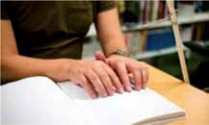
Technology is breaking down barriers faced by students with disabilities. Online journal articles now mean that those with visual impairments can zoom in to read printed text or convert it to easier-to-read formats such as braille. Universities are also increasingly recording lectures which students can replay at their own pace, which benefits students with dyslexia or attention deficit disorder too.
According to Alistair McNaught, a digital learning consultant, universities are increasingly tracking how students learn, and then directing them to the accessible resources most suited to their personal needs. McNaught appreciates the way assistive technologies can help all students — whether they have a disability or not — but stresses that it’s important for universities to get the basics right first. “Many higher and further institutions have inaccessible websites or inaccessible digital content. If the content is inaccessible, investments in assistive technology can be undermined at a stroke.”
Universities just need to get better at promoting the support that’s already there,” says Gemma Long. “Making specialist software and training generally available, rather than confining it to disabled students, makes it more widely known, as well as removes stigma.” For someone like her, who received her diagnoses late, it would have been particularly helpful. To this end, the assistive technology network she founded to represent staff who support their disabled students with tech, will hold its first awards ceremony next month.
Universities are slowly tackling the barriers for disabled students. There’s more yet to come: the prospect of virtual reality – particularly when it comes to fieldwork. “It can be incredibly difficult for a disabled student to get a wheelchair on to a salt marsh,” says Piers Wilkinson, a researcher in the area. “But if the learning aims are being immersed in an environment, and making discoveries, virtual reality can achieve that.”
(www.theguardian.com, 03.06.2019. Adaptado.)
In the context of the last paragraph, the fragment “when it comes to fieldwork” is closest in meaning to:
Questão 34 6430471
UNISA 2020Leia o texto para responder a questão.
Notre-Dame came far closer to collapsing than people knew
The security employee monitoring the smoke alarm panel at Notre-Dame cathedral was just three days on the job when the red warning light flashed on the evening of April 15: “Feu.” Fire. It was 6:18 on a Monday, the week before Easter. The Rev. Jean-Pierre Caveau was celebrating Mass before hundreds of worshipers and visitors, and the employee radioed a church guard who was standing just a few feet from the altar, and told him to go check for fire. He did and found nothing.
It took nearly 30 minutes before they realized their mistake: The guard had gone to the wrong building. The fire was in the attic of the cathedral, the famed latticework of ancient timbers known as “the forest.” The guard went to the attic of a small adjacent building, the sacristy.
Instead of calling the fire department, the security employee called his boss but didn’t reach him. The manager called back and eventually deciphered the mistake. He called the guard and told him to leave the sacristy and run to the main attic. But by the time the guard climbed 300 narrow steps to the attic, the fire was burning out of control, putting firefighters in a near impossible position. Ultimately, Notre-Dame still stands only because the firefighters decided to risk everything.
The miscommunication, uncovered in interviews with church officials and managers of the fire security company, has set off a bitter round of finger-pointing over who was responsible for allowing the fire to rage unchecked for so long. Who is to blame and how the fire started have not yet been determined and are at the heart of an investigation by the French authorities that will continue for months.
But the damage is done. What happened that night changed Paris. The cathedral — a soaring medieval structure that has captured the hearts of believer and nonbeliever alike for 850 years — was ravaged.
(Elian Peltier et al. www.nytimes.com, 18.07.2019. Adaptado.)
In the excerpt from the third paragraph “But by the time the guard climbed 300 narrow steps to the attic”, the underlined expression can be replaced by
Questão 48 6384042
UNIPAR Medicina 2020Atenção: Para responder à questão, considere o texto abaixo.
Testing for Caffeine Could Help Foil Fake Urine Scam
By Andy Extance on January 9, 2019
In a disturbing trend, scam artists are using commercially sold fake urine to fool doctors into prescribing pain medications such as hydrocodone − which can then be consumed or illegally sold. The synthetic pee lets patients pass tests intended to ensure they are not already taking opioid medications or drugs of abuse.
Hoping to address the situation, Patrick Kyle, director of clinical chemistry and toxicology at the University of Mississippi Medical Center and his pathologist colleague Jaswinder Kaur have now shown how legal indulgences − including chocolate, coffee and cigarettes − can help distinguish real pee from fake.
Past approaches to spotting fake specimens have included testing urine’s acidity and density and assessing concentration of a metabolic waste substance called creatinine. But some synthetic products now pass these evaluations, Kyle says.
The new method looks for four substances common in urine: caffeine and theobromine, both found in chocolate, tea and coffee; cotinine, produced as nicotine breaks down; and urobilin − degraded hemoglobin that gives urine its yellow color.
The scientists studied the various substances in four different groups. One group of 100 urine samples came from people who had been observed providing them. A second set of 100 came from individuals seeking pain medication, who were not observed. A third came from 200 unobserved job applicants. And the final group consisted of 10 samples of commercially available synthetic urine. All samples provided by observed individuals were positive for at least one of the four test substances; three from the pain medication group and two from the job applicants lacked them. No synthetic urine samples contained any of the four substances. Negative results do not prove criminal activity − but they can indicate attempted deception, Kyle says. In such cases, he adds, “the clinic or the business should simply collect another specimen from the individual.”
(Adapted from: www.scientificamerican.com)
Segundo o estudo com o método novo feito com quatro grupos de indivíduos,
Questão 46 6384017
UNIPAR Medicina 2020Atenção: Para responder à questão, considere o texto abaixo.
Testing for Caffeine Could Help Foil Fake Urine Scam
By Andy Extance on January 9, 2019
In a disturbing trend, scam artists are using commercially sold fake urine to fool doctors into prescribing pain medications such as hydrocodone − which can then be consumed or illegally sold. The synthetic pee lets patients pass tests intended to ensure they are not already taking opioid medications or drugs of abuse.
Hoping to address the situation, Patrick Kyle, director of clinical chemistry and toxicology at the University of Mississippi Medical Center and his pathologist colleague Jaswinder Kaur have now shown how legal indulgences − including chocolate, coffee and cigarettes − can help distinguish real pee from fake.
Past approaches to spotting fake specimens have included testing urine’s acidity and density and assessing concentration of a metabolic waste substance called creatinine. But some synthetic products now pass these evaluations, Kyle says.
The new method looks for four substances common in urine: caffeine and theobromine, both found in chocolate, tea and coffee; cotinine, produced as nicotine breaks down; and urobilin − degraded hemoglobin that gives urine its yellow color.
The scientists studied the various substances in four different groups. One group of 100 urine samples came from people who had been observed providing them. A second set of 100 came from individuals seeking pain medication, who were not observed. A third came from 200 unobserved job applicants. And the final group consisted of 10 samples of commercially available synthetic urine. All samples provided by observed individuals were positive for at least one of the four test substances; three from the pain medication group and two from the job applicants lacked them. No synthetic urine samples contained any of the four substances. Negative results do not prove criminal activity − but they can indicate attempted deception, Kyle says. In such cases, he adds, “the clinic or the business should simply collect another specimen from the individual.”
(Adapted from: www.scientificamerican.com)
Infere-se do texto que
06