


![[Marketing] Questao Topo - deslogado](https://storage.estuda.com.br/banners/0_6b7ebee90b03af1c560c73bb8bcce34a_banner_deslogado_70_dias.png)
Questões de Inglês
19.971 Questões
Questão 32 10636639
FDF C. Gerais 2020Leia o texto para responder à questão.
What is the point of the UN General Assembly?
The United Nations (UN) General Assembly is the world’s parliament, where all the UN’s 193 member states are represented. Each sovereign state gets one vote so it is not exactly representative of the world’s population. The General Assembly is not nearly as powerful as the Security Council, which can pass binding resolutions, and is dominated by the five permanent members: the United States, China, the United Kingdom, France and Russia, who each have a veto. But the General Assembly can express world opinion, make recommendations to the Security Council and elect the Council’s non-permanent members. The 74th session takes place this year, in September, in New York.
The General Assembly and the Security Council are two of six main organs of the UN. They sit alongside the Secretariat, the International Court of Justice, the Economic and Social Council and the Trusteeship Council. The world’s leaders converge on New York, where each is given a time limit of 15 minutes to speak in front of the green marble podium and orate in front of the world. Leaders occupy positions in the hall in alphabetical order by country name, usually with a different nation occupying the first seat each year.
In truth, the General Assembly week usually makes news in the first day or two, when the United States president and other powerful heads of state tend to have their moment, and then attention tends to tail off. For that reason, there is always some horse trading before the General Assembly week, with prime ministers from big countries trying to swap speaking slots with presidents of small countries. This year, there is a climate action summit on the eve of the general debate, attended by the teen activist, Greta Thunberg. Putting the climate emergency centre stage and forcing states to do something are two very distinct things, however.
Although it is the UN Secretary General who gets the limelight for most of the year, the event gives the president of the General Assembly, elected each year by the member states ahead of general debate, a chance to shine. This year it is Nigeria’s Tijjani Muhammad-Bande. After the initial excitement of greeting the world leaders, however, it is rather a thankless task, introducing each leader to the assembly and then sitting through one speech after another, most of them turgid and self-congratulatory.
The UN General Assembly is the world’s biggest summit and it attracts a lot of side events because of the proximity and potential participation of world leaders. The most glittering of these events is the Goalkeepers conference run by the Bill and Melinda Gates Foundation, where celebrities, activists and politicians will talk about global inequality
(Julian Borger. www.theguardian.com, 23.09.2019. Adaptado.)
De acordo com o texto, uma das atribuições da Assembleia Geral da ONU é
Questão 35 9911708
Humanitas Medicina 2020/1Leia o texto para responder à questão
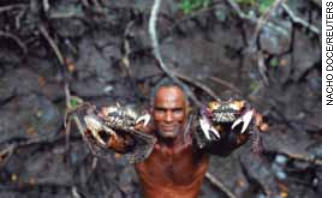
Reuters photographer Nacho Doce has documented the mangrove forests in Cairu, Brazil. He visited a community of mud houses along the edge of the Caratingui River, known as The Train because the single-file homes look like train carriages.
Mangroves cover 13,989 sq km of Brazil’s coast and are an important protection against climate change, with one acre of mangrove forest absorbing nearly the same amount of carbon dioxide as an acre of Amazon rainforest.
Fisherman Jose da Cruz makes his living by fishing for crabs where freshwater rivers meet the brackish Atlantic Ocean. Instead of a rod or a net, he uses his hands to search for crabs in the mud among the mangrove trees, sometimes lying flat on the ground and reaching deep down. His daily catch of several dozen crabs will earn him 200 reais (£40) a week, enough on which to survive. Mr Da Cruz says his daily catch is half what it was 10 years ago and in that time the water line has advanced 3m (10ft) inland.
According to climate researcher Carlos Nobre, at the University of Sao Paulo, water levels have risen 20-30cm (1ft) over the past 100 years in coastal Bahia state. Scientists predict the global surface temperature will have risen by more than 1.5C by the end of the 21st Century. And some prediction models in a 2014 report say this temperature increase will actually exceed 2C, without unprecedented changes within human societies. “Nature is upset”, Mr da Cruz says.
(www.bbc.com, 13.06.2019. Adaptado.)
According to Mr da Cruz, “nature is upset”.
This means that nature is
Questão 53 9722365
IFRR Superior 2020/1Read the text and answer the question:
TEXT
It was the end of an era: In July 1997, as the flag of the United Kingdom was lowered over Hong Kong, the prosperous colony was returned to China after over 150 years of British rule. The sun had finally set on one of the wealthiest modern outposts of the British Empire. But was it the beginning of lasting autonomy for Hong Kong?
The United Kingdom had held Hong Kong as a colony since 1841, when it occupied the area during the First Opium War. The war broke out after Qing-dynasty China attempted to crack down an illegal opium trade that led to widespread addiction in China. Defeat came at a high cost: In 1842, China agreed to cede the island of Hong Kong to the British in perpetuity through the Treaty of Nanjing.
Over the next half-century, the United Kingdom gained control over all three main regions of Hong Kong: After Hong Kong Island came the Kowloon Peninsula, and finally the New Territories, a swath of land that comprises the bulk of Hong Kong today. The final treaty, the 1898 Convention for the Extension of Hong Kong Territory, leased the New Territories to Britain for 99 years. Under the terms of the treaty, China would regain control of its leased lands on July 1, 1997.
British Hong Kong’s trajectory was different from that of mainland China, which became a Communist country in 1949. Up to 100,000 Chinese found refuge in Hong Kong after the Communist Party took power. Capitalist Hong Kong soon experienced an economic boom, becoming home to a multicultural, international community.
As the treaty’s expiration loomed, separating the New Territories from the rest of Hong Kong became increasingly unthinkable. Starting in the late 1970s, the U.K. and China began to discuss Hong Kong’s future. In 1984, British Prime Minister Margaret Thatcher and China’s premier Zhao Ziyang signed the Sino-British Joint Declaration, agreeing that China would give Hong Kong some political and social autonomy through a “one country, two systems” policy for a 50-year- period.
After the handover, Hong Kong became a Special Administrative Region of China with its own “mini constitution,” legal system, and some democratic rights like free speech and the freedom of assembly under its Basic Law. However, Hong Kong residents cannot elect their own leaders; rather, a chief executive is elected by a 1,200-member election committee.
Starting in 2014, elections were conducted using a list of candidates vetted by Beijing. That and other Chinese policies, like a recent attempt to allow extradition to the mainland, have led to mass protests, strained British-Chinese diplomatic relations, and fueled increasing concerns that China is stifling public dissent, interfering in localpolitics, and eroding human rights in Hong Kong. The handover still has another phase ahead: the expiration of China’s agreement to honor Hong Kong’s Basic Law. Will China continue to recognize Hong Kong’s autonomy after then? We’ll find out in 2047.
(Fragment from “How Hong Kong’s complex history explains its current crisis with China”, by Erin Blakemore. Online since 07 August 2019. URL: http://nationalgeographic.com/culture/topics/references/hong- kong-history-explain-relationship-china/)
About the second paragraph of the text is INCORRECT to infer:
Questão 50 9714911
IFRR Superior 2020/1Read the text and answer the question:
TEXT
It was the end of an era: In July 1997, as the flag of the United Kingdom was lowered over Hong Kong, the prosperous colony was returned to China after over 150 years of British rule. The sun had finally set on one of the wealthiest modern outposts of the British Empire. But was it the beginning of lasting autonomy for Hong Kong?
The United Kingdom had held Hong Kong as a colony since 1841, when it occupied the area during the First Opium War. The war broke out after Qing-dynasty China attempted to crack down an illegal opium trade that led to widespread addiction in China. Defeat came at a high cost: In 1842, China agreed to cede the island of Hong Kong to the British in perpetuity through the Treaty of Nanjing.
Over the next half-century, the United Kingdom gained control over all three main regions of Hong Kong: After Hong Kong Island came the Kowloon Peninsula, and finally the New Territories, a swath of land that comprises the bulk of Hong Kong today. The final treaty, the 1898 Convention for the Extension of Hong Kong Territory, leased the New Territories to Britain for 99 years. Under the terms of the treaty, China would regain control of its leased lands on July 1, 1997.
British Hong Kong’s trajectory was different from that of mainland China, which became a Communist country in 1949. Up to 100,000 Chinese found refuge in Hong Kong after the Communist Party took power. Capitalist Hong Kong soon experienced an economic boom, becoming home to a multicultural, international community.
As the treaty’s expiration loomed, separating the New Territories from the rest of Hong Kong became increasingly unthinkable. Starting in the late 1970s, the U.K. and China began to discuss Hong Kong’s future. In 1984, British Prime Minister Margaret Thatcher and China’s premier Zhao Ziyang signed the Sino-British Joint Declaration, agreeing that China would give Hong Kong some political and social autonomy through a “one country, two systems” policy for a 50-year- period.
After the handover, Hong Kong became a Special Administrative Region of China with its own “mini constitution,” legal system, and some democratic rights like free speech and the freedom of assembly under its Basic Law. However, Hong Kong residents cannot elect their own leaders; rather, a chief executive is elected by a 1,200-member election committee.
Starting in 2014, elections were conducted using a list of candidates vetted by Beijing. That and other Chinese policies, like a recent attempt to allow extradition to the mainland, have led to mass protests, strained British-Chinese diplomatic relations, and fueled increasing concerns that China is stifling public dissent, interfering in localpolitics, and eroding human rights in Hong Kong. The handover still has another phase ahead: the expiration of China’s agreement to honor Hong Kong’s Basic Law. Will China continue to recognize Hong Kong’s autonomy after then? We’ll find out in 2047.
(Fragment from “How Hong Kong’s complex history explains its current crisis with China”, by Erin Blakemore. Online since 07 August 2019. URL: http://nationalgeographic.com/culture/topics/references/hong- kong-history-explain-relationship-china/)
Choose the only alternative which demonstrates what it is TRUE about Hong Kong:
Questão 13 9571134
Unilago 2020/1Leia o texto a seguir e responda à questão.

OTTUMWA, Iowa – The motivational speaker had a lot of wisdom to share: How he overcame challenges, found out who he was and learned to accept himself with his good points and bad. And the students seemed to get it. But they also wanted to know how close he and actor Ashton Kutcher are.
“We’re twins ... and I consider him my best friend,” said Michael Kutcher, talking to kids Thursday at Ottumwa, Iowa, High School.
Christopher Ashton Kutcher almost grew up without a brother, Mike said. Their mom and her doctor thought she was having a boy. They were surprised when it turned out to be two boys.
Ashton was born first, at 4.5 kilos. Mike referred to his twin as Jabba the Hutt, the slug-like, gigantic “Star Wars” character. A few minutes later, Mike was born. He weighed just 0,950 kilos and was over-oxygenated.
“The doctor told my parents, ‘You might want to name and baptize him. He may not survive.’ Of course, Jabba the Hutt was fine. I tell people he must have ate everything while we were in the womb.”
When the boys were 3, Mom realized that while Ashton was running around just fine, Mike was not moving the way he should, was lagging behind and just seemed generally “slow.”
Doctors diagnosed him with cerebral palsy.
“For those of you who don’t know what cerebral palsy is, it’s a disability that mostly affects motor function,”
Mike said.
His walk is impaired, he said, and so is his speech. He has trouble performing physical tasks with his right side, is 80 percent deaf in his left ear and has had two cataract surgeries.
“My case is considered mild,” he said.
Mike climbed the steps to the stage and walked back and forth during his talk Thursday, and students seemed to understand him just fine. But there are some things he just can’t do well.
When he and his brother were still in elementary school, they were shooting basketball, following each other’s shots. Ashton made a called shot, “Right hand.”
Mike walked away.
“Where are you going?” asked Ashton.
“I said, ‘You know I can’t make that shot. It’s not fair.’ And Chris (Ashton) even at that age said, ‘You can do anything you want. I can’t make that shot for you. Mom’s not here; she can’t do it for you. It’s your
challenge. Stop using your disability as a crutch. This is your obstacle.’ ”
Those words stayed with him for the rest of his life; there are obstacles that are his to overcome or not overcome. He tossed that ball using his disabled right hand. Unfortunately, since they were in a real Iowa
town, not in a Hollywood script, Mike missed the shot.
“I don’t think I could make that shot today,” he quipped in answer to an Ottumwa student’s question.
But it didn’t matter. The lesson, from a boy his same age, stuck. He’d try. Sometimes, he’d miss. Other
times, he’d succeed.
(Adaptado de: THE ASSOCIATED PRESS. Michael Kutcher talks about twin brother Ashton, life with cerebral palsy IN Twin Cities Pioneer Press (online). Publicado em 2 fev. 2012. Atualizado em 20 março 2019. Disponível em: https://www.twincities.com/2012/02 /02/michael-kutcher-talks-about-twin-brother-ashton-life-with-cerebral-palsy/. Acesso em: 26 set. 2019.)
Considere a sentença “Unfortunately, since they were in a real Iowa town, not in a Hollywood script, Mike missed the shot.”.
Assinale a alternativa que apresenta, corretamente, o termo que substitui a palavra sublinhada, sem alterar o sentido no texto.
Questão 10 9571084
Unilago 2020/1Leia o texto a seguir e responda à questão.
ER at 25: a matter of life, death – and George Clooney

ER is 25 years old. And this means you should all drop whatever you’re doing now and dedicate the next 331 hours of your life to reminding yourself what an incredible series it was. The overwhelming majority of shows from the past 25 years would be dramatically different if it wasn’t for ER.
Of course, this might not be entirely evident when you first watch it. Stumble across the wrong episode and you might be bewildered by its sentimentality, or the ridiculous matinee-idol looks of its cast. But this is to be expected. Like other shows that were groundbreaking at the time, the wider culture has subsequently absorbed what made ER so great and spread it wide across everything it could. There are elements of ER in almost every TV programme you’ve watched in the last 20 years.
Then came ER. The first episode arrived like a hammer attack. A building collapses within the first four minutes, sending the cast into a frenzy of quick-fire medical jargon as a nervous percussive score kicks in. Stretchers flood into the hospital. We see the walls and ceiling of the hospital from the viewpoint of a wheeled-in patient. Teams of doctors attend to multiple people, communicating in long streams of deep-cut hospital terminology, punctuated by short reassurances. It’s a whirling, breathless sequence that leaves both the camera and the audience racing to keep up. When it finally comes to an end, shaking with tears after seven or eight minutes, everything else on television felt it came from another planet.
Better yet, despite its influence, ER holds up incredibly well today. Although it would eventually succumb to a comfortable soapiness, the propulsive set-pieces are still remarkably sophisticated. They’re not just technically impressive but, in their refusal to lead viewers by the hand, they laid the seeds for almost every show you love today. You couldn’t just watch ER the old way, letting it flop across your eyes like wallpaper. You had to actively be a participant to get the most out of it.
(Adaptado de: HERITAGE, Stuart. ER at 25: a matter of life, death – and George Clooney. In The Guardian (online). 19 set. 2019. Disponível em: . Acesso em: 26 set. 2019.)
A partir da leitura dos trechos sublinhados no texto, assinale a alternativa correta.
06