


![[Marketing] Questao Topo - deslogado](https://storage.estuda.com.br/banners/0_6b7ebee90b03af1c560c73bb8bcce34a_banner_deslogado_70_dias.png)
Questões de Inglês
19.971 Questões
Questão 32 6713571
Claretiano 2021Leia o texto para responder a questão.
Ever heard of the gnu goat, the red-eared guenon or the Gila monster? They could be the future icons of conservation, according to a study. Scientists say these little-known animals are key to raising money for protecting vulnerable ecosystems. The likes of tigers and elephants, which appeal to the masses, are often selected for fundraising campaigns. But this approach has been criticised for neglecting many other species that need our help.
“It’s time for us to put some science behind the species we use to market and fundraise for conservation — rather than framing our approach around what’s popular or seen as ‘cute’ by the public,” said Dr Hugh Possingham, chief scientist at conservation NGO, The Nature Conservancy.
To test whether a more scientific approach could have wider benefits for vulnerable ecosystems, the researchers compiled data on protected areas, human impacts, and the ranges of thousands of animals. They identified priority places for conservation in the world and suitable “flagship species” to fundraise for them. “We can’t afford to waste a single conservation dollar. Given the state of the biodiversity crisis we need to be strategic, effective and efficient with the conservation work that we do”, said Dr Jennifer McGowan of Australia’s Macquarie University. Flagship species are a good way “to appeal to hearts and minds”, she said, citing images from the recent wildfires in Australia showing injured koalas. “Millions of dollars were raised — because no-one can look at those pictures and not have their hearts break.”
The study, published in Nature Communications, compiled a list of hundreds of mammals, birds and reptiles that could act as new flagship species. They are charismatic in their own right, but often overlooked in favour of more iconic alternatives. Animals highlighted include:
• The Andean bear from the Andean mountain forests.
• The fossa, a cat-like predator from Madagascar.
• The rhinoceros hornbill of south-east Asia.
• The secretary bird of the East African savannahs.
• The Gila monster, which lives in the deserts of Mexico and the US.
(Helen Briggs. www.bbc.com, 24.02.2020. Adaptado.)
According to the text, the flagship approach has been widely criticized because organizations frequently
Questão 25 6695647
Mackenzie 2021TEXT
Telehealth Is The Future But May Also Be Healthcare Security’s Achilles' Heel

(https://nchc.orr/wp-content/uploads, /2019/01/Gettvimages- 691761024- Converted-01-21546971155813.jpg)
Everything changed overnight for telehealth at the onset of Covid-19. We went from a small footprint to telehealth becoming one of the most common ways Americans access care. According to the Department of Health and Human Services, nearly half of Medicare primary care visits were telehealth visits in April 2020, compared to 0.1% in February. Waiting weeks to months for a 15- minute physician exam is no longer acceptable for many when you can just set up a quick telehealth conference. However, with widespread healthcare breaches making news, such as the recent suspected ransomware hack on United Health Services, security executives should be on guard because the rise of telehealth has provided new entry points for hackers to exploit.
[…]
(From: https://www.forbes.com/sites/forbestechcouncil/2020/12/10/telehealthis-the-future-but-may-also-be-healthcare-securitys-achillesheel/?sh=19666a1938b5)
The text ends with a(n)
Questão 24 6695638
Mackenzie 2021TEXT
Telehealth Is The Future But May Also Be Healthcare Security’s Achilles' Heel
(https://nchc.orr/wp-content/uploads, /2019/01/Gettvimages- 691761024- Converted-01-21546971155813.jpg)
Everything changed overnight for telehealth at the onset of Covid-19. We went from a small footprint to telehealth becoming one of the most common ways Americans access care. According to the Department of Health and Human Services, nearly half of Medicare primary care visits were telehealth visits in April 2020, compared to 0.1% in February. Waiting weeks to months for a 15- minute physician exam is no longer acceptable for many when you can just set up a quick telehealth conference. However, with widespread healthcare breaches making news, such as the recent suspected ransomware hack on United Health Services, security executives should be on guard because the rise of telehealth has provided new entry points for hackers to exploit.
[…]
(From: https://www.forbes.com/sites/forbestechcouncil/2020/12/10/telehealthis-the-future-but-may-also-be-healthcare-securitys-achillesheel/?sh=19666a1938b5)
The first sentence informs that the changes for telehealth were
Questão 21 6695535
Mackenzie 2021TEXT

(From: https://wwvw glasbergen com/healthcare-cartoons-cartoons about-healthicare)
This cartoon plays with two different interpretations of the word
Questão 20 6695520
Mackenzie 2021READ TEXT AND ANSWER THE QUESTION
TEXT
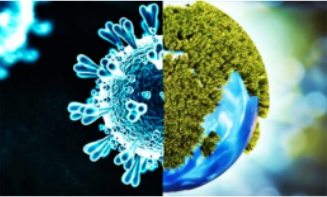
Climate And COVID-19: Converging Crises
(https: //bibliotecapleyades.net/imagenes_ciencia4/dimatechange.jpg)
The climate crisis is still raging. A year ago, news headlines were dominated by the climate youth movement and a sense of urgency. But COVID-19 has displaced that interest and awareness. In fact, the causes of both crises share commonalities, and their effects are converging. The climate emergency and COVID-19, a zoonotic disease, are both borne of human activity that has led to environmental degradation. Neither the climate emergency nor a zoonotic pandemic were unexpected. Both have led to the preventable loss of lives through actions that are delayed, insufficient, or mistaken. However, aligning responses presents an opportunity to improve public health, create a sustainable economic future, and better protect the planet's remaining natural resources and biodiversity.
That health and climate change are interwoven is widely accepted, with extensive evidence of their interactions. For the past 5 years, the Lancet Countdown on Health and Climate Change has monitored and reported more than 40 global indicators that measure the impact of our changing climate on health. The newly published 2020 report includes novel indicators on heat-related mortality, migration and population displacement, urban green spaces, low-carbon diets, and the economic costs of labour capacity loss due to extreme heat. The breadth of the indicators has deepened scientific understanding of how climate affects health and puts stress on health systems. […]
Curbing the drivers of climate change will help to suppress the emergence and re-emergence of zoonotic diseases that are made more likely by intensive farming, international trade of exotic animals, and increased human encroachment into wildlife habitats, which in turn increase the likelihood of contact between people and zoonotic disease. Increased international travel and urbanisation leading to higher population density encourage the rapid spread of zoonoses once they spill over into the human population. These factors also have an important role in climate change as environmental determinants of health.
Both COVID-19 and the climate crisis have exposed the fact that the poorest and most marginalised people in society, such as migrants and refugee populations, are always the most vulnerable to shocks. With regard to climate change, those most impacted by extremes have usually contributed the least to the root causes of the crisis. This year's Countdown report finds that no country is immune to avoidable loss of lives arising from widening inequalities, with every indicator in the report following a worsening trend.
Climate has slipped from the top of the global agenda because of political indifference and the need to deal with the immediacies of COVID-19. 5 years on from the Paris Agreement, seizing the opportunity to refocus interests on sustainability offers the cobenefits of protecting our future health, the environment, and our planetary systems. As governments embark on economic recovery plans in the wake of COVID-19, concerns for climate change and equity are rightly focused on a green recovery. A global rapid transition to clean energy sources is needed, ending the stranglehold of fossil fuels. Decisions being made now must tackle both crises together to ensure the most effective response to each.
(Adapted from https://www.thelancet.com/journals/lancet/article/PIIS0140- 6736(20)32579-4/fulltext, published: December 02, 2020)
The final sentence expresses a
Questão 18 6695510
Mackenzie 2021READ TEXT AND ANSWER THE QUESTION
TEXT
Climate And COVID-19: Converging Crises
(https: //bibliotecapleyades.net/imagenes_ciencia4/dimatechange.jpg)
The climate crisis is still raging. A year ago, news headlines were dominated by the climate youth movement and a sense of urgency. But COVID-19 has displaced that interest and awareness. In fact, the causes of both crises share commonalities, and their effects are converging. The climate emergency and COVID-19, a zoonotic disease, are both borne of human activity that has led to environmental degradation. Neither the climate emergency nor a zoonotic pandemic were unexpected. Both have led to the preventable loss of lives through actions that are delayed, insufficient, or mistaken. However, aligning responses presents an opportunity to improve public health, create a sustainable economic future, and better protect the planet's remaining natural resources and biodiversity.
That health and climate change are interwoven is widely accepted, with extensive evidence of their interactions. For the past 5 years, the Lancet Countdown on Health and Climate Change has monitored and reported more than 40 global indicators that measure the impact of our changing climate on health. The newly published 2020 report includes novel indicators on heat-related mortality, migration and population displacement, urban green spaces, low-carbon diets, and the economic costs of labour capacity loss due to extreme heat. The breadth of the indicators has deepened scientific understanding of how climate affects health and puts stress on health systems. […]
Curbing the drivers of climate change will help to suppress the emergence and re-emergence of zoonotic diseases that are made more likely by intensive farming, international trade of exotic animals, and increased human encroachment into wildlife habitats, which in turn increase the likelihood of contact between people and zoonotic disease. Increased international travel and urbanisation leading to higher population density encourage the rapid spread of zoonoses once they spill over into the human population. These factors also have an important role in climate change as environmental determinants of health.
Both COVID-19 and the climate crisis have exposed the fact that the poorest and most marginalised people in society, such as migrants and refugee populations, are always the most vulnerable to shocks. With regard to climate change, those most impacted by extremes have usually contributed the least to the root causes of the crisis. This year's Countdown report finds that no country is immune to avoidable loss of lives arising from widening inequalities, with every indicator in the report following a worsening trend.
Climate has slipped from the top of the global agenda because of political indifference and the need to deal with the immediacies of COVID-19. 5 years on from the Paris Agreement, seizing the opportunity to refocus interests on sustainability offers the cobenefits of protecting our future health, the environment, and our planetary systems. As governments embark on economic recovery plans in the wake of COVID-19, concerns for climate change and equity are rightly focused on a green recovery. A global rapid transition to clean energy sources is needed, ending the stranglehold of fossil fuels. Decisions being made now must tackle both crises together to ensure the most effective response to each.
(Adapted from https://www.thelancet.com/journals/lancet/article/PIIS0140- 6736(20)32579-4/fulltext, published: December 02, 2020)
Evidence from the 2020 report mentioned indicates that
06