


![[Marketing] Questao Topo - deslogado](https://storage.estuda.com.br/banners/0_6b7ebee90b03af1c560c73bb8bcce34a_banner_deslogado_70_dias.png)
Questões de Inglês
19.971 Questões
Questão 16 6856537
FEMA Medicina 2021/2Leia o texto para responder a questão.
Average westerner’s eating habits lead to loss of four trees every year
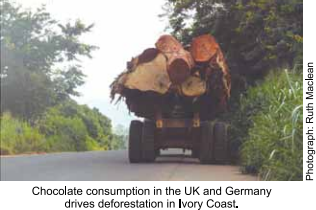
The average western consumer of coffee, chocolate, beef, palm oil and other commodities is responsible for the felling of four trees every year, many in wildlife-rich tropical forests, research has calculated.
Destruction of forests is a major cause of both the climate crisis and plunging wildlife populations, as natural ecosystems are razed for farming. The study is the first to fully link highresolution maps of global deforestation to the wide range of commodities imported by each country across the world.
The research lays bare the direct links between consumers and the loss of forests across the planet. Chocolate consumption in the UK and Germany is an important driver of deforestation in Ivory Coast and Ghana, the scientists found, while beef and soy demand in the US, European Union and China results in forest destruction in Brazil.
Consumption in G7 states accounts for an average loss of four trees a year per person, the research says; the US is above average with five trees being lost per capita. In five G7 countries — the UK, Japan, Germany, France, and Italy — more than 90% of their deforestation footprint was in foreign countries and half of this was in tropical nations.
(Damian Carrington. www.theguardian.com, 29.03.2021. Adaptado.)
According to the fourth paragraph, the largest loss of trees a year per person related to consumption is in
Questão 10 6790013
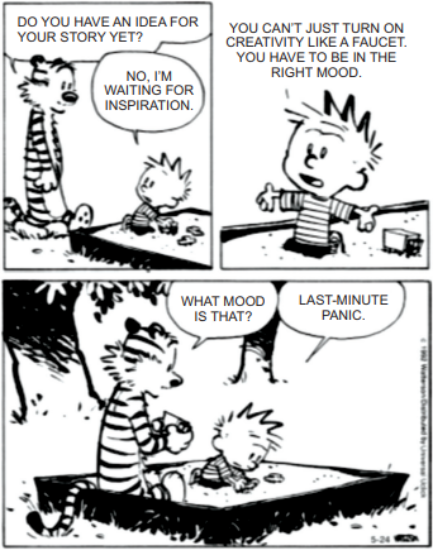
UERR 2021Examine a tira Calvin and Hobbes, de Bill Watterson.
(www.gocomics.com)
O tema central da tira é a
Questão 18 6780161
UnirG 2021/1Read the text to answer question.
‘The Terror of Blue John Gap’ is a short story written by Sir Arthur Conan Doyle, first published in 1912. He is best known as the creator of the great fictional detective, Sherlock Holmes. This story is set in the English county of Derbyshire, in the Peak District, near the village of Castleton. The main action takes place in the old, disused Blue John mines in the area. Blue John Stone is a rare, semi-precious mineral.
The story is as a series of diary entries, written by Dr James Hardcastle and found after his disappearance. Armitage, a local man, who introduces the story, describes Hardcastle as a rational and scientific man, “absolutely devoid of imagination, and most unlikely to invent any abnormal series of events”. Dr Hardcastle has been sent to the country to recover from tuberculosis. He is staying on a farm, near the town of Castleton. He spends his time walking in the hills, and he becomes interested in the old disused mines and caves under the hills. Armitage tells Dr Hardcastle the legend of Blue John Gap.
Local people say there is a monster that lives in the underground caves and comes out at night to steal sheep. Armitage says he has heard the monster. Dr Hardcastle is surprised by how superstitious the locals are, until he himself hears the strange noise, too. He decides to explore the cave when he is feeling stronger. Dr Hardcastle starts to explore the entrance of the cave, and wonders if it is possible that some kind of strange creature lives in the underground caves. While in the caves, his candle goes out and he is left in the dark. He hears strange noises and feels the presence of the monster. He immediately runs out of the caves, frightened by his experience, and then he decides to tell someone about what happened. He goes to visit a local doctor. The doctor refers him to a specialist, but Dr Hardcastle chooses not to talk to him. At the same time, sheep go missing on the hills near Blue John Gap. When Armitage also goes missing, Dr Hardcastle decides to tell the police about his experience and yet they laugh at him, so Dr Hardcastle decides to face the monster on his own. He buys a lantern and a rifle, and leaves a note in his bedroom, telling his hosts to look for him in Blue John Gap if he goes missing.
(Available at: https://www.onestopenglish.com/ Accessed in July 2019.)
At the end of the text, the connector yet indicates the idea of:
Questão 17 6780147
UnirG 2021/1Read the text to answer question.
‘The Terror of Blue John Gap’ is a short story written by Sir Arthur Conan Doyle, first published in 1912. He is best known as the creator of the great fictional detective, Sherlock Holmes. This story is set in the English county of Derbyshire, in the Peak District, near the village of Castleton. The main action takes place in the old, disused Blue John mines in the area. Blue John Stone is a rare, semi-precious mineral.
The story is as a series of diary entries, written by Dr James Hardcastle and found after his disappearance. Armitage, a local man, who introduces the story, describes Hardcastle as a rational and scientific man, “absolutely devoid of imagination, and most unlikely to invent any abnormal series of events”. Dr Hardcastle has been sent to the country to recover from tuberculosis. He is staying on a farm, near the town of Castleton. He spends his time walking in the hills, and he becomes interested in the old disused mines and caves under the hills. Armitage tells Dr Hardcastle the legend of Blue John Gap.
Local people say there is a monster that lives in the underground caves and comes out at night to steal sheep. Armitage says he has heard the monster. Dr Hardcastle is surprised by how superstitious the locals are, until he himself hears the strange noise, too. He decides to explore the cave when he is feeling stronger. Dr Hardcastle starts to explore the entrance of the cave, and wonders if it is possible that some kind of strange creature lives in the underground caves. While in the caves, his candle goes out and he is left in the dark. He hears strange noises and feels the presence of the monster. He immediately runs out of the caves, frightened by his experience, and then he decides to tell someone about what happened. He goes to visit a local doctor. The doctor refers him to a specialist, but Dr Hardcastle chooses not to talk to him. At the same time, sheep go missing on the hills near Blue John Gap. When Armitage also goes missing, Dr Hardcastle decides to tell the police about his experience and yet they laugh at him, so Dr Hardcastle decides to face the monster on his own. He buys a lantern and a rifle, and leaves a note in his bedroom, telling his hosts to look for him in Blue John Gap if he goes missing.
(Available at: https://www.onestopenglish.com/ Accessed in July 2019.)
At the beginning of the text (lines 7 – 8), in this sentence – “Armitage, a local man, who introduces the story, describes Hardcastle as a rational and scientific man.” – the pronoun ‘who’
Questão 16 6780143
UnirG 2021/1Read the text to answer question.
‘The Terror of Blue John Gap’ is a short story written by Sir Arthur Conan Doyle, first published in 1912. He is best known as the creator of the great fictional detective, Sherlock Holmes. This story is set in the English county of Derbyshire, in the Peak District, near the village of Castleton. The main action takes place in the old, disused Blue John mines in the area. Blue John Stone is a rare, semi-precious mineral.
The story is as a series of diary entries, written by Dr James Hardcastle and found after his disappearance. Armitage, a local man, who introduces the story, describes Hardcastle as a rational and scientific man, “absolutely devoid of imagination, and most unlikely to invent any abnormal series of events”. Dr Hardcastle has been sent to the country to recover from tuberculosis. He is staying on a farm, near the town of Castleton. He spends his time walking in the hills, and he becomes interested in the old disused mines and caves under the hills. Armitage tells Dr Hardcastle the legend of Blue John Gap.
Local people say there is a monster that lives in the underground caves and comes out at night to steal sheep. Armitage says he has heard the monster. Dr Hardcastle is surprised by how superstitious the locals are, until he himself hears the strange noise, too. He decides to explore the cave when he is feeling stronger. Dr Hardcastle starts to explore the entrance of the cave, and wonders if it is possible that some kind of strange creature lives in the underground caves. While in the caves, his candle goes out and he is left in the dark. He hears strange noises and feels the presence of the monster. He immediately runs out of the caves, frightened by his experience, and then he decides to tell someone about what happened. He goes to visit a local doctor. The doctor refers him to a specialist, but Dr Hardcastle chooses not to talk to him. At the same time, sheep go missing on the hills near Blue John Gap. When Armitage also goes missing, Dr Hardcastle decides to tell the police about his experience and yet they laugh at him, so Dr Hardcastle decides to face the monster on his own. He buys a lantern and a rifle, and leaves a note in his bedroom, telling his hosts to look for him in Blue John Gap if he goes missing.
(Available at: https://www.onestopenglish.com/ Accessed in July 2019.)
The narrator of the story is:
Questão 22 6766646
UFRR Módulo 3 2021TEXT
The World’s Largest Tropical Wetland Has Become an Inferno
By Catrin Einhorn, Maria Magdalena Arréllaga, Blacki Migliozzi and Scott Reinhard
This year, roughly a quarter of the vast Pantanal wetland in Brazil, one of the most biodiverse places on Earth, has burned in wildfires worsened by climate change. What happens to a rich and unique biome when so much is destroyed?
The unprecedented fires in the wetland have attracted less attention than blazes in Australia, the Western United States and the Amazon, its celebrity sibling to the north. But while the Pantanal is not a global household name, tourists in the know flock there because it is home to exceptionally high concentrations of breathtaking wildlife: Jaguars, tapirs, endangered giant otters and bright blue hyacinth macaws. Like a vast tub, the wetland swells with water during the rainy season and empties out during the dry months. Fittingly, this rhythm has a name that evokes a beating heart: the flood pulse.
The wetland, which is larger than Greece and stretches over parts of Brazil, Paraguay and Bolivia, also offers unseen gifts to a vast swath of South America by regulating the water cycle upon which life depends. Its countless swamps, lagoons and tributaries purify water and help prevent floods and droughts. They also store untold amounts of carbon, helping to stabilize the climate.
(…)
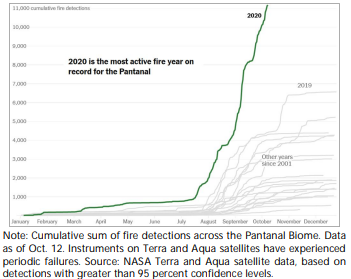
Naturally occurring fire plays a role in the Pantanal, in addition to the burning by ranchers. The flames are usually contained by the landscape’s mosaic of water. But this year’s drought sucked these natural barriers dry. The fires are far worse than any since satellite records began.
The fires are also worse than any in the memory of the Guató people, an Indigenous group whose ancestors have lived in the Pantanal for thousands of years.
Guató leaders in an Indigenous territory called Baía dos Guató said the fires spread from the ranches that surround their land, and satellite images confirm that the flames swept in from the outside. When fire started closing in on the home of Sandra Guató Silva, a community leader and healer, she fought to save it with the help of her son, grandson and a boat captain with a hose.
(...)
Now Ms. Guató Silva mourns the loss of nature itself. “It makes me sick,” she said. “The birds don’t sing anymore. I no longer hear the song of the Chaco chachalaca bird. Even the jaguar that once scared me is suffering. That hurts me. I suffer from depression because of this. Now there is a hollow silence. I feel as though our freedom has left us, has been taken from us with the nature that we have always protected.”
Disponível em: https://www.nytimes.com/interactive/2020/10/13/climate/pantanalbrazil-fires.html Acesso em: 12 nov. 2020.
According to the data analyzed and reported by The New York Times agency, “The fires are far worse than any since satellite records began”.
By reading the graph, the months when the cumulative sum of fire detections across Pantanal started to increase were:
06