


![[Marketing] Questao Topo - deslogado](https://storage.estuda.com.br/banners/0_6b7ebee90b03af1c560c73bb8bcce34a_banner_deslogado_70_dias.png)
Questões de Inglês
19.971 Questões
Questão 17 6888121
UPF Inverno 2021Text
Biden, Calling for Action, Commits U.S. to Halving Its Climate Emissions
Addressing leaders at a virtual summit meeting he convened, the president cast the fight against global warming as an economic opportunity for the world.
By Lisa Friedman, Somini Sengupta and Coral Davenport Published April 22, 2021 - Updated April 28, 2021
WASHINGTON — President Biden on Thursday moved to put four years of official climate denial behind the United
States, declaring that America would cut its global warming emissions at least in half by the end of the decade.
Addressing 40 world leaders at the start of a two-day summit about the U.S. return to the Paris climate agreement,
Mr. Biden sought to galvanize other countries to take more aggressive steps. He cast the challenge of avoiding
[5] catastrophic warming as an economic opportunity for America and the world, a striking contrast to his predecessor
who had abandoned the agreement. “This is a moral imperative, an economic imperative” Mr. Biden said. “A
moment of peril, but also a moment of extraordinary possibilities.”
In rapid succession, Japan, Canada, Britain and the European Union committed to steeper cuts. But China, India
and Russia made no new emissions promises, and even Mr. Biden’s commitment to cut U.S. greenhouse gases 50
[10] percent to 52 percent below 2005 levels by the end of the decade will be extraordinarily difficult to meet,
economically and politically.
Energy experts said it would require a dramatic overhaul of American society, including the virtual elimination of
coal for electricity and the replacement of millions of gasoline-powered cars with electric vehicles. And the Biden
administration’s ambitions cut to the heart of its toughest diplomatic challenge: Dealing with China. While the United
[15] States is the largest emitter in history, China’s emissions are currently the largest, which only add to the issues that
have both Republicans and Democrats seething at Beijing.
The stakes are enormous, for Mr. Biden and for the planet. If nations fail to keep global temperatures from rising
more than 1.5 degrees Celsius above preindustrial levels, the world economy will suffer $23 trillion in losses by
midcentury from natural disasters and the spread of disease, according to a report from Swiss Re, one of the world’s
[20] largest providers of insurance to other insurance companies.
American credibility has been battered by years of joining and then abandoning efforts to tackle climate change; if
the United States does not meet its new goals, or if it reverses course once again with a new administration, trust
from the international community would plunge still further.
Retrieved and adapted from: https://www.nytimes.com/2021/04/22/climate/biden-climate-change.html.Access on May 2nd, 2021.
Considering the summit mentioned, the only question that cannot be answered based on the text content is
Questão 23 6886375
UPF Verão 2021Text
Singing away the coronavirus blues: making music in a time of crisis reminds us we belong
March 24, 2020
By Michelle Langley and Leah Coutts
In being confined to our homes, we are missing our normal social support from friends and family, and our freedom
to control our day-to-day lives. But making music provides a means to regain control.
People in Spain have been filmed acting out with music, creating duos across apartment buildings. The citizens of
Wuhan chanting “Keep it up, Wuhan!” and singing patriotic songs from their windows encouraged themselves and
[5] their neighbours in their efforts to save their city. In Italy, citizens have been playing instruments and singing from
their balconies during their lockdown. Parodies on YouTube are both lifting community spirits and reminding people
to look after each other.
For some, this behaviour might have begun with trying to break the tedium of staying confined at home. But others
clearly wished to support their community in one of the only ways they had left available to them: by making music.
[10] It is an antidote to the growing sense of alienation and isolation in society in general – even more so now we are
being asked to actively practise social distancing and isolation. In the face of uncertainty and panic, music is a social
balm for soothing anxiety, enhancing community connections and acting in defiance of a threat to community spirit.
During the coronavirus crisis, community support has evolved from a series of spontaneous musical flash mobs to
connect with each other to coordinated displays of appreciation – including clapping, shouting and singing – to
[15] acknowledge the health workers on the front lines. Much like singing, this external expression of gratitude is helping
people to cope in times of crisis: providing personal and social development, mental health and well-being benefits,
and community strength and harmony.
Finding the first evidence for singing – likely our first foray into music – is impossible, though instruments dating
back some 40,000 years have been found in Europe. These bone flutes would not be the first instruments to be
[20] created, however, as they already show signs of complex design and most musical tools, such as skin drums,
couldn’t survive the many thousands of years to discovery by an archaeologist.
Today, music is the most consumed form of culture. People listen to music to regulate their mood, to achieve self
awareness, and as an expression of personal and collective identity and social relatedness.
The ability of music to increase social cohesion and direct human attention was probably a key reason for its
[25] development throughout human behavioural evolution, allowing early humans to convey emotions and intentions
effectively. This communication could prove decisive in times of stress, and ultimately mean the difference between
life and death. Now, we are seeing this age-old human adaptation once again being mobilised in response to the
COVID-19 pandemic to keep communities pulling together.
Retrieved and adapted from https://theconversation.com/singing-away-the-coronavirus-blues-making-music-in-a-time-of-crisis-reminds-us-webelong-133790. Access on April 20, 2020.
According to the article, in the Covid-19 pandemic crisis, music
I. joins residents together in different parts of the world, although in confinement.
II. conducts people to look after their individual concerns, only.
III. keeps spirits up and reminds people to act with the greater good in mind.
IV. supports communities in times of need.
The true statements are
Questão 22 6886344
UPF Verão 2021Text
Singing away the coronavirus blues: making music in a time of crisis reminds us we belong
March 24, 2020
By Michelle Langley and Leah Coutts
In being confined to our homes, we are missing our normal social support from friends and family, and our freedom
to control our day-to-day lives. But making music provides a means to regain control.
People in Spain have been filmed acting out with music, creating duos across apartment buildings. The citizens of
Wuhan chanting “Keep it up, Wuhan!” and singing patriotic songs from their windows encouraged themselves and
[5] their neighbours in their efforts to save their city. In Italy, citizens have been playing instruments and singing from
their balconies during their lockdown. Parodies on YouTube are both lifting community spirits and reminding people
to look after each other.
For some, this behaviour might have begun with trying to break the tedium of staying confined at home. But others
clearly wished to support their community in one of the only ways they had left available to them: by making music.
[10] It is an antidote to the growing sense of alienation and isolation in society in general – even more so now we are
being asked to actively practise social distancing and isolation. In the face of uncertainty and panic, music is a social
balm for soothing anxiety, enhancing community connections and acting in defiance of a threat to community spirit.
During the coronavirus crisis, community support has evolved from a series of spontaneous musical flash mobs to
connect with each other to coordinated displays of appreciation – including clapping, shouting and singing – to
[15] acknowledge the health workers on the front lines. Much like singing, this external expression of gratitude is helping
people to cope in times of crisis: providing personal and social development, mental health and well-being benefits,
and community strength and harmony.
Finding the first evidence for singing – likely our first foray into music – is impossible, though instruments dating
back some 40,000 years have been found in Europe. These bone flutes would not be the first instruments to be
[20] created, however, as they already show signs of complex design and most musical tools, such as skin drums,
couldn’t survive the many thousands of years to discovery by an archaeologist.
Today, music is the most consumed form of culture. People listen to music to regulate their mood, to achieve self
awareness, and as an expression of personal and collective identity and social relatedness.
The ability of music to increase social cohesion and direct human attention was probably a key reason for its
[25] development throughout human behavioural evolution, allowing early humans to convey emotions and intentions
effectively. This communication could prove decisive in times of stress, and ultimately mean the difference between
life and death. Now, we are seeing this age-old human adaptation once again being mobilised in response to the
COVID-19 pandemic to keep communities pulling together.
Retrieved and adapted from https://theconversation.com/singing-away-the-coronavirus-blues-making-music-in-a-time-of-crisis-reminds-us-webelong-133790. Access on April 20, 2020.
The sentence which does not represent an idea from the text is
Questão 20 6886279
UPF Verão 2021Text
Zoom's massive 'overnight success' actually took nine years
By Samantha Murphy Kelly, CNN Business
When you think of a social network, you probably imagine news feeds, birthday reminders and baby photos. But
the social network of the moment -- the one that's currently getting more app downloads than either Snapchat or
TikTok -- looks a little different: It's a videoconferencing service called Zoom, where many peoples' work and social
lives now unfold.
[5] As the coronavirus pandemic has forced millions around the world to stay in their homes, the 9-year-old platform
has emerged as the go-to service for not only virtual meetings and classroom lessons but happy hours, costume
parties, church services, brunches, book clubs and romantic dates. Like Facebook and Twitter, it's also become a
key part of internet culture: The Facebook Group "Zoom Memes for Self Quarantines," with nearly 395,000
members, offers a steady stream of jokes, ranging from a video of a student pretending Zoom is glitchy to get out
[10] of a homework assignment to a professor starting a lesson with cameos from stuffed animals.
From the start, Zoom aspired to stand out in a market of products that were probably more hated than loved. In
a letter to shareholders included with its paperwork for going public a year ago, founder and CEO Eric Yuan talked
about "how unhappy" people were with the videoconference tools on the market. But that was before the pandemic.
Now video conferencing tools have gone from the punchline of a dry office joke to a vital social lifeline - and perhaps
[15] none more so than Zoom.
Zoom's free version can host up 100 video participants at once - Microsoft (MSFT- owned Skype's free model allows
for 50 - and features personalized tools, including the ability to pick from different backgrounds (whether it be the
Golden Gate Bridge option or a picture you upload), change the camera angles, hold encrypted private calls, send
direct messages and record sessions. In recent weeks, Zoom has emerged as the most downloaded app on the
[20] Apple App Store, repeatedly breaking its download records.
The company launched in 2011 when Yuan left Cisco as a founding engineer on its WebEx video platform, one
of Zoom's rivals. In April 2019, Zoom went public and fared better than splashier tech companies such as Lyft and
Uber, which held their IPOs around the same time. Zoom shares surged 72% on its first day of trading, giving it
a market valuation of $16 billion. As of Friday, Zoom was valued at more than $40 billion, or roughly as much
[25] as Uber. (Unlike Uber, Zoom is actually profitable.)
From the start of its life as a publicly traded company, investors seemed to ________ Yuan's vision, as laid out his
letter to shareholders: "video is the future of communications." But it looks like that future came much faster and
more abruptly than anyone could have expected. "This is a very critical moment," Yuan said on a conference call
with analysts earlier this month. "Overnight almost everybody read and understood they needed a tool like this." At
[30] the same time, Zoom must work to keep its service up and running amid surging demand for online communication
tools and social networks that has strained far bigger platforms.
Retrieved and adapted from: https://edition.cnn.com/2020/03/27/tech/zoom-appcoronavirus/index.html?fbclid=IwAR0IPLspbqiLT_Y7Eo4wLLSSk8O4pzWPW8z2y_Uhdk86WqIFOCnae7grLpQ. Access on April 05, 2020.
The expression that best fits the gap in “From the start of its life as a publicly traded company, investors seemed to ________ Yuan's vision […]” (line 26), is
Questão 19 6886273
UPF Verão 2021Text
Zoom's massive 'overnight success' actually took nine years
By Samantha Murphy Kelly, CNN Business
When you think of a social network, you probably imagine news feeds, birthday reminders and baby photos. But
the social network of the moment -- the one that's currently getting more app downloads than either Snapchat or
TikTok -- looks a little different: It's a videoconferencing service called Zoom, where many peoples' work and social
lives now unfold.
[5] As the coronavirus pandemic has forced millions around the world to stay in their homes, the 9-year-old platform
has emerged as the go-to service for not only virtual meetings and classroom lessons but happy hours, costume
parties, church services, brunches, book clubs and romantic dates. Like Facebook and Twitter, it's also become a
key part of internet culture: The Facebook Group "Zoom Memes for Self Quarantines," with nearly 395,000
members, offers a steady stream of jokes, ranging from a video of a student pretending Zoom is glitchy to get out
[10] of a homework assignment to a professor starting a lesson with cameos from stuffed animals.
From the start, Zoom aspired to stand out in a market of products that were probably more hated than loved. In
a letter to shareholders included with its paperwork for going public a year ago, founder and CEO Eric Yuan talked
about "how unhappy" people were with the videoconference tools on the market. But that was before the pandemic.
Now video conferencing tools have gone from the punchline of a dry office joke to a vital social lifeline - and perhaps
[15] none more so than Zoom.
Zoom's free version can host up 100 video participants at once - Microsoft (MSFT- owned Skype's free model allows
for 50 - and features personalized tools, including the ability to pick from different backgrounds (whether it be the
Golden Gate Bridge option or a picture you upload), change the camera angles, hold encrypted private calls, send
direct messages and record sessions. In recent weeks, Zoom has emerged as the most downloaded app on the
[20] Apple App Store, repeatedly breaking its download records.
The company launched in 2011 when Yuan left Cisco as a founding engineer on its WebEx video platform, one
of Zoom's rivals. In April 2019, Zoom went public and fared better than splashier tech companies such as Lyft and
Uber, which held their IPOs around the same time. Zoom shares surged 72% on its first day of trading, giving it
a market valuation of $16 billion. As of Friday, Zoom was valued at more than $40 billion, or roughly as much
[25] as Uber. (Unlike Uber, Zoom is actually profitable.)
From the start of its life as a publicly traded company, investors seemed to ________ Yuan's vision, as laid out his
letter to shareholders: "video is the future of communications." But it looks like that future came much faster and
more abruptly than anyone could have expected. "This is a very critical moment," Yuan said on a conference call
with analysts earlier this month. "Overnight almost everybody read and understood they needed a tool like this." At
[30] the same time, Zoom must work to keep its service up and running amid surging demand for online communication
tools and social networks that has strained far bigger platforms.
Retrieved and adapted from: https://edition.cnn.com/2020/03/27/tech/zoom-appcoronavirus/index.html?fbclid=IwAR0IPLspbqiLT_Y7Eo4wLLSSk8O4pzWPW8z2y_Uhdk86WqIFOCnae7grLpQ. Access on April 05, 2020.
The purpose of mentioning “TikTok” and “Snapchat” (lines 2 e 3) in the text is due to the
Questão 16 6856537
FEMA Medicina 2021/2Leia o texto para responder a questão.
Average westerner’s eating habits lead to loss of four trees every year
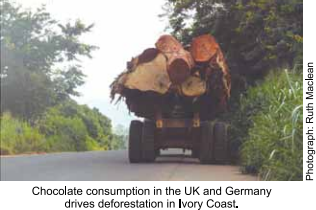
The average western consumer of coffee, chocolate, beef, palm oil and other commodities is responsible for the felling of four trees every year, many in wildlife-rich tropical forests, research has calculated.
Destruction of forests is a major cause of both the climate crisis and plunging wildlife populations, as natural ecosystems are razed for farming. The study is the first to fully link highresolution maps of global deforestation to the wide range of commodities imported by each country across the world.
The research lays bare the direct links between consumers and the loss of forests across the planet. Chocolate consumption in the UK and Germany is an important driver of deforestation in Ivory Coast and Ghana, the scientists found, while beef and soy demand in the US, European Union and China results in forest destruction in Brazil.
Consumption in G7 states accounts for an average loss of four trees a year per person, the research says; the US is above average with five trees being lost per capita. In five G7 countries — the UK, Japan, Germany, France, and Italy — more than 90% of their deforestation footprint was in foreign countries and half of this was in tropical nations.
(Damian Carrington. www.theguardian.com, 29.03.2021. Adaptado.)
According to the fourth paragraph, the largest loss of trees a year per person related to consumption is in
06