


![[Marketing] Questao Topo - deslogado](https://storage.estuda.com.br/banners/0_6b7ebee90b03af1c560c73bb8bcce34a_banner_deslogado_70_dias.png)
Questões de Inglês
19.971 Questões
Questão 37 8065858
FMC Medicina 2021/2Can we stop wearing masks after being vaccinated?
In some countries, wearing masks against COVID-19 is not mandatory anymore, but can the world follow suit?
21 May 2021- by Pryia Joi
The US Centers for Disease Control and Prevention (CDC) announced in late April (2021) that people who have been fully vaccinated would not need to wear masks any more in most places, except for high-risk areas such as hospitals, nursing homes and on public transport. This change provides an extra incentive for people in the United States to get vaccinated. A few other countries have already gone maskfree, and it is probably one of the things people are looking forward to in a bid to return to normal, but it may not be the right approach for all countries just yet.
MASK-FREE NATIONS
Israel was the first country to lift the mandatory face mask rule, when it achieved low rates of symptomatic COVID-19 disease in April. Around 70% of the population has been vaccinated. Bhutan is also mask-free, after vaccinating 90% of its population in just two weeks.
New Zealand, which has been praised from the start for its rapid and effective response to the pandemic, has stopped the spread of COVID-19 among its population using non-pharmaceutical interventions such as tracking, tracing, and isolation of cases, so no-one has to wear masks anymore. China, one of the worst-hit countries at the start of the pandemic, brought the disease under control, and now masks are not mandatory anymore.
WHEN CAN WE ALL DITCH THE MASKS?
The US CDC justified their decision on a study indicating that healthcare workers at St. Jude’s Hospital in Memphis, Tennessee who received two doses of the Pfizer vaccine were 75% less likely to have asymptomatic infections. This means that if people have been vaccinated and they are not showing any symptoms of infection, they are much less likely to spread COVID-19 undetected.
However, it's not clear that all other vaccines, used in other countries, work equally well at preventing asymptomatic infections, or that any vaccine would do as well against the virus new variants. In addition, several new variants of SARS-CoV-2 also seem to affect children more than last year, and given that children are not yet vaccinated, and, in many countries, young children don’t have to wear masks, continuing to enforce mask-wearing even in vaccinated adults may be important.
Available in: https://www.gavi.org/vaccineswork?gclid=Cj0KCQjwktKFB hCkARIsAJeDT0hnVYDGKpEitbKv_sRM0B8DkPUsFqfa7 Wz7X35r69mo-6IZclv-wLsaAjGhEALw_wcB. Access: 20 May 2020. Adapted.
The main topic discussed in the text is the
Questão 14 7879305
UNIFAN Medicina 2021/1Read the text below.
ARE VIRUSES ALIVE?
For about 100 years, the scientific community has repeatedly changed its collective mind over what viruses are. First seen as poisons, then as lifeforms, then biological chemicals, viruses today are thought of as being in a gray area between living and nonliving: they cannot replicate on their own but can do so in truly living cells and can also affect the behavior of their hosts profoundly. Finally, however, scientists are beginning to appreciate viruses as fundamental players in the history of life.
To Be or Not to Be
The seemingly simple question of whether or not viruses are alive, which my students often ask, has probably defied a simple answer all these years because it raises a fundamental issue: What exactly defines “life?” A precise scientific definition of life is an elusive thing, but most observers would agree that life includes certain qualities in addition to an ability to replicate. For example, a living entity is in a state bounded by birth and death. Living organisms also are thought to require a degree of biochemical autonomy, carrying on the metabolic activities that produce the molecules and energy needed to sustain the organism. This level of autonomy is essential to most definitions.
Viruses, however, parasitize essentially all biomolecular aspects of life. That is, they depend on the host cell for the raw materials and energy necessary for nucleic acid synthesis, protein synthesis, processing and transport, and all other biochemical activities that allow the virus to multiply and spread. One might then conclude that even though these processes come under viral direction, viruses are simply nonliving parasites of living metabolic systems.
(Source: scientificamerican.com)
According to the text, a clear definition of virus is difficult because
Questão 12 7879300
UNIFAN Medicina 2021/1Read the text below.
ARE VIRUSES ALIVE?
For about 100 years, the scientific community has repeatedly changed its collective mind over what viruses are. First seen as poisons, then as lifeforms, then biological chemicals, viruses today are thought of as being in a gray area between living and nonliving: they cannot replicate on their own but can do so in truly living cells and can also affect the behavior of their hosts profoundly. Finally, however, scientists are beginning to appreciate viruses as fundamental players in the history of life.
To Be or Not to Be
The seemingly simple question of whether or not viruses are alive, which my students often ask, has probably defied a simple answer all these years because it raises a fundamental issue: What exactly defines “life?” A precise scientific definition of life is an elusive thing, but most observers would agree that life includes certain qualities in addition to an ability to replicate. For example, a living entity is in a state bounded by birth and death. Living organisms also are thought to require a degree of biochemical autonomy, carrying on the metabolic activities that produce the molecules and energy needed to sustain the organism. This level of autonomy is essential to most definitions.
Viruses, however, parasitize essentially all biomolecular aspects of life. That is, they depend on the host cell for the raw materials and energy necessary for nucleic acid synthesis, protein synthesis, processing and transport, and all other biochemical activities that allow the virus to multiply and spread. One might then conclude that even though these processes come under viral direction, viruses are simply nonliving parasites of living metabolic systems.
(Source: scientificamerican.com)
The text makes an intertextuality reference to
Questão 14 7766892
FGV-SP Economia 1ª Fase - LEI/ FIS/QUI/LPO BLOCO 3 2021/1Read the text to answer question.
The formula for calculating people’s environmental footprint is simple, but widely misunderstood: Impact = Population x Affluence x Technology (I = PAT). The global rate of consumption growth, before the pandemic, was 3% a year. Population growth is 1%. Some people assume this means that the rise in population bears one-third of the responsibility for increased consumption. But population growth is overwhelmingly concentrated among the world’s poorest people, who have scarcely any A or T to multiply their P.
Yet it is widely used as a blanket explanation of environment breakdown. Panic about population growth enables the people most responsible for the impacts of rising consumption (the affluent) to blame those who are least responsible.
(George Monbiot. www.theguardian.com, 26.08.2020. Adapted.)
The text states that
Questão 12 7766826
FGV-SP Economia 1ª Fase - LEI/ FIS/QUI/LPO BLOCO 3 2021/1The American embassy escaped the blast in Beirut’s port unscathed. Many Western countries either have missions in the city centre or diplomats who live in the area. The wife of the Dutch ambassador was killed, as was a German diplomat. But America’s embassy sits in the mountain village of Awkar, five miles from the port. Security measures are onerous, a hangover from the bombing of the American embassy in Beirut in 1983, which killed 63 people. It took a week before the ambassador, Dorothy Shea, a career diplomat, toured the port. Even on social media it has been far quieter than other foreign powers.
(www.economist.com, 13.08.2020. Adapted.)
The descriptions in the paragraph
Questão 11 7766813
FGV-SP Economia 1ª Fase - LEI/ FIS/QUI/LPO BLOCO 3 2021/1Read the text and the graphs.
Bypassed by the rescue
In a pandemic that’s wreaked widespread economic havoc, Cleveland has been among the hardesthit cities in the U.S. And at a time when the U.S. is engaged in another conversation about its foundational racial inequalities, not much of Washington’ $2 trillion has reached Cleveland’s predominantly Black neighborhoods.
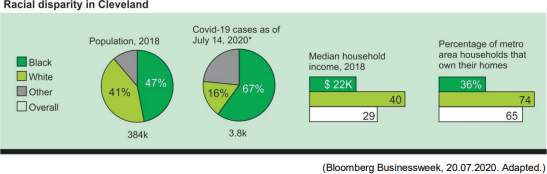
By comparing the text and the graphs it is possible to state that
06