


![[Marketing] Questao Topo - deslogado](https://storage.estuda.com.br/banners/0_6b7ebee90b03af1c560c73bb8bcce34a_banner_deslogado_70_dias.png)
Questões de Inglês
19.971 Questões
Questão 10 14731051
PUC-SP Verão A 2021Temperatures of deepest ocean rising quicker than previously thought
Warming ocean contributes to sea level rise and to more extreme weather such as hurricanes
10/14th, 2020

Studies say high levels of climate pollution by the end of the century will penetrate deeper in the ocean, threatening sea creatures. Photograph: Alexis Rosenfeld/Getty Images
1- Even the pitch black, nearly freezing waters at the bottom of the ocean – far from where humans live and burn fossil fuels – are slowly warming, according to a study of a decade of hourly measurements.
2- The temperatures are rising quicker than previously thought, as recorded at stations at four different depths in the Atlantic Ocean off the coast of Uruguay. Between 2009 and 2019, the water there at points between 1,360m (4,462ft) and 4,757m deep warmed by 0.02-0.04C.
3- The change may seem minuscule, but it is significant.
4- “If you think about how large the deep ocean is, it’s an enormous amount of heat,” said Christopher Meinen, an oceanographer at the US National Oceanic and Atmospheric Administration (NOAA) and lead author of the study, published in the journal Geophysical Research Letters.
5- While the general consensus has been that the deep ocean is warming, scientists have had to rely on a snapshot of data collected every 10 years from research vessels. Climate models have found that high levels of climate pollution by the end of the century will penetrate deeper in the ocean, threatening deep sea creatures.
6- Roughly 90% of the heat absorbed by the Earth goes into the oceans. Although they warm slowly, the heat makes water molecules expand, contributing to sea-level rise. It also intensifies hurricanes.
7- By comparison, the global land and ocean surface temperatures are heating up much faster. In 2009, they were 0.56C higher than the long-term average. By 2019, they were 0.95C higher, according to NOAA data.
8- Meinen, who spoke for himself and not on behalf of the government agency, said the new findings are consistent with human-caused climate change. However, more research is needed to make definitive conclusions because there is not enough historical data on the deep ocean, which has not been studied as much as Earth’s atmosphere.
9- “We didn’t expect that you would see hour-to-hour and day-to-day variations down that deep,” Meinen said. “There are processes in the deep ocean that are making things change rapidly, and we don’t really know what those processes are yet.”
10-The research data came from a package of instruments scientists had been using for years to study ocean currents. After reading a study from the University of Rhode Island, the team realized the thick glass sphere weighted down by barbell plates also included a temperature sensor that was built into its pressure sensor.
11-The scientists also concluded that deep ocean temperatures must be taken at least yearly to understand long-term trends. They hope the study will prompt others to examine their own temperature data from similar instruments.
12- A better system for observing the ocean – including the deep ocean – could help scientists forecast seasonal weather so farmers can better choose which crops to plant, Meinen said.
in:https://www.theguardian.com/environment/2020/oct/14/enormous-amount-of-heat-even-deepest-ocean-is-warming-study
No parágrafo 11, a expressão must be taken, em The scientists also concluded that deep ocean temperatures must be taken at least yearly to understand long-term trends, pode ser substituída por
Questão 6 14731039
PUC-SP Verão A 2021Temperatures of deepest ocean rising quicker than previously thought
Warming ocean contributes to sea level rise and to more extreme weather such as hurricanes
10/14th, 2020
Studies say high levels of climate pollution by the end of the century will penetrate deeper in the ocean, threatening sea creatures. Photograph: Alexis Rosenfeld/Getty Images
1- Even the pitch black, nearly freezing waters at the bottom of the ocean – far from where humans live and burn fossil fuels – are slowly warming, according to a study of a decade of hourly measurements.
2- The temperatures are rising quicker than previously thought, as recorded at stations at four different depths in the Atlantic Ocean off the coast of Uruguay. Between 2009 and 2019, the water there at points between 1,360m (4,462ft) and 4,757m deep warmed by 0.02-0.04C.
3- The change may seem minuscule, but it is significant.
4- “If you think about how large the deep ocean is, it’s an enormous amount of heat,” said Christopher Meinen, an oceanographer at the US National Oceanic and Atmospheric Administration (NOAA) and lead author of the study, published in the journal Geophysical Research Letters.
5- While the general consensus has been that the deep ocean is warming, scientists have had to rely on a snapshot of data collected every 10 years from research vessels. Climate models have found that high levels of climate pollution by the end of the century will penetrate deeper in the ocean, threatening deep sea creatures.
6- Roughly 90% of the heat absorbed by the Earth goes into the oceans. Although they warm slowly, the heat makes water molecules expand, contributing to sea-level rise. It also intensifies hurricanes.
7- By comparison, the global land and ocean surface temperatures are heating up much faster. In 2009, they were 0.56C higher than the long-term average. By 2019, they were 0.95C higher, according to NOAA data.
8- Meinen, who spoke for himself and not on behalf of the government agency, said the new findings are consistent with human-caused climate change. However, more research is needed to make definitive conclusions because there is not enough historical data on the deep ocean, which has not been studied as much as Earth’s atmosphere.
9- “We didn’t expect that you would see hour-to-hour and day-to-day variations down that deep,” Meinen said. “There are processes in the deep ocean that are making things change rapidly, and we don’t really know what those processes are yet.”
10-The research data came from a package of instruments scientists had been using for years to study ocean currents. After reading a study from the University of Rhode Island, the team realized the thick glass sphere weighted down by barbell plates also included a temperature sensor that was built into its pressure sensor.
11-The scientists also concluded that deep ocean temperatures must be taken at least yearly to understand long-term trends. They hope the study will prompt others to examine their own temperature data from similar instruments.
12- A better system for observing the ocean – including the deep ocean – could help scientists forecast seasonal weather so farmers can better choose which crops to plant, Meinen said.
in:https://www.theguardian.com/environment/2020/oct/14/enormous-amount-of-heat-even-deepest-ocean-is-warming-study
Leia o texto com atenção e escolha a alternativa correta.
Questão 37 14705109
UNESP 2 Fase - Conhecimentos Específicos 2021Os meios de transporte e comunicação em massa, as mercadorias, casa, alimento e roupa, a produção irresistível da indústria de diversões e informação trazem consigo atitudes e hábitos prescritos, certas reações intelectuais e emocionais que prendem os consumidores mais ou menos agradavelmente aos produtores e, através destes, ao todo. Os produtos doutrinam e manipulam; […] E, ao ficarem esses produtos benéficos à disposição de maior número de indivíduos e de classes sociais, a doutrinação que eles portam deixa de ser publicidade; torna-se um estilo de vida.
(Herbert Marcuse. A ideologia da sociedade industrial: o homem unidimensional, 1973.)
Marcuse critica o modelo de produção da sociedade indus trial, que, segundo o texto, se expressa na
Questão 17 14704080
UNESP 2 Fase - Conhecimentos Específicos 2021Leia o texto para responder à questão.
“Culture is language”:
why an indigenous tongue is thriving in Paraguay

Paraguayan Guaraní — a language descended from several indigenous tongues — remains one of the main languages of 70% of Paraguay’s population.
On a hillside monument in Asunción, a statue of the mythologized indigenous chief Lambaré stands alongside other great leaders from Paraguayan history. The other historical heroes on display are of mixed ancestry, but the idea of a noble indigenous heritage is strong in Paraguay, and — uniquely in the Americas — can be expressed by most of the country’s people in an indigenous language: Paraguayan Guaraní. “Guaraní is our culture — it’s where our roots are,” said Tomasa Cabral, a market vendor in the city.
Elsewhere in the Americas, European colonial languages are pushing native languages towards extinction, but Paraguayan Guaraní — a language descended from several indigenous tongues — remains one of the main languages of 70% of the country’s population. And unlike other widely spoken native tongues — such as Quechua, Aymara or the Mayan languages — it is overwhelmingly spoken by non-indigenous people.
Miguel Verón, a linguist and member of the Academy of the Guaraní Language, said the language had survived partly because of the landlocked country’s geographic isolation and partly because of the “linguistic loyalty” of its people. “The indigenous people refused to learn Spanish,” he said. “The imperial governors had to learn to speak Guaraní.” But while it remains under pressure from Spanish, Paraguayan Guaraní is itself part of the threat looming over the country’s other indigenous languages. Paraguay’s 19 surviving indigenous groups each have their own tongue, but six of them are listed by Unesco as severely or critically endangered.
The benefits of speaking the country’s two official languages were clear. Spanish remains the language of government, and Paraguayan Guaraní is widely spoken in rural areas, where it is a key requisite for many jobs. But the value of maintaining other tongues was incalculable, said Alba Eiragi Duarte, a poet from the Ava Guaraní people. “Our culture is transmitted through our own language: culture is language. When we love our language, we love ourselves.”
(William Costa. www.theguardian.com, 03.09.2020. Adaptado.)
The excerpt from the third paragraph “But while it remains under pressure from Spanish, Paraguayan Guaraní is itself part of the threat looming over the country’s other indigenous languages” means that Paraguayan Guaraní
Questão 29 14659316
UPE SSA 3ª Fase - 1° Dia 2021Text 1
ZOOM FATIGUE
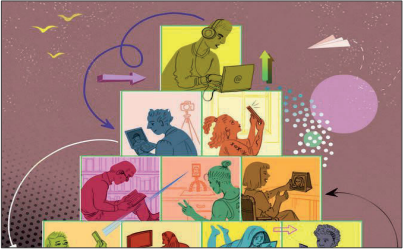
1 For many of us who are still working we are waking up to a calendar filled with Zoom meetings. Not only are we packing in more Zoom meetings than we probably would in a normal office setting, but it has made us all fatigued. Why are Zoom meetings so exhausting? Shouldn‘t it be less of an effort than in person meeting?
2 We are already exhausted from the upheaval in our lives from the pandemic and while connecting over video chat seems like a way to relieve the isolating aspect of working from home there‘s actually a disconnect happening. In an interview with BBC, Gianpiero Petriglieri explained that being on a video call requires more focus than a face-to-face chat. "Video chats mean we need to work harder to process non-verbal cues like facial expressions, the tone and pitch of the voice, and body language; paying more attention to these consumes a lot of energy".
3 In a face to face meeting we are able to read the room and then adjust our own behaviors accordingly. So you can imagine our brains are operating on overload trying to figure out how to read 50+ "virtual rooms" at the same time while figuring out whether to stare into the persons eyes or their baby succulent in the top left corner of the screen.
4 An initially scheduled 30-minute Zoom meeting can turn into an hour + meeting because of things such as poor wi-fi, frozen screens and software crashes. In the beginning of quarantine, Zoom and many other conferencing platforms were actually crashing several times a day.
6 Our homes have now become our work spaces and our work spaces our homes. Zoom has blurred that balance even more because we are using the platform for work and social purposes. While virtually connecting with friends and family is a great thing, it can be overwhelming after a full work day of doing so. Ask yourself the question, "could this Zoom meeting have been an e-mail?" If the answer is yes try to suggest communicating over e-mail or even just a regular phone call so you don‘t have to worry about what you or background setting look like.
Disponível em: https://www.forbes.com/sites/yolarobert1/2020/04/30/heres-why-youre-feeling-zoom-fatigue/#3233932a2ac6 (Adaptado). Acesso em: 05 jul. 2020. Photo bay: Margaux Quayle Cannon. In:https://www.backstage.com/magazine/article/how-to-conduct-yourself-on-zoom-meeting71092/.
In the 5th paragraph, the word our is used four times as a
Questão 25 14659312
UPE SSA 3ª Fase - 1° Dia 2021Text 1
ZOOM FATIGUE
1 For many of us who are still working we are waking up to a calendar filled with Zoom meetings. Not only are we packing in more Zoom meetings than we probably would in a normal office setting, but it has made us all fatigued. Why are Zoom meetings so exhausting? Shouldn‘t it be less of an effort than in person meeting?
2 We are already exhausted from the upheaval in our lives from the pandemic and while connecting over video chat seems like a way to relieve the isolating aspect of working from home there‘s actually a disconnect happening. In an interview with BBC, Gianpiero Petriglieri explained that being on a video call requires more focus than a face-to-face chat. "Video chats mean we need to work harder to process non-verbal cues like facial expressions, the tone and pitch of the voice, and body language; paying more attention to these consumes a lot of energy".
3 In a face to face meeting we are able to read the room and then adjust our own behaviors accordingly. So you can imagine our brains are operating on overload trying to figure out how to read 50+ "virtual rooms" at the same time while figuring out whether to stare into the persons eyes or their baby succulent in the top left corner of the screen.
4 An initially scheduled 30-minute Zoom meeting can turn into an hour + meeting because of things such as poor wi-fi, frozen screens and software crashes. In the beginning of quarantine, Zoom and many other conferencing platforms were actually crashing several times a day.
6 Our homes have now become our work spaces and our work spaces our homes. Zoom has blurred that balance even more because we are using the platform for work and social purposes. While virtually connecting with friends and family is a great thing, it can be overwhelming after a full work day of doing so. Ask yourself the question, "could this Zoom meeting have been an e-mail?" If the answer is yes try to suggest communicating over e-mail or even just a regular phone call so you don‘t have to worry about what you or background setting look like.
Disponível em: https://www.forbes.com/sites/yolarobert1/2020/04/30/heres-why-youre-feeling-zoom-fatigue/#3233932a2ac6 (Adaptado). Acesso em: 05 jul. 2020. Photo bay: Margaux Quayle Cannon. In:https://www.backstage.com/magazine/article/how-to-conduct-yourself-on-zoom-meeting71092/.
In the 1st paragraph, the word meeting is used four times as
06