


![[Marketing] Questao Topo - deslogado](https://storage.estuda.com.br/banners/0_6b7ebee90b03af1c560c73bb8bcce34a_banner_deslogado_70_dias.png)
Questões de Inglês
19.971 Questões
Questão 12 8103572
UNICEUB Medicina 2022/1Leia o texto para responder à questão.
Warm-blooded animals are changing their physiology to adapt to a hotter climate, the scientists found. This includes getting larger beaks, legs and ears to better regulate their body temperature. When animals overheat, birds use their beaks and mammals use their ears to disperse the warmth. Some creatures in warmer climates have historically evolved to have larger beaks or ears to get rid of heat more easily. These differences are becoming more pronounced as the climate warms.
If animals fail to control their body temperature, they can overheat and die. Beaks, which are not covered by feathers and therefore not insulated, are a site of significant heat exchange, as are ears, tails and legs in mammals if not covered by fur. The review, published in the journal Trends in Ecology & Evolution, found that the differences are particularly pronounced in birds.
The author of the study, Sara Ryding of Deakin University, a bird researcher, said: “Shapeshifting does not mean that animals are coping with climate change and that all is fine. It just means they are evolving to survive it — but we’re not sure what the other ecological consequences of these changes are, or indeed that all species are capable of changing and surviving.”
(Helena Horton. www.theguardian.com, 07.09.2021. Adaptado.)
No trecho do terceiro parágrafo “‘It just means they are evolving to survive it’”, o termo sublinhado refere-se a
Questão 11 8103562
UNICEUB Medicina 2022/1Leia o texto para responder à questão.
Warm-blooded animals are changing their physiology to adapt to a hotter climate, the scientists found. This includes getting larger beaks, legs and ears to better regulate their body temperature. When animals overheat, birds use their beaks and mammals use their ears to disperse the warmth. Some creatures in warmer climates have historically evolved to have larger beaks or ears to get rid of heat more easily. These differences are becoming more pronounced as the climate warms.
If animals fail to control their body temperature, they can overheat and die. Beaks, which are not covered by feathers and therefore not insulated, are a site of significant heat exchange, as are ears, tails and legs in mammals if not covered by fur. The review, published in the journal Trends in Ecology & Evolution, found that the differences are particularly pronounced in birds.
The author of the study, Sara Ryding of Deakin University, a bird researcher, said: “Shapeshifting does not mean that animals are coping with climate change and that all is fine. It just means they are evolving to survive it — but we’re not sure what the other ecological consequences of these changes are, or indeed that all species are capable of changing and surviving.”
(Helena Horton. www.theguardian.com, 07.09.2021. Adaptado.)
De acordo com o texto, as mudanças climáticas afetam, sobretudo,
Questão 45 7995053
FMJ 2022Analise os gráficos e leia o texto para responder à questão.
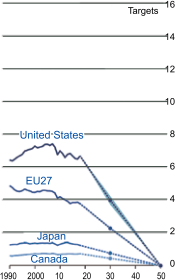
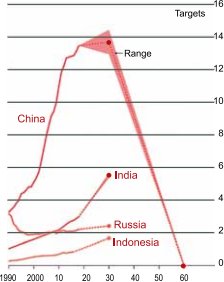
How climate targets compare against a common baseline
Greenhouse-gas emissions, tonnes of CO2 equivalent, bn Four largest emitters in each group
Graph 1 – Developed economies
Graph 2 – Emerging markets
New climate announcements are coming thick and fast. In recent weeks dozens of countries updated the mitigation plans known as “nationally determined contributions” (NDCs) required under the Paris climate agreement of 2015. The deal obliges its signatories to increase the ambition of their NDCs every five years. The original deadline for the first round of updates was COP26, the UN climate summit in Glasgow in 2020. However, because of the covid-19 pandemic, the event’s start was delayed until October this year. So far, 58% of the 191 signatories have submitted new NDCs.
Countries’ climate targets come in many shapes and sizes. Around two-thirds of the global economy is now covered by a pledge to achieve “net-zero”1 emissions by around midcentury. The array of different benchmarks and definitions can obscure how ambitious each country actually plans to be.
One type of climate goal involves promising to cut emissions compared with a business-as-usual scenario. Pakistan promises a cut of 20% by 2030, compared with a pathway where no climate action is taken whatsoever. Yet this goal means its emissions could surge threefold by 2030.
Rebasing climate targets changes the relative ambition of rich countries, too. On the face of it, the European Union’s target of lowering emissions by 55% by 2030 is more ambitious than America’s 52% cut. But the EU’s goal is based on 1990 levels and its emissions have already fallen from that point. By contrast, America’s plan is based on 2005 levels, and its emissions have fallen by less since. Once put on the same basis, America’s goal appears more admirable.
(www.economist.com, 07.08.2021. Adaptado.)
1 “net-zero”: (of a country, city, etc.) removing as many emissions as it produces.
De acordo com o segundo parágrafo, as metas ambientais dos diferentes países são obscuras devido à
Questão 14 7954135
UFRGS 2° dia 2022Instrução: A questão estão relacionadas ao texto abaixo.
The human capacity for compassion is not a
reflex that is triggered automatically by the
presence of another living thing. Though
people in all cultures can react sympathetically
[5] to kin, friends, and babies, they tend to hold
back when it comes to larger circles of
neighbors, strangers, foreigners, and other
sentient beings. Philosopher Peter Singer has
argued that over the course of history, people
[10] have enlarged the range of beings ........
interests they value as they value their own. An
interesting question is what inflated the
empathy circle. And a good candidate is the
expansion of literacy.
[15] Reading is a technology for perspective-taking.
When someone else’s thoughts are in your
head, you are observing the world from that
person’s vantage point. Not only are you taking
in sights and sounds that you could not
[20] experience firsthand, but you have stepped
inside that person’s mind and are temporarily
sharing his or her attitudes and reactions.
Adopting someone’s viewpoint is not the same
as feeling compassion toward the person, but
[25] the first can lead to the second by a natural
route. It’s not a big leap to suppose that the
habit of reading other people’s words could put
one in the habit of entering other people’s
minds.
[30] The power of literacy to lift readers out of their
parochial stations is not confined to factual
writing. Satirical fiction, ........ transports
readers into a hypothetical world from which
they can observe the follies of their own, may
[35] be an effective way to change people’s
sensibilities without haranguing or
sermonizing. Realistic fiction, for its part, may
expand readers’ circle of empathy by seducing
them into thinking and feeling like people very
[40] different from themselves. In the 18th century
the novel became a form of mass
entertainment, and unlike earlier epics which
recounted the exploits of heroes, aristocrats, or
saints, the novels brought to life the aspirations
[45] and losses of ordinary people.
That century was also the heyday of the
epistolary novel, in which the story unfolds in a
character’s own words, exposing the
character’s thoughts and feelings in real time
[50] rather than describing them from the
distancing perspective of a disembodied
narrator. Melodramatic novels named after
female protagonists became unlikely
bestsellers. Grown men burst into tears while
[55] experiencing the forbidden loves, intolerable
arranged marriages, and cruel twists of fate in
the lives of undistinguished women (including
servants) with ........ they had nothing in
common.
[60] The phenomenon suggests a causal chain:
reading novels about characters unlike oneself
exercises the ability to put oneself in other
people’s shoes, which turns one against cruel
punishments and other abuses of human
[65] rights. As usual, it is hard to rule out alternative
explanations for the correlation. Perhaps
people became more empathic for other
reasons, which simultaneously made them
receptive to novels and concerned with others’
[70] mistreatment.
Whether or not novels were critical in
expanding empathy, the explosion of reading
may have contributed to the Humanitarian
Revolution by getting people into the habit of
[75] straying from their parochial vantage points.
And it may have also contributed by creating a
hothouse for new ideas about moral values and
the social order.
Adapted from: PINKER, S. The better angels of our nature: why violence has declined. London: Viking Penguin, 2011.
Consider the different uses of the -ing form.
1. Verb as the subject of the sentence.
2. Verb as part of the present progressive structure.
3. Verb preceded by a preposition (collocation).
Select the alternative which contains words that exemplify each of the uses presented above, in the same sequence.
Questão 10 7954084
UFRGS 2° dia 2022Instrução: A questão estão relacionadas ao texto abaixo.
The human capacity for compassion is not a
reflex that is triggered automatically by the
presence of another living thing. Though
people in all cultures can react sympathetically
[5] to kin, friends, and babies, they tend to hold
back when it comes to larger circles of
neighbors, strangers, foreigners, and other
sentient beings. Philosopher Peter Singer has
argued that over the course of history, people
[10] have enlarged the range of beings ........
interests they value as they value their own. An
interesting question is what inflated the
empathy circle. And a good candidate is the
expansion of literacy.
[15] Reading is a technology for perspective-taking.
When someone else’s thoughts are in your
head, you are observing the world from that
person’s vantage point. Not only are you taking
in sights and sounds that you could not
[20] experience firsthand, but you have stepped
inside that person’s mind and are temporarily
sharing his or her attitudes and reactions.
Adopting someone’s viewpoint is not the same
as feeling compassion toward the person, but
[25] the first can lead to the second by a natural
route. It’s not a big leap to suppose that the
habit of reading other people’s words could put
one in the habit of entering other people’s
minds.
[30] The power of literacy to lift readers out of their
parochial stations is not confined to factual
writing. Satirical fiction, ........ transports
readers into a hypothetical world from which
they can observe the follies of their own, may
[35] be an effective way to change people’s
sensibilities without haranguing or
sermonizing. Realistic fiction, for its part, may
expand readers’ circle of empathy by seducing
them into thinking and feeling like people very
[40] different from themselves. In the 18th century
the novel became a form of mass
entertainment, and unlike earlier epics which
recounted the exploits of heroes, aristocrats, or
saints, the novels brought to life the aspirations
[45] and losses of ordinary people.
That century was also the heyday of the
epistolary novel, in which the story unfolds in a
character’s own words, exposing the
character’s thoughts and feelings in real time
[50] rather than describing them from the
distancing perspective of a disembodied
narrator. Melodramatic novels named after
female protagonists became unlikely
bestsellers. Grown men burst into tears while
[55] experiencing the forbidden loves, intolerable
arranged marriages, and cruel twists of fate in
the lives of undistinguished women (including
servants) with ........ they had nothing in
common.
[60] The phenomenon suggests a causal chain:
reading novels about characters unlike oneself
exercises the ability to put oneself in other
people’s shoes, which turns one against cruel
punishments and other abuses of human
[65] rights. As usual, it is hard to rule out alternative
explanations for the correlation. Perhaps
people became more empathic for other
reasons, which simultaneously made them
receptive to novels and concerned with others’
[70] mistreatment.
Whether or not novels were critical in
expanding empathy, the explosion of reading
may have contributed to the Humanitarian
Revolution by getting people into the habit of
[75] straying from their parochial vantage points.
And it may have also contributed by creating a
hothouse for new ideas about moral values and
the social order.
Adapted from: PINKER, S. The better angels of our nature: why violence has declined. London: Viking Penguin, 2011.
Consider the statements below.
I - According to Peter Singer, literacy has enlarged the empathy circle, which means that today more people care about individuals very much unlike themselves.
II - The author argues that literature forces readers to adopt alternative points of view, which may contribute to increasing empathy and compassion.
III- Phenomena such as that of adult men crying over melodramatic novels in the 18th century are proof of literature’s power to trigger emotional responses which make readers oppose human right abuses.
Which ones are correct according to the text?
Questão 9 7954015
UFRGS 2° dia 2022Instrução: A questão estão relacionadas ao texto abaixo.
The human capacity for compassion is not a
reflex that is triggered automatically by the
presence of another living thing. Though
people in all cultures can react sympathetically
[5] to kin, friends, and babies, they tend to hold
back when it comes to larger circles of
neighbors, strangers, foreigners, and other
sentient beings. Philosopher Peter Singer has
argued that over the course of history, people
[10] have enlarged the range of beings ........
interests they value as they value their own. An
interesting question is what inflated the
empathy circle. And a good candidate is the
expansion of literacy.
[15] Reading is a technology for perspective-taking.
When someone else’s thoughts are in your
head, you are observing the world from that
person’s vantage point. Not only are you taking
in sights and sounds that you could not
[20] experience firsthand, but you have stepped
inside that person’s mind and are temporarily
sharing his or her attitudes and reactions.
Adopting someone’s viewpoint is not the same
as feeling compassion toward the person, but
[25] the first can lead to the second by a natural
route. It’s not a big leap to suppose that the
habit of reading other people’s words could put
one in the habit of entering other people’s
minds.
[30] The power of literacy to lift readers out of their
parochial stations is not confined to factual
writing. Satirical fiction, ........ transports
readers into a hypothetical world from which
they can observe the follies of their own, may
[35] be an effective way to change people’s
sensibilities without haranguing or
sermonizing. Realistic fiction, for its part, may
expand readers’ circle of empathy by seducing
them into thinking and feeling like people very
[40] different from themselves. In the 18th century
the novel became a form of mass
entertainment, and unlike earlier epics which
recounted the exploits of heroes, aristocrats, or
saints, the novels brought to life the aspirations
[45] and losses of ordinary people.
That century was also the heyday of the
epistolary novel, in which the story unfolds in a
character’s own words, exposing the
character’s thoughts and feelings in real time
[50] rather than describing them from the
distancing perspective of a disembodied
narrator. Melodramatic novels named after
female protagonists became unlikely
bestsellers. Grown men burst into tears while
[55] experiencing the forbidden loves, intolerable
arranged marriages, and cruel twists of fate in
the lives of undistinguished women (including
servants) with ........ they had nothing in
common.
[60] The phenomenon suggests a causal chain:
reading novels about characters unlike oneself
exercises the ability to put oneself in other
people’s shoes, which turns one against cruel
punishments and other abuses of human
[65] rights. As usual, it is hard to rule out alternative
explanations for the correlation. Perhaps
people became more empathic for other
reasons, which simultaneously made them
receptive to novels and concerned with others’
[70] mistreatment.
Whether or not novels were critical in
expanding empathy, the explosion of reading
may have contributed to the Humanitarian
Revolution by getting people into the habit of
[75] straying from their parochial vantage points.
And it may have also contributed by creating a
hothouse for new ideas about moral values and
the social order.
Adapted from: PINKER, S. The better angels of our nature: why violence has declined. London: Viking Penguin, 2011.
Select the alternative that adequately fills in the blanks in lines 10, 32 and 58.
06