


![[Marketing] Questao Topo - deslogado](https://storage.estuda.com.br/banners/0_6b7ebee90b03af1c560c73bb8bcce34a_banner_deslogado_70_dias.png)
Questões de Inglês
19.971 Questões
Questão 30 14628504
UDESC Verão Manhã 2024/1THE POWER OF NUMBERS
By: Keith Harding and Alastair Lane
[01] There is an Indian legend that goes like this: Once upon a time, a king challenged a
pilgrim to a game of chess. The pilgrim agreed, but on the condition: if the king lost, he
would put a single grain of rice on the first chess square and then double the amount on
every square after that. The king lost and then discovered the price he had to pay: 1 grain
[05] on the first square, 2 grains on the second, 4 on the third, 8 on the fourth, and so on. By
the 64th square, the amount came to more than 18,000,000,000,000,000,000 grains of
rice!
A modern example of this type of growth is Moore's Law. This Law says that the power of
computer microchips doubles every 18 months. We can see the effects of this if we
[10] compare the space shuttle with a smartphone. The computer on the first space shuttle
could process 400,000 instructions per second and had a memory of 424 kilobytes; a
modern smartphone is over 35,000 times quicker and has over 33,000,000 times more
memory! These increases in computing power have caused scientific discovery to speed
up. It took the Human Genome project 13 years, from 1990 to 2003, to analyze the entire
[15] human genome*. Due to faster computers, scientists can now do this in a week. In the
next decades, computers will equal the power of the human brain. This may result in the
development of computers that are more intelligent than humans. The possible
consequences of this are profound.
The increasing speed of scientific discovery is also partly the result of larger social trends.
[20] In the 1960s in the UK, about 5% of young people went to university. Nowadays 40% of
people in the UK do a degree, whilst in Finland the number has reached 80%. Between
2000 and 2010, the number of students studying in universities abroad rose by 75%.
Because of the increase in university students, more people now do research at a
postgraduate level. This has created greater competition between research departments
[25] for funding. As a result, there is more pressure on scientists to publish their findings
quickly. This new research leads to other new discoveries and, as a consequence, new
technologies are developed more rapidly.
Fonte: Book: International Express- 3rd edition - OUP- www.oup.com/elt
The speed of change is hard to cope with because it means we need to keep learning and adapting. But we'd better get used it: it's not going to slow down.
The text says that:
Questão 29 14628503
UDESC Verão Manhã 2024/1THE POWER OF NUMBERS
By: Keith Harding and Alastair Lane
[01] There is an Indian legend that goes like this: Once upon a time, a king challenged a
pilgrim to a game of chess. The pilgrim agreed, but on the condition: if the king lost, he
would put a single grain of rice on the first chess square and then double the amount on
every square after that. The king lost and then discovered the price he had to pay: 1 grain
[05] on the first square, 2 grains on the second, 4 on the third, 8 on the fourth, and so on. By
the 64th square, the amount came to more than 18,000,000,000,000,000,000 grains of
rice!
A modern example of this type of growth is Moore's Law. This Law says that the power of
computer microchips doubles every 18 months. We can see the effects of this if we
[10] compare the space shuttle with a smartphone. The computer on the first space shuttle
could process 400,000 instructions per second and had a memory of 424 kilobytes; a
modern smartphone is over 35,000 times quicker and has over 33,000,000 times more
memory! These increases in computing power have caused scientific discovery to speed
up. It took the Human Genome project 13 years, from 1990 to 2003, to analyze the entire
[15] human genome*. Due to faster computers, scientists can now do this in a week. In the
next decades, computers will equal the power of the human brain. This may result in the
development of computers that are more intelligent than humans. The possible
consequences of this are profound.
The increasing speed of scientific discovery is also partly the result of larger social trends.
[20] In the 1960s in the UK, about 5% of young people went to university. Nowadays 40% of
people in the UK do a degree, whilst in Finland the number has reached 80%. Between
2000 and 2010, the number of students studying in universities abroad rose by 75%.
Because of the increase in university students, more people now do research at a
postgraduate level. This has created greater competition between research departments
[25] for funding. As a result, there is more pressure on scientists to publish their findings
quickly. This new research leads to other new discoveries and, as a consequence, new
technologies are developed more rapidly.
Fonte: Book: International Express- 3rd edition - OUP- www.oup.com/elt
The speed of change is hard to cope with because it means we need to keep learning and adapting. But we'd better get used it: it's not going to slow down.
The word "whilst" in line 21, means:
Questão 31 14625510
FGV-SP Administração - UNIFICADO 2024Texto para as questão.
SWEARING ON THE BIBLE
By Angela Stockton
1 On November 22, 1963, the day President John F. Kennedy was assassinated, Vice President Lyndon Johnson (LBJ) did not put his hand on the Bible when he took his oath of office [juramento de posse] as the new President. The book that he and the Secret Service agents thought was the Bible was in fact a missal, i.e., a book of prayers which Catholics used at Masses [Missas].
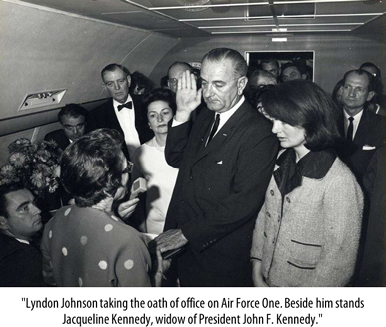
2 That didn’t make LBJ’s oath invalid. Because the Constitution specifically states that no religious test shall be required for public office [cargo público] in the United States, no public official needs to say “So help me, God,” or put his or her left hand on any book. LBJ’s oath would have been equally valid if he had put his left hand on a telephone book or a cookbook.
3 And Barack Obama did put his hand on a Bible for both his public inaugurations and undoubtedly at his third one. His third? Yes, if you recall, Chief Justice [Presidente da Suprema Corte dos EUA] John Roberts messed up the words of the oath when he swore in Obama at his first inauguration. (You had one job, John…) So that no one could say Obama was not validly inaugurated, Roberts went to the White House on the evening of January 20, 2009 and administered the oath again, in private. One hopes that he was reading it off the Constitution that time.
Adapted from Quora Digest, July 29, 2023.
Which of the following is most supported by the information in the article?
Questão 5 14617944
Campo Real Medicina 2024/2The following text refers to question.
Shōgun: The brutal Japanese history that inspired 2024’s latest TV hit
There’s a stomach-churning moment in the debut episode of FX/Disney+’s Shōgun that sets the standard for the kind of brutality surely to follow. Having endured starvation, scurvy, and a captain’s suicide aboard a ravaged Dutch trade ship, pilot major John Blackthorne and his surviving crew are shipwrecked off the coast of Anjiro, only to be thrown into a pit by sword-wielding captors to await their fate. Though Blackthorne avoids execution himself, a member of his entourage is less fortunate — he’s bound and placed into a cauldron, where he is slowly boiled to death.
This is Japan in the year 1600 — a time of great unrest after two centuries of civil wars. Here, Blackthorne — based on the real-life navigator William Adams, the first Englishman to reach Japan — must assimilate to a brutal, foreign reality as a tenuous five-regent government threatens to rupture into warring factions after the passing of the Taikō (retired Imperial regent). With Catholic missionaries providing a further antagonistic presence to the Protestant Blackthorne, his survival may depend on an alliance with Lord Yoshii Toranaga — who has seemingly himself been marked for termination by political rivals.
In 1600, the world’s power dynamics were very different from today: Protestant England had been forced to defend Elizabeth I’s throne from invasion in 1588, with the Spanish Armada intent on reinstating Catholicism and ending English support for Dutch independence from Spain. The latter country would, by this time, be in a dynastic union with Portugal; the two powerful Iberian states had previously divided the oceanic domains beyond Europe between their vast empires with the 1494 Treaty of Tordesillas. A vanguard of global exploration, Portugal discovered Japan in 1543 — and began to trade Western goods such as matchlock firearms with them while also spreading the Catholic faith via the introduction of Jesuit missionaries. This context serves as the backdrop to Blackthorne’s treacherous voyage in the opening of Shōgun.
Available in: https://www.bbc.com/culture/article/20240305-shogun-tv-hit-fx-violent-japanese-history/. Adapted.
An aspect that correctly describes Blackthorne’s voyage context is:
Questão 16 14609629
USS (Univassouras) Medicina 2024/2STUDY SUGGESTS MEDICAL ERRORS ARE NOW THE THIRD LEADING CAUSE OF DEATH IN THE U.S.
[1] Over 138 million patients are harmed every year by doctors’ errors and medical mistakes, which cause 2.6
million deaths yearly, the World Health Organization (WHO) warned, just a few days before celebrating the
first “World Patient Safety Day”, with which it seeks to raise awareness of this ongoing tragedy.
“Errors in diagnosis, errors in medicine prescriptions and treatments, and the inappropriate use of drugs are the
[5] three main reasons why so many patients are harmed”, WHO patient-safety coordinator, Dr. Neelam Dhingra-
Kumar, told a press conference on Friday. These mistakes occur because healthcare systems are not suitably
designed to deal with these errors and learn from them. Many medical facilities also hide what they did wrong,
which often keeps them from taking steps to make sure these errors are not repeated in the future.
Figures provided by the WHO refer only to countries with medium and low economic status, where 80
[10] per cent of the global population live. The real number could be even greater, considering that even in
developed countries, one out of every 10 patients is the victim of medical mistakes. Examples of these errors
are the application of medications in ways they were not designed for, errors in blood transfusions and in
taking X-rays, or in more dramatic cases, indicating that the wrong limb needs to be amputated or that the
wrong side of the brain requires surgery.
[15] According to the Geneva-based Organization, only errors related to erroneous medicine prescriptions cost
healthcare systems around the world some $42 billion (37 billion euros). To raise awareness about these
problems, starting this year, the WHO will celebrate every September 17 World Patient Safety Day, which in
its first year will light up with the colour orange a number of monuments and healthcare facilities worldwide.
Adapted from: https://ummid.com/news/2019/september/15.09.2019/deaths-due-to-doctor-error-who-data.html. Accessed 5 February 2022.
According to the Geneva-based Organization:
Questão 14 14609618
USS (Univassouras) Medicina 2024/2“(...) which often keeps them from taking steps to make sure these errors are not repeated in the future.” (l. 8)
The underlined word refers to:
06