


![[Marketing] Questao Topo - deslogado](https://storage.estuda.com.br/banners/0_6b7ebee90b03af1c560c73bb8bcce34a_banner_deslogado_70_dias.png)
Questões de Inglês
19.971 Questões
Questão 50 15119181
UFN VERÃO 2024Gentrification
Gentrification is a process of change currently underway in many American cities. Gentrification brings conflict between longtime residents of old neighborhoods and new arrivals.
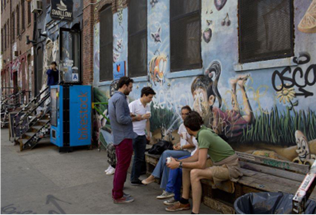
Gentrification in Bushwick
Gentrification is underway in many U.S. neighborhoods like Bushwick in Brooklyn, New York. This process can disrupt the traditional makeup of a neighborhood with the influx of wealthier people moving into downtrodden, largely minority, urban neighborhoods
PHOTOGRAPH BY ANDREW LICHTENSTEIN /CORBIS VIA GETTY IMAGES.
Gentrification describes a process where wealthy, college-educated individuals begin to move into poor or working-class communities, often originally occupied by communities of color. The people and businesses that move into gentrifying neighborhoods may have goals for their new homes that are at odds with the goals of people who have lived there for a long time. Rising costs of living and a changing community culture can make for a difficult adjustment for longtime residents. These changes may drive out people of color and minority-owned businesses. At the same time, gentrification brings much needed investment into long-neglected areas. Gentrification is thus a complicated issue that involves many different stakeholders and perspectives.
The poor communities of color who tend to inhabit neighborhoods targeted for gentrification were often the victims of unfair housing policies from the end of World War II. During the postwar economic boom, many suburbs appeared, located on the outskirts of cities. They provided the advantages of urban environments without the disadvantages of living in close proximity to others. In order to encourage people to move into suburbs, real estate brokers practiced something called blockbusting. They encouraged black families to pay a premium to move into particular urban neighborhoods so that white families would sell their houses at a low price to move out to the suburbs. After this process was complete, the new majority-African American communities were denied the money they needed to invest in improvements to their neighborhoods through a practice called redlining. These factors combined to reduce opportunities in many urban areas. As a result, the low cost of moving into those neighborhoods opened them up to gentrification.
https://education.nationalgeographic.org/resource/gentrification/
Em relação ao uso dos pronomes no texto sobre Gentrificação, da National Geographic, relacione a segunda coluna com a primeira.
1. Their
2. Who
3. There
4. They
5. Them
( ) Gentrifying neighborhoods
( ) Suburbs
( ) People
( ) Those neighborhoods
( ) The people and the businesses
Marque a alternativa que apresente a relação correta entre pronomes e referentes.
Questão 46 15119142
UFN VERÃO 2024Gentrification
Gentrification is a process of change currently underway in many American cities. Gentrification brings conflict between longtime residents of old neighborhoods and new arrivals.
Gentrification in Bushwick
Gentrification is underway in many U.S. neighborhoods like Bushwick in Brooklyn, New York. This process can disrupt the traditional makeup of a neighborhood with the influx of wealthier people moving into downtrodden, largely minority, urban neighborhoods
PHOTOGRAPH BY ANDREW LICHTENSTEIN /CORBIS VIA GETTY IMAGES.
Gentrification describes a process where wealthy, college-educated individuals begin to move into poor or working-class communities, often originally occupied by communities of color. The people and businesses that move into gentrifying neighborhoods may have goals for their new homes that are at odds with the goals of people who have lived there for a long time. Rising costs of living and a changing community culture can make for a difficult adjustment for longtime residents. These changes may drive out people of color and minority-owned businesses. At the same time, gentrification brings much needed investment into long-neglected areas. Gentrification is thus a complicated issue that involves many different stakeholders and perspectives.
The poor communities of color who tend to inhabit neighborhoods targeted for gentrification were often the victims of unfair housing policies from the end of World War II. During the postwar economic boom, many suburbs appeared, located on the outskirts of cities. They provided the advantages of urban environments without the disadvantages of living in close proximity to others. In order to encourage people to move into suburbs, real estate brokers practiced something called blockbusting. They encouraged black families to pay a premium to move into particular urban neighborhoods so that white families would sell their houses at a low price to move out to the suburbs. After this process was complete, the new majority-African American communities were denied the money they needed to invest in improvements to their neighborhoods through a practice called redlining. These factors combined to reduce opportunities in many urban areas. As a result, the low cost of moving into those neighborhoods opened them up to gentrification.
https://education.nationalgeographic.org/resource/gentrification/
De acordo com o texto, qual o conceito de gentrificação?
Questão 59 15093138
UNIPAM Tipo 1 2024Why are some people so afraid of clowns?
A first-of-its-kind study helps explain our fear of the white-faced, red-nosed jokesters By Teddy Amenabar (October 30, 2023)
For 15 years, psychology professor Philip John Tyson has been teaching classes on phobias. At the start of every semester, he asks his students the same question: What are you afraid of?
Students routinely cited spiders, snakes and claustrophobic spaces, but a consistent minority would say they were “terrified of clowns,” said Tyson, an associate professor of psychology at the University of South Wales. He wanted to know why.
Tyson and his colleagues began researching “coulrophobia” or fear of clowns. Although the prevalence of clown phobia isn’t clear, one recent survey in the United States found that about 5 percent of the population said they were afraid — or very afraid — of clowns. Tyson’s team used its own surveys to identify more than 500 people who suffered from clown fear and then asked them to rate their feelings about clowns. How often did they think of clowns?
What would they do if they encountered a clown on the street?
How long have they feared the red-nosed jokesters?
In what may be a first-of-its-kind study focusing on the origins of clown fear, the University of South Wales team noticed some distinct patterns in the group. The study, called “Fear of clowns: An investigation into the aetiology of coulrophobia” was published in the journal Frontiers in Psychology. While the research is not based on a representative sample of the population, the findings offer insights into the reasons some people fear clowns, Tyson said.
One of the most surprising findings is that for many people, having a “scary personal experience with a clown wasn’t a main contributor to the fear,” Tyson said. Instead, people said they were creeped out by clowns because:
You can never really know what a clown is thinking. It can be difficult to know what’s really going on in the mind of a clown with a painted on smile or frown. “There’s something about not being able to read facial expressions,” Tyson said. “And the fact that there might be something hidden and dangerous, there might be harmful intent behind the makeup.”
Clowns are unpredictable. Clowns make some people laugh, but they often behave in unpredictable and startling ways that normal people never would (such as squirting water from a flower or honking a horn). People who are scared of spiders say something similar, worrying the spider will jump on them unexpectedly, Tyson said.
A clown’s exaggerated features are disturbing. The big red nose, the egg head, the puffs of neon colored hair. People seem to be scared of beings that look nearly human but not exactly, in the same way some people find baby dolls, aliens or robots disturbing.
Movie clowns are terrifying. Many of those surveyed also said their fear is due, in part, to movies starring scary clowns, such as Joaquin Phoenix in “Joker” or Pennywise, the demonic clown in Stephen King’s “It.”
The fear of clowns is not entirely born from fiction. The mass murderer John Wayne Gacy, who killed at least 33 teenage boys and young men in the Chicago area, was known to have entertained at children’s parties as “Pogo the Clown.” In a trailer for a Netflix documentary about Gacy, he’s heard saying on tape that “clowns can get away with anything.” More recently, a spate of creepy clown sightings in the United Kingdom and the United States in 2016 caused schools to lock down, which all led King to tweet: “Hey, guys, time to cool the clown hysteria — most of 'em are good, cheer up the kiddies, make people laugh.”
The clowns would like to have a word
Jon Davison, a clown performer, teacher, director and researcher at the London Metropolitan University, said the reports of coulrophobia don’t match up with what he sees himself or hears from other performers. He said that in 38 years of clowning, he has only on two occasions come across fear of clowns. Clowns typically aren’t trying to unnerve or unsettle their audiences when they perform, he said.
“In fact, completely the opposite,” Davison said. The goal is to portray this person who is “helpless, vulnerable and, actually, doesn’t have a clue about how the world works.” Clowns want audiences to laugh at their performances but they’re also trying to get people to sympathize with their character, who’s often “at the mercy of our society.” “Somehow, you sense the humanity,” he said. “It’s like a little kid.”
What makes somebody creepy?
Tyson and colleagues are in the process of studying whether it’s certain aspects of clown makeup — specifically, the white and red paint — that elicit the fear or phobia.
James Greville, a lecturer in psychology at the University of South Wales, said one theory is that the white face paint can be perceived as a “deathly pallor,” pale and lifeless and something to be avoided. And the red lipstick or accents on a clown’s face may feel threatening because they tap into our wariness of blood or a contagious infection.
Frank McAndrew, a psychology professor at Knox College in Galesburg, Ill., said he “firmly believes” clowns have “wonderful intentions” to entertain audiences, but that doesn’t change whether some people are on guard when they see a clown. People don’t want to become the butt of a joke, McAndrew said.
“Nobody comes out of an interaction with a clown looking dignified,” he said. “For a lot of people who want to present themselves well in public, the clown is a threat.”
In 2016, McAndrew co-wrote a study called “On the Nature of Creepiness,” surveying more than 1,300 people to better understand the behaviors and characteristics that may lead someone to feel creeped out. In one section, the respondents rated 21 different occupations from “not at all creepy” to “very creepy.”
Clowning scored the highest among the group, rating higher in creepiness than a taxidermist, sex shop worker or funeral director. There’s a lot of uncertainty regarding an interaction with a clown, McAndrew said. You’re not sure how the performer is going to respond — and that can be unnerving.
“There’s this very easy connection between clowns and horror,” he said. “I don’t think they became creepy to us because people started putting them in haunted houses. I think they got put in haunted houses because people found them creepy to begin with.”
(Taken from: https://www.washingtonpost.com/wellness/2023/10/30/fear-of-clowns-coulrophobia/)
Read the synopses below and choose the one that represents the same idea of clowns as the one presented in Text 1.
Questão 54 15093046
UNIPAM Tipo 1 2024Why are some people so afraid of clowns?
A first-of-its-kind study helps explain our fear of the white-faced, red-nosed jokesters By Teddy Amenabar (October 30, 2023)
For 15 years, psychology professor Philip John Tyson has been teaching classes on phobias. At the start of every semester, he asks his students the same question: What are you afraid of?
Students routinely cited spiders, snakes and claustrophobic spaces, but a consistent minority would say they were “terrified of clowns,” said Tyson, an associate professor of psychology at the University of South Wales. He wanted to know why.
Tyson and his colleagues began researching “coulrophobia” or fear of clowns. Although the prevalence of clown phobia isn’t clear, one recent survey in the United States found that about 5 percent of the population said they were afraid — or very afraid — of clowns. Tyson’s team used its own surveys to identify more than 500 people who suffered from clown fear and then asked them to rate their feelings about clowns. How often did they think of clowns?
What would they do if they encountered a clown on the street?
How long have they feared the red-nosed jokesters?
In what may be a first-of-its-kind study focusing on the origins of clown fear, the University of South Wales team noticed some distinct patterns in the group. The study, called “Fear of clowns: An investigation into the aetiology of coulrophobia” was published in the journal Frontiers in Psychology. While the research is not based on a representative sample of the population, the findings offer insights into the reasons some people fear clowns, Tyson said.
One of the most surprising findings is that for many people, having a “scary personal experience with a clown wasn’t a main contributor to the fear,” Tyson said. Instead, people said they were creeped out by clowns because:
You can never really know what a clown is thinking. It can be difficult to know what’s really going on in the mind of a clown with a painted on smile or frown. “There’s something about not being able to read facial expressions,” Tyson said. “And the fact that there might be something hidden and dangerous, there might be harmful intent behind the makeup.”
Clowns are unpredictable. Clowns make some people laugh, but they often behave in unpredictable and startling ways that normal people never would (such as squirting water from a flower or honking a horn). People who are scared of spiders say something similar, worrying the spider will jump on them unexpectedly, Tyson said.
A clown’s exaggerated features are disturbing. The big red nose, the egg head, the puffs of neon colored hair. People seem to be scared of beings that look nearly human but not exactly, in the same way some people find baby dolls, aliens or robots disturbing.
Movie clowns are terrifying. Many of those surveyed also said their fear is due, in part, to movies starring scary clowns, such as Joaquin Phoenix in “Joker” or Pennywise, the demonic clown in Stephen King’s “It.”
The fear of clowns is not entirely born from fiction. The mass murderer John Wayne Gacy, who killed at least 33 teenage boys and young men in the Chicago area, was known to have entertained at children’s parties as “Pogo the Clown.” In a trailer for a Netflix documentary about Gacy, he’s heard saying on tape that “clowns can get away with anything.” More recently, a spate of creepy clown sightings in the United Kingdom and the United States in 2016 caused schools to lock down, which all led King to tweet: “Hey, guys, time to cool the clown hysteria — most of 'em are good, cheer up the kiddies, make people laugh.”
The clowns would like to have a word
Jon Davison, a clown performer, teacher, director and researcher at the London Metropolitan University, said the reports of coulrophobia don’t match up with what he sees himself or hears from other performers. He said that in 38 years of clowning, he has only on two occasions come across fear of clowns. Clowns typically aren’t trying to unnerve or unsettle their audiences when they perform, he said.
“In fact, completely the opposite,” Davison said. The goal is to portray this person who is “helpless, vulnerable and, actually, doesn’t have a clue about how the world works.” Clowns want audiences to laugh at their performances but they’re also trying to get people to sympathize with their character, who’s often “at the mercy of our society.” “Somehow, you sense the humanity,” he said. “It’s like a little kid.”
What makes somebody creepy?
Tyson and colleagues are in the process of studying whether it’s certain aspects of clown makeup — specifically, the white and red paint — that elicit the fear or phobia.
James Greville, a lecturer in psychology at the University of South Wales, said one theory is that the white face paint can be perceived as a “deathly pallor,” pale and lifeless and something to be avoided. And the red lipstick or accents on a clown’s face may feel threatening because they tap into our wariness of blood or a contagious infection.
Frank McAndrew, a psychology professor at Knox College in Galesburg, Ill., said he “firmly believes” clowns have “wonderful intentions” to entertain audiences, but that doesn’t change whether some people are on guard when they see a clown. People don’t want to become the butt of a joke, McAndrew said.
“Nobody comes out of an interaction with a clown looking dignified,” he said. “For a lot of people who want to present themselves well in public, the clown is a threat.”
In 2016, McAndrew co-wrote a study called “On the Nature of Creepiness,” surveying more than 1,300 people to better understand the behaviors and characteristics that may lead someone to feel creeped out. In one section, the respondents rated 21 different occupations from “not at all creepy” to “very creepy.”
Clowning scored the highest among the group, rating higher in creepiness than a taxidermist, sex shop worker or funeral director. There’s a lot of uncertainty regarding an interaction with a clown, McAndrew said. You’re not sure how the performer is going to respond — and that can be unnerving.
“There’s this very easy connection between clowns and horror,” he said. “I don’t think they became creepy to us because people started putting them in haunted houses. I think they got put in haunted houses because people found them creepy to begin with.”
(Taken from: https://www.washingtonpost.com/wellness/2023/10/30/fear-of-clowns-coulrophobia/)
Professor Philip John Tyson teaches classes on phobias. According to a few of his students, they are afraid of clowns because
Questão 56 15092771
EsPCEx Dia 2 2024The Army leadership code
Our Army needs to move with the times. The operating environment is increasingly uncertain, complex and dispersed. Leadership has never been more challenging. This intent (1)____________ how we will meet this challenge in war and in peace, with our approach to both being as similar as possible. It is to be read and (2)____________ by all soldiers at every level. Our war fighting doctrine is based on mutual trust between leaders and those they lead. Leaders have a duty to provide the guidance, including resources that allow subordinates to use their initiative and judgment, whereas subordinates have a duty to act with loyalty and discipline.
This is a culture that empowers all leaders at every level. This enables us to (3)____________ an enemy in the most chaotic and demanding circumstances. We want to unlock the potential of every soldier. Leaders must empower their subordinates routinely because this will give them the confidence to act boldly and independently on the battlefield. Leaders must know those they lead, understand them, and place the care of their subordinates at the forefront of all that they do.
This means leaders must tolerate risk and accept honest mistakes as a natural part of leader development. Micromanagement has no place on the battlefield and in peacetime either. This is not about encouraging soldiers to be reckless or to gamble; it is about accepting errors in the pursuit of calculated risk taking, boldness and initiative. In return, we expect all soldiers to live by our values, to approach every day with an open-minded attitude that sees the potential in everyone, refuses to allow unacceptable behaviour, and seizes the opportunities that mission command offers.
The world is changing rapidly, and external factors, such as global conflict, are causing long-term effects on the Army and its leadership. Nevertheless, it is critical that we remark that some things have not changed and should not change. The values that have long governed the Army have served as a cornerstone for years. Furthermore, those values define who we are and make us different.
Adapted from www.army.mod.uk and www.moore.army.mil
According to the text, choose the correct statement.
Questão 54 15092769
EsPCEx Dia 2 2024The Army leadership code
Our Army needs to move with the times. The operating environment is increasingly uncertain, complex and dispersed. Leadership has never been more challenging. This intent (1)____________ how we will meet this challenge in war and in peace, with our approach to both being as similar as possible. It is to be read and (2)____________ by all soldiers at every level. Our war fighting doctrine is based on mutual trust between leaders and those they lead. Leaders have a duty to provide the guidance, including resources that allow subordinates to use their initiative and judgment, whereas subordinates have a duty to act with loyalty and discipline.
This is a culture that empowers all leaders at every level. This enables us to (3)____________ an enemy in the most chaotic and demanding circumstances. We want to unlock the potential of every soldier. Leaders must empower their subordinates routinely because this will give them the confidence to act boldly and independently on the battlefield. Leaders must know those they lead, understand them, and place the care of their subordinates at the forefront of all that they do.
This means leaders must tolerate risk and accept honest mistakes as a natural part of leader development. Micromanagement has no place on the battlefield and in peacetime either. This is not about encouraging soldiers to be reckless or to gamble; it is about accepting errors in the pursuit of calculated risk taking, boldness and initiative. In return, we expect all soldiers to live by our values, to approach every day with an open-minded attitude that sees the potential in everyone, refuses to allow unacceptable behaviour, and seizes the opportunities that mission command offers.
The world is changing rapidly, and external factors, such as global conflict, are causing long-term effects on the Army and its leadership. Nevertheless, it is critical that we remark that some things have not changed and should not change. The values that have long governed the Army have served as a cornerstone for years. Furthermore, those values define who we are and make us different.
Adapted from www.army.mod.uk and www.moore.army.mil
Choose the alternative with verbs that correctly and respectively complete gaps (1), (2) and (3) in paragraphs 1 and 2.
06