


![[Marketing] Questao Topo - deslogado](https://storage.estuda.com.br/banners/0_6b7ebee90b03af1c560c73bb8bcce34a_banner_deslogado_70_dias.png)
Questões de Inglês
19.971 Questões
Questão 58 16543535
FACERES Medicina 2024/2Use the comic strip bellow to answer the question:
Callous
(https://www.callouscomics.com/index/tag/%20hospital)
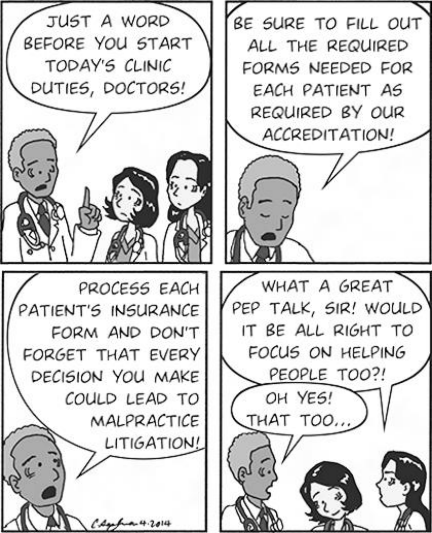
Taking into account the stretch, “Be sure to fill out all the required forms needed for each patient as required by our accreditation!”, which are the forms of the words in bold?
Questão 57 16543499
FACERES Medicina 2024/2Use the comic strip bellow to answer the question:
Callous
(https://www.callouscomics.com/index/tag/%20hospital)
According to the context in the comic strip, the words just, start and clinic in the following stretch “Just a word before you start today’s clinic duties, doctors” are used as:
Questão 60 16439026
FACERES Medicina 2024/1Use the comic strip bellow to answer the question.
(Fonte: Disponível em: https://www.rcxrules.com/blog/value-based-carecomic-strips-with-a-serious-message. Acesso em: 09 abr. 2024)
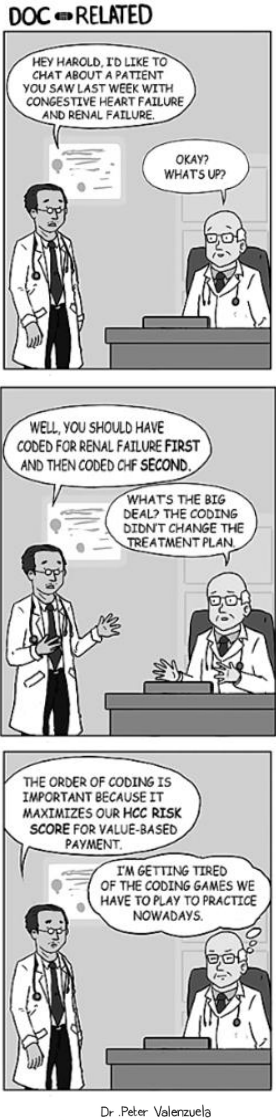
According to the context, why does the doctor say “The order of coding is important because it maximizes our HCC risk score for value-based payment”?
Questão 58 16439019
FACERES Medicina 2024/1Use the comic strip bellow to answer the question.
(Fonte: Disponível em: https://www.rcxrules.com/blog/value-based-carecomic-strips-with-a-serious-message. Acesso em: 09 abr. 2024)
Taking into account the stretch, “Hey Harold, I’d like to chat about a patient you saw last week”, which are the forms of the verbs in bold?
Questão 15 16117753
IDOMED Medicina 2024/2RE-EMERGING DISEASES
By Robyn Correll, MPH
In the past century or so, humans have fought, and won, their fair share of battles with diseases. Vaccines defeated smallpox, antibiotics conquered Scarlet Fever, and insecticide scaled back mosquito-borne illnesses. Despite these successes, some diseases appear to be making a comeback. Outbreaks of measles and mumps have made more than a few headlines of late, for example.
One of the greatest public health achievements in history, vaccines are credited for the massive decline of potentially dangerous diseases like measles and polio. But, although the majority of families embrace vaccination, a growing number appear to be delaying or forgoing vaccines altogether, due to a misunderstanding of the safety, effectiveness, and necessity of vaccination.
In Texas, for example, the number of students with nonmedical exemptions to school vaccine requirements has skyrocketed from just 10,404 in 2007 to 52,756 in 2017. While the overall vaccination rate for measles in Texas held fairly steady between 2007 and 2017, with a rate of about 97% for students, research shows that unvaccinated individuals tend to cluster in the same communities and schools. This results in a breakdown of protective herd immunity, leaving those individuals vulnerable to outbreaks of disease.
According to a review published in JAMA, high numbers of vaccine refusers in a given community increase the risk of measles not just for unvaccinated individuals, but for vaccinated people too. That’s because no vaccine is 100% effective. Some people who receive the vaccine might not respond to it and could get sick anyway if they are exposed to the virus. And many of the individuals involved in recent outbreaks of mumps and pertussis have been at least partially vaccinated. Does that mean that the vaccine doesn’t work?
Pertussis vaccines are about 80% to 90% effective when they’re first given. Mumps vaccines are about 88% effective after two doses. As time goes on, however, research suggests that immunity wanes, and more doses might be needed to protect against outbreaks.
Additionally, while some of these pathogens are, indeed, showing signs of a resurgence, many more are conquered every day through large-scale and coordinated public health efforts and the significance of this success shouldn’t be overlooked.
Adapted from: https://www.verywellhealth.com/why-some-diseases-are-re-emerging-4151072 Accessed 5 February 2022
The main message in the last paragraph is the following:
Questão 12 16103895
IDOMED Medicina 2024/1WHAT IS GLOBAL PUBLIC HEALTH?
By Sam Macarthur
In the age of globalization, global public health is one of the foremost challenges facing humanity. Not any one nation, not any one coalition of nations, but all of humanity. That’s because global health is not just the work of massive governmental agencies, or international global health organizations, but of people in communities: doctors, nurses, educators, volunteers, and advocates. Fighting disease and spreading health throughout the world is one of the most important missions the human race can undertake in the 21st century.
To put it simply, global health is important because life in the 21st century is global. With globalization of business, accessibility of transportation, and the information afforded by the internet, the world has gotten smaller in all sorts of ways. And with a smaller, more connected world, comes the reality that what affects one nation affects many.
In much of the world, rapid industrialization and development has intensified global health challenges and threats, leading the UN to adopt its Sustainable Development Goals. Eliminating poverty and hunger are goals aligned with clean water and sanitation, while sustainability, responsible consumption and production, and climate action are explicitly tied to the overall well-being and health of populations and, as such, they are considered broader goals.
Lack of resources is one of the most significant global health challenges. The lack of clean drinking water in many developing nations, for instance, is the immediate cause of epidemics like cholera, typhoid, and water-borne parasites. Global public health works to fight both the causes of resource scarcity and the consequences.
Global health is also threatened by all sorts of diseases and illnesses, many of which can be treated with existing medicines and techniques, if the people could only access them. Some of the largest global health challenges in the 21st century include HIV and AIDS, diarrheal diseases, tuberculosis, and malaria – almost all of which can be prevented or treated with modern medicine and sanitation.
Other common global challenges faced by health professionals include events like Hurricane Irma in Puerto Rico, or the volcanic eruptions in Guatemala. Moreover, communities throughout the developing world are also affected by disasters caused by pollution, and much of the problem of unsafe drinking water throughout Africa and Asia is caused by unchecked pollution in rapidly developing urban areas and does not stem from natural causes.
Available at: mphonline.org. Accessed September 4 2023. (Adapted).
In paragraph 3, the proposals to guarantee global health are best summarized in the following option:
06