


![[Marketing] Questao Topo - deslogado](https://storage.estuda.com.br/banners/0_6b7ebee90b03af1c560c73bb8bcce34a_banner_deslogado_70_dias.png)
Questões de Inglês
19.971 Questões
Questão 21 16046549
UESB 1 Dia 2025There have always been myths about immortality, that is, being able to live forever. Well, our Marine Biologists have found a creature that comes close – a tiny transparent jellyfish. While it has the unofficial name of Immortal Jellyfish, its official name is Turritopsis dohrnii. After an adult male T. dohrnii squirts his sperm into the ocean waters, some of them end up inside a female T. dohrnii. This creates the fertilised eggs, which then turn into tiny free-swimming larvae called “planula”. After a while, the planula give up swimming, dive down to the sea floor, and attach themselves to a rock. They then change shape entirely into columns of highly branched polyps. After a few days, another change of shape happens. Tiny jellyfish (about 1 mm across) “bud” off from the tips of the polyp and, like miniature asexual umbrellas with tentacles, float through the ocean. After 2-4 weeks, they become sexually mature males or females.
Now T. dohrnii jellyfish can be eaten by bigger creatures – so they are not truly immortal. But when T. dohrnii suffers a physical attack, instead of dying, they change firstly into a tiny blob, and then back to the polyp stage within 3 days. They become another polyp colony sitting on a rock. The polyp is genetically identical to the original jellyfish – but is packaged differently.
Did that original jellyfish die? Not really. Did that original jellyfish continue to live in the same body? No. It’s kind of like a butterfly that instead of dying changes back to a caterpillar – or an aged chicken turning back into an egg. So technically it’s more like “Regeneration”, but it’s the closest that we have to immortality. And once we learn how T. dohrnii does it, we could apply this knowledge to medical science for humans.
Internet:www.natgeokids.com (adapted).
According to the text, understanding T. dohrnii’s mechanism is interesting for humans because
Questão 57 16025787
CEFSA Conhecimentos Gerais 2025/2Leia o texto para responder à questão.
You probably know what an “influencer” is — people with large, highly engaged social media followings who have the power to sway beliefs and purchasing decisions. But you might not have yet heard of virtual influencers.
They’re like human influencers … but they’re not human. They’re characters brought to life by computer-generated imagery (CGI) and artificial intelligence (AI), designed to target demographic groups from a first-person perspective.
Virtual influencers are becoming more popular and prevalent every day. A full-blown industry has sprung up around them — an industry with agencies and companies dedicated to creating and managing them, with some of the top personas earning millions annually.
As we enter the era of AI proliferation, it seems virtual influencers are here to stay. There are at least 200 digital personalities out there today, and platforms like Facebook, Instagram and TikTok are rolling out new tools that will enable everyday users to craft their own virtual personas.
Given the absence of laws for non-humans, the rise of virtual influencers on social media raises a whole host of urgent ethical questions about authenticity online.
(Ateqah Khaki et al. www.theconversation.com, 20.02.2025. Adaptado.)
In the excerpt from the first paragraph “But you might not have yet heard of virtual influencers”, the underlined word expresses the idea of:
Questão 54 16025775
CEFSA Conhecimentos Gerais 2025/2Leia a tirinha da cartunista Dana Simpson para responder à questão.
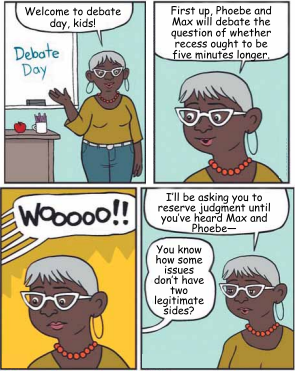
(www.gocomics.com)
No trecho do segundo quadrinho “Phoebe and Max will debate the question of whether recess ought to be five minutes longer”, a expressão sublinhada pode ser substituída, sem prejuízo de sentido, por:
Questão 57 16024563
CEFSA Conhecimentos Gerais 2025/1Leia o texto para responder à questão

Incensed after finding out his rental home of 10 years was about to become a tourist apartment, Daniel Romero took to social media. What followed quickly became a movement, as residents in Málaga, Spain, began plastering stickers — reading “A family used to live here” (“AnTes una familia vivia aquí”) or “Go home” (“Anda Tu casa”) — outside tourist lets1 across the southern Spanish city.
“I didn’t mean to arm a revolution,” said Romero. “I’m just looking for a house to live in.”
At the core of what one Spanish broadcaster called “the sticker rebellion” is not a rejection of tourism, said Romero. Instead, as city residents struggle with a record number of tourists, it’s a sincere appeal for a more balanced approach that could allow for a better coexistence between residents and tourists.
It’s a debate playing out across Europe, as cities from Athens to Amsterdam wrestle with how best to tackle overtourism.
In Málaga, Romero did all he could to negotiate with his landlord2. His landlord’s refusal, however, cast Romero into a desperate search amid the slim pickings of a real estate market where tourist lets have for years surpassed the number of residents in the city centre.
Fuelled by frustration, he took to the social media page of the bar he owns, posting his own version on the blue AT — Apartamento Turístico or Tourist Apartment — signs that advertise tourist lets in the city. “ATtack against the citizens of the city,” he said, as he invited others to create their own version of these short-term rentals.
(Ashifa Kassam. www.theguardian.com, 30.03.2024. Adaptado.)
1tourist lets: apartamentos que são alugados para turistas para estadias de
curto prazo.
2landlord: proprietário do imóvel.
In the excerpt from the third paragraph “Instead, as city residents struggle with a record number of tourists”, the underlined word can be replaced, without meaning change, by:
Questão 56 16024559
CEFSA Conhecimentos Gerais 2025/1Leia o texto para responder à questão
Incensed after finding out his rental home of 10 years was about to become a tourist apartment, Daniel Romero took to social media. What followed quickly became a movement, as residents in Málaga, Spain, began plastering stickers — reading “A family used to live here” (“AnTes una familia vivia aquí”) or “Go home” (“Anda Tu casa”) — outside tourist lets1 across the southern Spanish city.
“I didn’t mean to arm a revolution,” said Romero. “I’m just looking for a house to live in.”
At the core of what one Spanish broadcaster called “the sticker rebellion” is not a rejection of tourism, said Romero. Instead, as city residents struggle with a record number of tourists, it’s a sincere appeal for a more balanced approach that could allow for a better coexistence between residents and tourists.
It’s a debate playing out across Europe, as cities from Athens to Amsterdam wrestle with how best to tackle overtourism.
In Málaga, Romero did all he could to negotiate with his landlord2. His landlord’s refusal, however, cast Romero into a desperate search amid the slim pickings of a real estate market where tourist lets have for years surpassed the number of residents in the city centre.
Fuelled by frustration, he took to the social media page of the bar he owns, posting his own version on the blue AT — Apartamento Turístico or Tourist Apartment — signs that advertise tourist lets in the city. “ATtack against the citizens of the city,” he said, as he invited others to create their own version of these short-term rentals.
(Ashifa Kassam. www.theguardian.com, 30.03.2024. Adaptado.)
1tourist lets: apartamentos que são alugados para turistas para estadias de
curto prazo.
2landlord: proprietário do imóvel.
As specified by the third paragraph, “the sticker rebellion” is
Questão 19 15917902
SARESP Provão Paulista - 3 Ano | LT-CNT 2025Leia o texto para responder à questão.
CNN: AI’s Effects On The Brain
Omar Jimenez, on The Brief with Jim Sciutto
In a recent CNN1 interview, MIT’2 s Dr. Nataliya Kosmyna shared findings from a new study showing that relying solely on AI for tasks like writing can reduce brain activity and memory. The research highlights how overusing AI3 tools like ChatGPT may impact how we think – and why human effort still matters.
Transcript
OMAR JIMENEZ: Meanwhile, a new study from MIT is raising the alarm about how AI impacts learning and how convenience could come at a cost for your brain. The study looked at essay writing across three groups, people using AI, a search engine, or just their own brain power. That last group, no tools at all, showed the strongest brain activity plus better memory recall. They were followed by the search engine users and in last place, people relying on AI.
Now, as students and workers become more and more dependent on tools like ChatGPT, it does raise a lot of questions about the future of how we think.
Joining me now is Nataliya Kosmyna lead author on the study. Thank you for being here. Can you just explain what you learned from this study? Did it surprise you?
(https://www.media.mit.edu. Acesso em 21.07.2025. Adaptado)
GLOSSÁRIO:
1.CNN: canal de noticiário na televisão e mídias.
2. MIT: Massachusetts Institute of Technology, uma universidade de pesquisa nos Estados Unidos.
3.AI (artificial intelligence): inteligência artificial.
A notícia aborda
06