


![[Marketing] Questao Topo - deslogado](https://storage.estuda.com.br/banners/0_6b7ebee90b03af1c560c73bb8bcce34a_banner_deslogado_70_dias.png)
Questões de Inglês
19.971 Questões
Questão 34 16156081
USP FUVEST - Simulado Oficial - 1ª Fase (2ª edição) 2027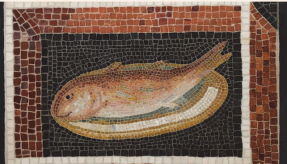
A fish on a platter depicted in a Roman mosaic dating from the 2nd century AD.
Until relatively recently, our knowledge of the realities of daily life in the Roman empire relied heavily on literary sources. They inevitably focused on the imperial elites.
The past 40 years, however, have seen an explosion in the discovery of new material and textual evidence.
The meticulous triangulation of all this new evidence by scholars has birthed a new, data-driven school of ancient history that has yielded an extraordinarily detailed picture of the lives and livelihoods not just of the empire’s privileged upper classes but of everyone else as well.
The result is thrilling, because it overturns so many earlier assumptions.¬¬ It used to be thought that the harsh living conditions of most ancient Romans must have taken a terrible toll on their health. Yet new bio-archaeological techniques reveal that skeletal signatures of childhood disease were twice as high in Victorian London as in Roman British cities. Dental records do reveal an alarming deterioration in oral health coincident with Roman rule. The Romans’ relative good health probably had something to do with their diet.
Here, it is the assumption that most scraped by on a subsistence level which new data consigns to history. In fact, even slaves enjoyed typical daily calorific intakes nearly twice the subsistence level. Urban and rural diets were surprisingly rich and varied — bone analysis reveals a healthy mix of seafood, meat, dairy and legumes — even in the farthest-flung corners of the empire.
The economic irrelevance of women and girls is another misconception. Textiles were a vast industry, employing up to half of all the labour in the empire, and what women could earn from spinning rivalled some male monthly wages. Thus, for an enormous number of Roman households, the female members were economically just as important as the males.
Financial Times. 10 January 2026. Adaptado.
Conforme o texto, a análise do papel econômico feminino no setor têxtil desafia a percepção de que
Questão 59 16410414
CEFSA Conhecimentos Gerais 2026/2Leia a tirinha de Jenny Campbell e responda à questão.

(www.gocomics.com)
1flare: sinal.
According to the comic strip, the girl in the green shirt
Questão 57 16410412
CEFSA Conhecimentos Gerais 2026/2Leia o texto para responder à questão.
Creative tourism is a growing form of travel where visitors learn by taking part in hands-on, culturally rooted activities. These can include classes in local cooking, craft workshops or music sessions. Millennials1 who have a good income that enables them to travel value a work/life balance. They enjoy travelling and are inclined towards creative experiences. This form of tourism connects them to the places and people they encounter.
Research conducted in South Africa surveyed 1,530 people whose average age was 29 years old. It was found that the millennials were more interested in domestic creative tourism than international creative tourism. They were motivated by the possibility of authentic and creative experiences that build skills. Domestic travel was more closely tied to learning. International trips were driven by the desire to escape everyday life. This suggests that domestic tourism is especially well suited to creative tourism.
South Africa is one of the world’s most culturally diverse countries. Thus, there are opportunities to learn about cultures through, for example, indigenous arts and crafts. And creative tourism can create jobs in low income or remote communities. Remote and rural areas are rich in cultural heritage, but have low incomes and ageing populations. There is a great deal of outmigration as people leave for towns and cities. Developing creative tourism could slow this by creating economic opportunities. At the same time, it would boost a sense of social cohesion, where groups in a society feel connected and share a sense of solidarity and belonging. Creative tourism also enables local communities to value and use their own cultural and creative resources. It would be enhanced by the emotional connection that a host has with their home, neighbourhood, or a natural area.
While there is a demand for creative tourism experiences, there also needs to be adequate supply. This requires different organisations and levels of government to work together to develop the creative tourism experience. This will need support and policies that promote greater collaboration between all organisations and government departments involved in tourism.
(Anneli Douglas et al. www.theconversation.com, 22.12.2025. Adaptado.)
1millennials: people who were born between 1981 and 1996.
In the excerpt from the third paragraph “use their own cultural and creative resources”, the underlined word refers to
Questão 56 16410411
CEFSA Conhecimentos Gerais 2026/2Leia o texto para responder à questão.
Creative tourism is a growing form of travel where visitors learn by taking part in hands-on, culturally rooted activities. These can include classes in local cooking, craft workshops or music sessions. Millennials1 who have a good income that enables them to travel value a work/life balance. They enjoy travelling and are inclined towards creative experiences. This form of tourism connects them to the places and people they encounter.
Research conducted in South Africa surveyed 1,530 people whose average age was 29 years old. It was found that the millennials were more interested in domestic creative tourism than international creative tourism. They were motivated by the possibility of authentic and creative experiences that build skills. Domestic travel was more closely tied to learning. International trips were driven by the desire to escape everyday life. This suggests that domestic tourism is especially well suited to creative tourism.
South Africa is one of the world’s most culturally diverse countries. Thus, there are opportunities to learn about cultures through, for example, indigenous arts and crafts. And creative tourism can create jobs in low income or remote communities. Remote and rural areas are rich in cultural heritage, but have low incomes and ageing populations. There is a great deal of outmigration as people leave for towns and cities. Developing creative tourism could slow this by creating economic opportunities. At the same time, it would boost a sense of social cohesion, where groups in a society feel connected and share a sense of solidarity and belonging. Creative tourism also enables local communities to value and use their own cultural and creative resources. It would be enhanced by the emotional connection that a host has with their home, neighbourhood, or a natural area.
While there is a demand for creative tourism experiences, there also needs to be adequate supply. This requires different organisations and levels of government to work together to develop the creative tourism experience. This will need support and policies that promote greater collaboration between all organisations and government departments involved in tourism.
(Anneli Douglas et al. www.theconversation.com, 22.12.2025. Adaptado.)
1millennials: people who were born between 1981 and 1996.
According to the third paragraph, the development of creative tourism in rural areas of South Africa may
Questão 55 16410410
CEFSA Conhecimentos Gerais 2026/2Leia o texto para responder à questão.
Creative tourism is a growing form of travel where visitors learn by taking part in hands-on, culturally rooted activities. These can include classes in local cooking, craft workshops or music sessions. Millennials1 who have a good income that enables them to travel value a work/life balance. They enjoy travelling and are inclined towards creative experiences. This form of tourism connects them to the places and people they encounter.
Research conducted in South Africa surveyed 1,530 people whose average age was 29 years old. It was found that the millennials were more interested in domestic creative tourism than international creative tourism. They were motivated by the possibility of authentic and creative experiences that build skills. Domestic travel was more closely tied to learning. International trips were driven by the desire to escape everyday life. This suggests that domestic tourism is especially well suited to creative tourism.
South Africa is one of the world’s most culturally diverse countries. Thus, there are opportunities to learn about cultures through, for example, indigenous arts and crafts. And creative tourism can create jobs in low income or remote communities. Remote and rural areas are rich in cultural heritage, but have low incomes and ageing populations. There is a great deal of outmigration as people leave for towns and cities. Developing creative tourism could slow this by creating economic opportunities. At the same time, it would boost a sense of social cohesion, where groups in a society feel connected and share a sense of solidarity and belonging. Creative tourism also enables local communities to value and use their own cultural and creative resources. It would be enhanced by the emotional connection that a host has with their home, neighbourhood, or a natural area.
While there is a demand for creative tourism experiences, there also needs to be adequate supply. This requires different organisations and levels of government to work together to develop the creative tourism experience. This will need support and policies that promote greater collaboration between all organisations and government departments involved in tourism.
(Anneli Douglas et al. www.theconversation.com, 22.12.2025. Adaptado.)
1millennials: people who were born between 1981 and 1996.
In the excerpt from the third paragraph “Developing creative tourism could slow this by creating economic opportunities”, the underlined word can be replaced, with no change in meaning, by:
Questão 60 16406669
CEFSA Conhecimentos Gerais 2026/1Leia o pôster da Federação Canadense de Basquete em Cadeira de Rodas.

(www.wheelchairbasketball.ca)
No contexto em que se insere, o trecho do pôster “and an audience that can’t see past the wheelchair” serve para destacar, sobretudo,
06