


![[Marketing] Questao Topo - deslogado](https://storage.estuda.com.br/banners/0_6b7ebee90b03af1c560c73bb8bcce34a_banner_deslogado_70_dias.png)
Questões de Inglês
19.971 Questões
Questão 33 1067458
ITA 2008A questão corresponde ao seguinte texto:
The hold-up
The gunman, is useless.
I know it.
He knows it.
The whole bank knows it.
[5] Even my best mate Marvin knows it and he’s more useless than the gunman.
The worst part about the whole thing is that Marv’s car is standing outside in a fifteen-minute parking zone. We’re all face-down
on the floor and the car’s only got a few minutes left on it.
‘I wish this bloke’d hurry up,’ I mention.
‘I know,’ Marv whispers back. ‘This is outrageous.’ His voice rises from the depths of the floor. ‘I’ll be getting a fine because of
[10] this useless bastard. I can’t afford another fine, Ed.’
‘The car’s not even worth it.’
‘What?’
Marv looks over at me now. I can sense he’s getting uptight.
Offended. If there’s one thing Marv doesn’t tolerate, it’s someone putting shit on his car. He repeats the question.
[15] ‘What did you say, Ed?’
‘I said,’ I whisper, ‘it isn’t even worth the fine, Marv.’
‘Look,’ he says, ‘I’ll take a lot of things, Ed, but…’
I tune out of what he’s saying, because quite frankly, once Marv gets going about his car, it’s downright pain in the arse material.
He goes on and on, like a kid, and he’s just turned twenty, for Jesus sake.
[20] He goes on for another minute or so, until I have to cut him off.
‘Marv,’ I point out, ‘the car’s an embarrassment, okay? It doesn’t even have a handbrake – it’s sitting out there with two bricks
behind the back wheels.’ I’m trying to keep my voice as quiet as possible. ‘Half the time you don’t even bother locking it. You’re
probably hoping someone’ll flog it so you can collect the insurance.’
‘It isn’t insured.’ (…)
[25] That’s when the gunman turns around and shouts, ‘Who’s talkin’ back there?!’
Marv doesn’t care. He’s worked up about the car. (…)
Zusak, M. The Messenger,
Austrália: Ed. Picador, 2002 p. 3-4
Entende-se, pela leitura do texto, que o carro de Marvin
I. está estacionado próximo ao banco.
II. apresenta problema no freio.
III. possui seguro.
Está(ão) correta(s)
Questão 31 1067434
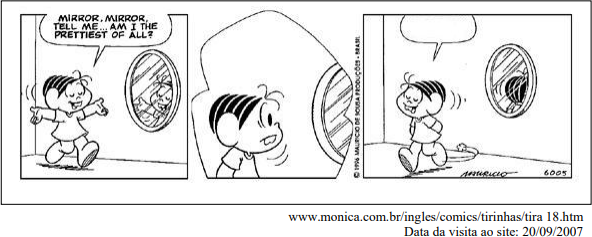
ITA 2008Assinale a opção que melhor expressaria a fala da Mônica no 2º balão.
Questão 30 1067413
ITA 2008A questão refere-se ao texto a seguir:
Taking Measure With Hardware and Software
The researchers who founded National Instruments Corp switched from building their own equipment to beefing up other people’s.
“You could start a company.” That offhand comment by Jim Truchard got Jeff Kodosky and Bill Nowlin thinking. Within days, Truchard and his two employees at the Applied Research Laboratories (ARL) at the University of Texas at Austin (UT) decided to give it a go. That was in February 1976. By May, the trio had incorporated. Today, National Instruments Corp has annual Sales topping $425 million, employs more than 3100 people, sells some 1500 hardware and software products, and, for five years running, has been rated by Fortune magazine as one of the 100 best companies to work for.
At ARL, Truchard headed an underwater acoustic measurements lab. “I had about two dozen different projects, all the way from basic acoustics to pragmatic testing of military sonar beam formers,” he says. Truchard went into science because of Sputnik. “I was right on the cusp of that movement. We were all taking Russian and physics,” he says. He earned bachelor’s and master’s degrees in physics and did his PhD — on a nonlinear parametric acoustic receiving array — in electrical engineering, all at UT. Kodosky and Nowlin both worked part-time for Truchard while enrolled at UT. Nowlin earned a master’s in electrical engineering and Kodosky, who has a bachelor’s in physics from Rensselaer Polytechnic Institute, worked toward a PhD; he drifted between theoretical high-energy physics and computer science but did not complete the degree. (…)
Physics intuition
Both Kodosky and Truchard point to their physics training as playing a role in their success with National Instruments. Says Truchard, “Acoustical measurements are fairly tricky, and it happens to be a smaller area where you didn’t have off-the-shelf equipment. You had to build equipment. That background, and the measurements themselves, created a basis.” What’s more, he adds, “the physics background helps create good intuition. I think having solved differential equations and learned about gradients, you know how things are going to work out. I’ve always felt it helped me develop intuition about business.”
In leaving academic research, says Kodosky, “we took a giant step back from what we were working on. ARL was cutting edge. Now it was customers who were doing the interesting experiments.” Still, he and Truchard say they have more impact on science by supplying tools than they would have had as researchers. “We can have a nonlinear effect on the productivity of the science and engineering community. There is plenty of anecdotal evidence that our virtual instrumentation can make people 5 to 10 times as productive,” Kodosky says. “I personally would find it frustrating [to do research] because it’s slow, but dropping by a customer’s site every couple of years is fun. We live vicariously through them.”
Toni Feder
Physics Today, July 2004
A expressão What’s more (2ª coluna, 1° Parágrafo) NÃO pode ser substituída por
Questão 28 1067401
ITA 2008A questão refere-se ao texto a seguir:
Taking Measure With Hardware and Software
The researchers who founded National Instruments Corp switched from building their own equipment to beefing up other people’s.
“You could start a company.” That offhand comment by Jim Truchard got Jeff Kodosky and Bill Nowlin thinking. Within days, Truchard and his two employees at the Applied Research Laboratories (ARL) at the University of Texas at Austin (UT) decided to give it a go. That was in February 1976. By May, the trio had incorporated. Today, National Instruments Corp has annual Sales topping $425 million, employs more than 3100 people, sells some 1500 hardware and software products, and, for five years running, has been rated by Fortune magazine as one of the 100 best companies to work for.
At ARL, Truchard headed an underwater acoustic measurements lab. “I had about two dozen different projects, all the way from basic acoustics to pragmatic testing of military sonar beam formers,” he says. Truchard went into science because of Sputnik. “I was right on the cusp of that movement. We were all taking Russian and physics,” he says. He earned bachelor’s and master’s degrees in physics and did his PhD — on a nonlinear parametric acoustic receiving array — in electrical engineering, all at UT. Kodosky and Nowlin both worked part-time for Truchard while enrolled at UT. Nowlin earned a master’s in electrical engineering and Kodosky, who has a bachelor’s in physics from Rensselaer Polytechnic Institute, worked toward a PhD; he drifted between theoretical high-energy physics and computer science but did not complete the degree. (…)
Physics intuition
Both Kodosky and Truchard point to their physics training as playing a role in their success with National Instruments. Says Truchard, “Acoustical measurements are fairly tricky, and it happens to be a smaller area where you didn’t have off-the-shelf equipment. You had to build equipment. That background, and the measurements themselves, created a basis.” What’s more, he adds, “the physics background helps create good intuition. I think having solved differential equations and learned about gradients, you know how things are going to work out. I’ve always felt it helped me develop intuition about business.”
In leaving academic research, says Kodosky, “we took a giant step back from what we were working on. ARL was cutting edge. Now it was customers who were doing the interesting experiments.” Still, he and Truchard say they have more impact on science by supplying tools than they would have had as researchers. “We can have a nonlinear effect on the productivity of the science and engineering community. There is plenty of anecdotal evidence that our virtual instrumentation can make people 5 to 10 times as productive,” Kodosky says. “I personally would find it frustrating [to do research] because it’s slow, but dropping by a customer’s site every couple of years is fun. We live vicariously through them.”
Toni Feder
Physics Today, July 2004
Considere as seguintes afirmações:
I. Truchard estudou Física na Rússia e tem doutorado em Engenharia Elétrica.
II. Nowlin é mestre em Engenharia Elétrica.
III. Kodosky não concluiu o doutorado.
Está(ão) correta(s)
Questão 27 1067391
ITA 2008A questão refere-se ao texto a seguir:
Taking Measure With Hardware and Software
The researchers who founded National Instruments Corp switched from building their own equipment to beefing up other people’s.
“You could start a company.” That offhand comment by Jim Truchard got Jeff Kodosky and Bill Nowlin thinking. Within days, Truchard and his two employees at the Applied Research Laboratories (ARL) at the University of Texas at Austin (UT) decided to give it a go. That was in February 1976. By May, the trio had incorporated. Today, National Instruments Corp has annual Sales topping $425 million, employs more than 3100 people, sells some 1500 hardware and software products, and, for five years running, has been rated by Fortune magazine as one of the 100 best companies to work for.
At ARL, Truchard headed an underwater acoustic measurements lab. “I had about two dozen different projects, all the way from basic acoustics to pragmatic testing of military sonar beam formers,” he says. Truchard went into science because of Sputnik. “I was right on the cusp of that movement. We were all taking Russian and physics,” he says. He earned bachelor’s and master’s degrees in physics and did his PhD — on a nonlinear parametric acoustic receiving array — in electrical engineering, all at UT. Kodosky and Nowlin both worked part-time for Truchard while enrolled at UT. Nowlin earned a master’s in electrical engineering and Kodosky, who has a bachelor’s in physics from Rensselaer Polytechnic Institute, worked toward a PhD; he drifted between theoretical high-energy physics and computer science but did not complete the degree. (…)
Physics intuition
Both Kodosky and Truchard point to their physics training as playing a role in their success with National Instruments. Says Truchard, “Acoustical measurements are fairly tricky, and it happens to be a smaller area where you didn’t have off-the-shelf equipment. You had to build equipment. That background, and the measurements themselves, created a basis.” What’s more, he adds, “the physics background helps create good intuition. I think having solved differential equations and learned about gradients, you know how things are going to work out. I’ve always felt it helped me develop intuition about business.”
In leaving academic research, says Kodosky, “we took a giant step back from what we were working on. ARL was cutting edge. Now it was customers who were doing the interesting experiments.” Still, he and Truchard say they have more impact on science by supplying tools than they would have had as researchers. “We can have a nonlinear effect on the productivity of the science and engineering community. There is plenty of anecdotal evidence that our virtual instrumentation can make people 5 to 10 times as productive,” Kodosky says. “I personally would find it frustrating [to do research] because it’s slow, but dropping by a customer’s site every couple of years is fun. We live vicariously through them.”
Toni Feder
Physics Today, July 2004
Considere as seguintes afirmações:
I. Truchard, Nowlin e Kodosky fundaram a empresa National Instruments Corp, em 1976.
II. A National Instruments Corp atua na área de informática e, de acordo com a Revista Fortune, está entre as 100 empresas mais produtivas nesta área.
III. Nowlin e Kodosky trabalhavam para Truchard, em tempo parcial, enquanto estudavam na Universidade do Texas.
Está(ão) correta(s)
Questão 26 1067384
ITA 2008A questão refere-se ao seguinte texto:
Botelho a worthy Award Winner
This year, Brazil and the world have been celebrating the 100th anniversary of the first flight at a public event by Brazilian Alberto Santos-Dumont.
With his imminent retirement next April as president and chief executive officer of Embraer, Mauricio Botelho must be seen as another Brazilian aviation hero, one who turned a small money-losing company into a vibrant world-class aircraft manufacturer.
Botelho spent the first 15 years of his working career at Embraer before leaving to pursue other opportunities. When he returned in 1995, Embraer had been privatised and was embarking on production and delivery of its first regional jets, several years behind competitor Bombardier.
The Embraer ERJ-145 had its maiden flight just weeks before Botelho came on board. First delivery was in late 1996, and the company has never looked back. Nearly 1,000 aircraft based on the ERJ-145 platform have been delivered to 87 operators around the world. A decate on, the ERJ-145 program has reached the 10 million flight-hour milestone.
Under Botelho’s leadship, Embraer has had a penchant for seizing market opportunities. It saw an unfilled market niche for aircraft seating 70-110, and its four-model 170/190 program has won 731 orders to date from airlines around the world.
Embraer also used the ERJ platform to develop an Intelligence, Surveillance and Reconnaissance aircraft, and to produce the Legacy, its first foray into business jets. It is now raking in orders for three other business aircraft in development.
Botelho’s “legacy” is a dynamic company, one of Brazil’s leading exporters, investing in its employees and technology to produce top-notch aircraft.
Airline Business Daily
@ ALTA, 2 December, 2006 p.6
Considere as seguintes afirmações:
I. maiden em “The Embraer ERJ-145 had its maiden flight just weeks before…” (4° Parágrafo) pode ser substituído por single.
II. penchant em “...Embraer has had a penchant for seizing market opportunities.” (5° Parágrafo) pode ser substituído por tendency.
III. foray em “... its first foray into business jets.” (6° Parágrafo) pode ser substituído por attempt.
Está(ão) correta(s)
06