


![[Marketing] Questao Topo - deslogado](https://storage.estuda.com.br/banners/0_6b7ebee90b03af1c560c73bb8bcce34a_banner_deslogado_70_dias.png)
Questões de Inglês
19.971 Questões
Questão 40 40290
FUVEST (USP) 2009In 1993, the dawn of the Internet age, the liberating anonymity of the online world was captured in a wellknown New Yorker cartoon. One dog, sitting at a computer, tells another: “On the Internet, nobody knows you’re a dog.” Fifteen years later, that anonymity is gone.
Technology companies have long used “cookies,” little bits of tracking software slipped onto your computer, and other means, to record the Web sites you visit, the ads you click on, even the words you enter in search engines – information that some hold onto forever. They’re not telling you they’re doing it, and they’re not asking permission. Internet service providers (I.S.P.’s) are now getting into the act. Because they control your connection, they can keep track of everything you do online, and there have been reports that I.S.P.’s may have started to sell the information they collect.
The driving force behind this prying is commerce. The big growth area in online advertising right now is “behavioral targeting.” Web sites can charge a premium if they are able to tell the maker of an expensive sports car that its ads will appear on Web pages clicked on by upperincome, middle-aged men.
The New York Times, April 5th 2008.
De acordo com o texto, a evolução da internet nos últimos quinze anos permite concluir que
Questão 39 40288
FUVEST (USP) 2009In 1993, the dawn of the Internet age, the liberating anonymity of the online world was captured in a wellknown New Yorker cartoon. One dog, sitting at a computer, tells another: “On the Internet, nobody knows you’re a dog.” Fifteen years later, that anonymity is gone.
Technology companies have long used “cookies,” little bits of tracking software slipped onto your computer, and other means, to record the Web sites you visit, the ads you click on, even the words you enter in search engines – information that some hold onto forever. They’re not telling you they’re doing it, and they’re not asking permission. Internet service providers (I.S.P.’s) are now getting into the act. Because they control your connection, they can keep track of everything you do online, and there have been reports that I.S.P.’s may have started to sell the information they collect.
The driving force behind this prying is commerce. The big growth area in online advertising right now is “behavioral targeting.” Web sites can charge a premium if they are able to tell the maker of an expensive sports car that its ads will appear on Web pages clicked on by upperincome, middle-aged men.
The New York Times, April 5th 2008.
Segundo o texto, os provedores de internet
Questão 38 40287
FUVEST (USP) 2009In 1993, the dawn of the Internet age, the liberating anonymity of the online world was captured in a wellknown New Yorker cartoon. One dog, sitting at a computer, tells another: “On the Internet, nobody knows you’re a dog.” Fifteen years later, that anonymity is gone.
Technology companies have long used “cookies,” little bits of tracking software slipped onto your computer, and other means, to record the Web sites you visit, the ads you click on, even the words you enter in search engines – information that some hold onto forever. They’re not telling you they’re doing it, and they’re not asking permission. Internet service providers (I.S.P.’s) are now getting into the act. Because they control your connection, they can keep track of everything you do online, and there have been reports that I.S.P.’s may have started to sell the information they collect.
The driving force behind this prying is commerce. The big growth area in online advertising right now is “behavioral targeting.” Web sites can charge a premium if they are able to tell the maker of an expensive sports car that its ads will appear on Web pages clicked on by upperincome, middle-aged men.
The New York Times, April 5th 2008.
As personagens dos quadrinhos, mencionadas no texto, se vangloriam de
Questão 36 40284
FUVEST (USP) 2009Two in every three people on the planet–some 4 billion in total–are “excluded from the rule of law.” In many cases, this begins with the lack of official recognition of their birth: around 40% of the developing world’s five-yearold children are not registered as even existing.
Later, people will find that the home they live in, the land they farm, or the business that they start, is not protected by legally enforceable property rights. Even in the rare cases when they can afford to go to court, the service is poor. India, for example, has only 11 judges for every 1million people.
These alarming statistics are contained in a report from a commission on the legal empowerment of the poor, released on June 3rd at the United Nations. It argues that not only are such statistics evidence of grave injustice, they also reflect one of the main reasons why so much of humanity remains mired in poverty. Because they are outside the rule of law, the vast majority of poor people are obliged to work (if they work at all) in the informal economy, which is less productive than the formal, legal part of the economy.
The Economist, June 7th 2008.
De acordo com o texto,
Questão 21 39192
UFMT 2009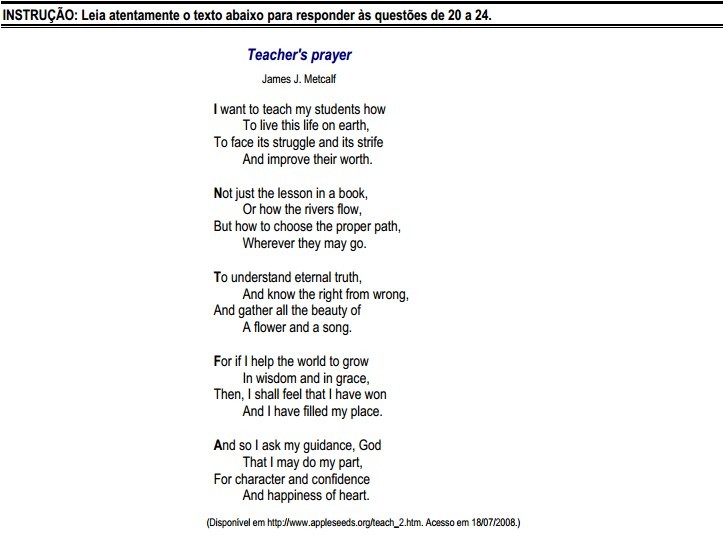
Sobre o texto, marque V para as afirmativas verdadeiras e F para as falsas.
( ) O eu-lírico, na primeira estrofe, propõe-se viver sem problemas.
( ) A quinta estrofe revela que o eu-lírico busca a felicidade.
( ) Na quarta estrofe, o eu-lírico expressa a possibilidade de sucesso.
( ) Valores como verdade, beleza e sabedoria são exaltados pelo eu-lírico.
Assinale a seqüência correta.
Questão 17 39170
UFMT 2009
Quem narra o fato é
06