


![[Marketing] Questao Topo - deslogado](https://storage.estuda.com.br/banners/0_6b7ebee90b03af1c560c73bb8bcce34a_banner_deslogado_70_dias.png)
Questões de Inglês
19.971 Questões
Questão 24 77060
UFU 2° Dia 2009/2Leia o Texto 2 para responder a questão de número 24
Texto 2
U.S. launches another drone plane to patrol Canadian border
CBC News http://news.sympatico.msn.cbc.ca
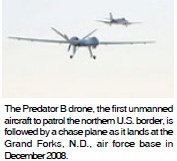
[1] The U.S. has been using the Predator B drone aircraft to patrol its border with
Mexico. “It has been very successful in using that technology there, and we’re testing to
see if we can apply that technology to the northern border as well,” said Steve Sapp of
U.S. Customs and Border Patrol in Fort Drum, N.Y., which is the plane’s base.
[5] The Predator is the unarmed version of the drone plane that the U.S. uses to conduct
air strikes in Pakistan, Iraq and Afghanistan. The aircraft is able to fly at an altitude of
6,000 metres and can remain in the air for 20 hours. The plane is equipped with 3,000
sensors and cameras capable of detecting a moving person from 10 kilometres away.
The planes will gather information along the border and transmit it to operators who will
[10] in turn contact border agents. The drones will not carry weapons and the U.S. will need permission to send them into
in Canadian airspace.
In eastern Canada, the focus of the Predator is the Akwesasne Mohawk Territory. “Essentially, we’re supplying
high-grade marijuana through this one small rural county of 50,000 people, thanks to the border, to all of the northeast,”
said Derek Champagne, district attorney of Franklin County, N.Y., and head of the area’s border and narcotics task
[15] force. However, people on the reserve are uneasy about being watched, Mohawk youth counsellor Brant Davis said.
“We no longer have the life we had 20 years ago here. Cameras, infrared, laser, informants, everything.”
De acordo com o texto, quais afirmativas completam corretamente o enunciado?
The Predator B drone aircraft
I – is the first unmanned aircraft to patrol the US–Canada border.
II – has been used before to patrol the US border with Mexico.
III – flies only at very low altitudes.
IV – does not need authorization to enter Canada airspace.
Assinale a alternativa que contém somente afirmativas corretas.
Questão 23 77059
UFU 2° Dia 2009/2texto 1
Cows with names make more milk
By Jordan Lite
http://www.scientificamerican.com
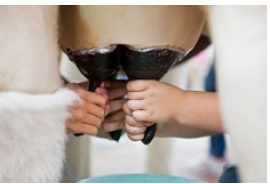
Cows with names make more milk
By Jordan Lite
http://www.scientificamerican.com
[1] Will Bessie make more milk if you call her by name? British agricultural
specialists say she will. Dairy farmers who address their cows by name
reported higher milk yields over the animals’ 10-month lactation period
than those who didn’t, according to new research published in Anthrozoos,
[5] a British journal dedicated to the “interactions of animals and people.”
British researchers compared production from the country’s National
Milk Records with the survey responses of 516 dairy farmers to see if there
was an association between yield and cow naming. Dairy farmers who
reported calling their cows by name got 2,105 gallons (7,938 liters) out of
[10] their cows, compared with 2,029 gallons (7,680 liters) per 10-month lactation
cycle. The results held regardless of the size of the farm or how much the
cows were fed.
“It was quite a revelation and quite encouraging, actually,” says study co-author Catherine Douglas of Newcastle
University in northeast England and a former dairy industry advisor. She tells ScientificAmerican.com the reason for
[15] the link is unclear, but speculates it may have a soothing effect on cows, which tend to fear people and get nervous
when led into the milking parlor. “If cows are slightly fearful of humans, they could produce the hormone cortisol, which
suppresses milk production,” Douglas says. Farmers who have named their cows, she adds, “probably have a better
relationship with them. They’re less fearful, more relaxed and less stressed, so that could have an effect on milk yield.”
Named or otherwise, cows make six times more milk today than they did in the 1990s, according to a 2007 piece
[20] in The Scientist. One reason is growth hormone that many U.S. farmers now inject their cows with to increase their
milk output; another is milking practices that extend farther into cows’ pregnancies, according to the article. Selective
breeding also makes for lots of lactation.
De acordo com o texto, todos os itens abaixo explicam porque as vacas produzem muito mais leite atualmente que nos anos 90, EXCETO:
Questão 18 76696
FATEC 2009/2The Climber
John Slattery ─ actor in just about everything ─ finally rises through the ranks in ‘Mad Men’
Veteran TV actor John Slattery spent last year dividing his time between two very different shows about the American íd: Mad Men and Desperate Housewives. One pays well, but the other is the revelation. In AMC’s Mad Men, set in a 1960s Madison Avenue ad agency, vodka-and-milk passes for breakfast, secretaries take alt the wrong kinds of dictation, and the happiness-for-sale modern era is forged. Slattery is Roger Sterling, an aloofly confident boss (“My name’s on the building,” he says) with a taste for everything under the sun ─ except family. As Slattery plays him, you’d love to have a drink (or seven) with the guy. Slattery explains how he pulls it all off .
• On simultaneous roles in Mad Men and Desperate Housewives: “I had just bought a house. The Housewives producers said, ‘Do you want to do a year on the show?’ The men don’t get as much interesting material as the women, but it’s watched by, what, 20 million people a week? I had a good year.”
• On the fate of his Mad Men character, Roger Sterling: “The last time you see Roger in season one, he has his second heart attack. I said to [creator] Matt Weiner, ‘What the hell?’ He said, ‘Don’t worry. My uncle had six heart attacks.’ I was like, ‘Okay, right. Fantastic.’’’
• On the Mad Men set: “It’s a lot of props: You’re doing dialogue while lighting cigarettes, dealing with the clothes, pouring drinks ... But my sister could roll a joint while driving a Volkswagen Bug, so I thought, Hell, I can do this.”
• On playing a politician with a urine fetish on (yes) Sex and the City: “Sex and the City probably has a lot of alumni with erectile dysfunction or latex fetishes or whatever. We should all compare notes.”
(WILL WELCH - GQConnects Aug08)
No texto, John Slaterry conta sobre como foi seu último ano,
Questão 16 76694
FATEC 2009/2The Green Fairy Returns
In the 20,000 years or so that humans have been getting pissdrunk, no spirit has earned a worse rap than absinthe. Said to turn mild- mannered imbibers into raving maniacs, it was banned in the US and much of Europe in the early 1900s. (Remember Van Gogh’s ear incident? Some scholars blame the green fairy.) The chemical culprit was thujone, a toxic compound found in the crushed ftowers and leaves of absinthe’s key ingredient, wormwood. Or so we thought.
Three years ago, WIRED sent me to meet Ted Breaux, a chemist and microbiologist who had reverse engineered the liquor’s recipe and discovered that there was barely any thujone present (November 2005). During harvest and distillation, he explained, its concentration was reduced to a minuscule five parts per million. Breaux’s research-finaIIy published this spring in the Journal of Agricultural and Food Chemistry - and that WIRED story have helped change absinthe’s image from drug to drink. The US has been slowly peeling away its ban, and in March, the Alcohol and Tobacco Tax and Trade Bureau approved the sale of absinthes that were “thujone free” (containing less than 10 parts per million).
To date, there are four brands on US shelves: Lucid (Breaux’s formula), Kübler, Green Moon, and, St. George Absinthe Verte. “The US is lucky in that its first absinthes are high-quality products, distilled from whole herbs,” Breaux says. “In the European market, 80 to 90 percent is industrial junk.” Under the Jade label, Breaux is making his own absinthes in France and trying to get them green-lighted for saIe in the US. “Even at this point, gaining that approval seems to involve more luck than anything,” he says. Luck, and a littIe chemistry.
(BRIAN ASHCRAFT - Wired / Aug08)
Assinale a alternativa que apresenta o antônimo da palavra “culprit”, localizada no 1º parágrafo do texto.
Questão 15 76693
FATEC 2009/2The Green Fairy Returns
In the 20,000 years or so that humans have been getting pissdrunk, no spirit has earned a worse rap than absinthe. Said to turn mild- mannered imbibers into raving maniacs, it was banned in the US and much of Europe in the early 1900s. (Remember Van Gogh’s ear incident? Some scholars blame the green fairy.) The chemical culprit was thujone, a toxic compound found in the crushed ftowers and leaves of absinthe’s key ingredient, wormwood. Or so we thought.
Three years ago, WIRED sent me to meet Ted Breaux, a chemist and microbiologist who had reverse engineered the liquor’s recipe and discovered that there was barely any thujone present (November 2005). During harvest and distillation, he explained, its concentration was reduced to a minuscule five parts per million. Breaux’s research-finaIIy published this spring in the Journal of Agricultural and Food Chemistry - and that WIRED story have helped change absinthe’s image from drug to drink. The US has been slowly peeling away its ban, and in March, the Alcohol and Tobacco Tax and Trade Bureau approved the sale of absinthes that were “thujone free” (containing less than 10 parts per million).
To date, there are four brands on US shelves: Lucid (Breaux’s formula), Kübler, Green Moon, and, St. George Absinthe Verte. “The US is lucky in that its first absinthes are high-quality products, distilled from whole herbs,” Breaux says. “In the European market, 80 to 90 percent is industrial junk.” Under the Jade label, Breaux is making his own absinthes in France and trying to get them green-lighted for saIe in the US. “Even at this point, gaining that approval seems to involve more luck than anything,” he says. Luck, and a littIe chemistry.
(BRIAN ASHCRAFT - Wired / Aug08)
Atualmente a bebida tem uma qualidade melhor
Questão 14 76692
FATEC 2009/2The Green Fairy Returns
In the 20,000 years or so that humans have been getting pissdrunk, no spirit has earned a worse rap than absinthe. Said to turn mild- mannered imbibers into raving maniacs, it was banned in the US and much of Europe in the early 1900s. (Remember Van Gogh’s ear incident? Some scholars blame the green fairy.) The chemical culprit was thujone, a toxic compound found in the crushed ftowers and leaves of absinthe’s key ingredient, wormwood. Or so we thought.
Three years ago, WIRED sent me to meet Ted Breaux, a chemist and microbiologist who had reverse engineered the liquor’s recipe and discovered that there was barely any thujone present (November 2005). During harvest and distillation, he explained, its concentration was reduced to a minuscule five parts per million. Breaux’s research-finaIIy published this spring in the Journal of Agricultural and Food Chemistry - and that WIRED story have helped change absinthe’s image from drug to drink. The US has been slowly peeling away its ban, and in March, the Alcohol and Tobacco Tax and Trade Bureau approved the sale of absinthes that were “thujone free” (containing less than 10 parts per million).
To date, there are four brands on US shelves: Lucid (Breaux’s formula), Kübler, Green Moon, and, St. George Absinthe Verte. “The US is lucky in that its first absinthes are high-quality products, distilled from whole herbs,” Breaux says. “In the European market, 80 to 90 percent is industrial junk.” Under the Jade label, Breaux is making his own absinthes in France and trying to get them green-lighted for saIe in the US. “Even at this point, gaining that approval seems to involve more luck than anything,” he says. Luck, and a littIe chemistry.
(BRIAN ASHCRAFT - Wired / Aug08)
Pesquisas realizadas mostraram que o absinto
06