


![[Marketing] Questao Topo - deslogado](https://storage.estuda.com.br/banners/0_6b7ebee90b03af1c560c73bb8bcce34a_banner_deslogado_70_dias.png)
Questões de Inglês
19.971 Questões
Questão 87 42677
UFG 2010/1Posted at:
06:42 PM on April 23, 2008
I haven't been able to come to terms with all of the lying that happens on the internet.
I have sons that spend a great deal of time on MySpace and FaceBook. I was looking at one of their profiles and a great deal of the info. on there was a lie. I asked him about it and he said that it was OK because everyone lied a little on MySpace. He is a young man of great character, and this does not represent his normal behaviour.
I understand that giving out personal information over the internet is not wise. Some lies are told to cover the true identity of the person communicating. But how many? And when is it enough? Which lies are acceptable? Which are not?
It seems like this constant acceptance of lying over the internet can desensitize one, to the point that lying in general, is more acceptable in one's daily life.
I have not been able to get past this and think it will not have a positive effect on the younger generation.
Disponível em: <http://bigthink.com/montelinn/why-is-lying-on-theinternet -considered-not-as-offensive-as-lying-in-general>. Acesso em: 30 set. 2009. [Adaptado].
Glossary:
wise: sensato
O autor do texto mostra-se preocupado com a
Questão 86 42674
UFG 2010/1Posted at:
06:42 PM on April 23, 2008
I haven't been able to come to terms with all of the lying that happens on the internet.
I have sons that spend a great deal of time on MySpace and FaceBook. I was looking at one of their profiles and a great deal of the info. on there was a lie. I asked him about it and he said that it was OK because everyone lied a little on MySpace. He is a young man of great character, and this does not represent his normal behaviour.
I understand that giving out personal information over the internet is not wise. Some lies are told to cover the true identity of the person communicating. But how many? And when is it enough? Which lies are acceptable? Which are not?
It seems like this constant acceptance of lying over the internet can desensitize one, to the point that lying in general, is more acceptable in one's daily life.
I have not been able to get past this and think it will not have a positive effect on the younger generation.
Disponível em: <http://bigthink.com/montelinn/why-is-lying-on-theinternet -considered-not-as-offensive-as-lying-in-general>. Acesso em: 30 set. 2009. [Adaptado].
Glossary:
wise: sensato
O texto apresenta uma
Questão 83 42668
UFG 2010/1Language and Neo-colonialism: African Development Challenge
[...] Africa represents today the only major historical and cultural area of the world where despite their indigenous socio-cultural majorities, countries prefer to use the languages of their erstwhile masters in their attempts to develop and make social progress. The result of this neocolonial approach to culture and democracy is that the scientific and technological culture of Africans is hardly advancing. Actually, Africa, by and large, is retrogressing or stagnating. Mass society and its culture is shut off, and condemned to cultural backwardness and alienation from the life of the elite. The elite in turn is bent on what many social critics regard as mindless imitation of the colonial and metropolitan cultures of the west. This is an orientation, which in effect integrates the elite more into the culture of the former colonial masters than the indigenous cultures from where this elite historically and socially derives […].
Disponível em: <http://africaunchained.blogspot.com/2005/09/languageand- neo-colonialism-african.html>. Acesso em: 30 set. 2009.
Glossary:
erstwhile: antigos
by and large: de modo geral
shut off: excluída
backwardness: atraso
mindless: irracional
De acordo com Kwesi Kwaa Prah, significa um retrocesso para o continente africano a
Questão 81 42647
UFG 2010/1
The Major League Baseball (MLB) is the world's premier professional baseball league and contains 30 professional baseball teams, which feature players from many countries around the world. Look at the list of some players injured this year and answer the question.
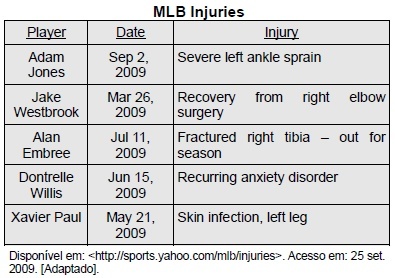
Which of the players may be under psychological treatment?
Questão 19 42127
UERJ 2010/1Why do we need “alternative reality fiction”?
As editor for a magazine on “speculative” fiction, I happen to need one. Though,
being a self-reflective sort of person, I found myself asking why. One person in
our associate page discussions asked why not just call it a magazine for “fiction”?
It’s a valid argument on a philosophical level. It’s a nightmare on a practical level.
[5] Without some way to modify the term “fiction” with greater specificity, readers
will assume general fiction. Without putting some parameters on the types of
fiction we publish and review, submissions would be a nightmare. One of the
most common reasons we reject short stories for publication is simply that they
don’t meet our basic themes. They are not science fiction, fantasy, horror or
[10] historical fiction.
If umbrella terms are so objectionable, then the next step is toward the more specific. Should we
expand the scope of the genre Science Fiction and also include Fantasy, Horror and Historical?
This is certainly a difficult task. Quite frankly, though, I read all of these genres, and I’m not keen on
being in the role to separate them. What makes one book science fiction, and another fantasy? What
[15] makes one book horror, and another historical? These four genres of fiction cannot so efficiently be
separated from one another. Of course, these are not the only genres that get mixed up together in
cross-genre works. For example, historical romances have long been a standard of the monolithic
modern romance genre.
Science fiction, fantasy, horror and historical fiction share an essential common thread – they all
[20] attract readers who seek fiction that transports them to a milieu removed from everyday life. On the
one hand, it’s an issue of setting, but more importantly, I believe, it’s an issue of approach. Readers
of these genres seek to see and writers seek to show our own world through a radically different
lens. They share an ambition to experience the eternal themes of life and humanity from new angles,
in new forms, impossible in realistic fiction. They want their fiction to answer the question “what if”,
[25] not just the question “what is”. They want to see how human, or human-like, characters react to and
manipulate circumstances that are alien to our everyday lives.
I found my best solution to the “umbrella term” issue – the title “alternative reality fiction”. Whether all
these genres are “speculative”, we will leave that question up to you. But there is no doubt that they
all aspire to create alternative realities for readers to experience. Is this term somewhat artificial and
[30] arbitrary? Do I expect it to catch on with readers? The answer is “of course not”. I expect “science
fiction”, “fantasy” and “horror” to remain the staples of the common lexicon. What I am looking to
accomplish with the term “alternative reality fiction” is simply to acknowledge that these non-realistic
genres have more in common with one another than they do with other genres. Above all, I think
the term is useful, precisely because of the most important commonality among these genres: their
readers.
S.K. Slevinski

They want their fiction to answer the question “what if”, not just the question “what is”. (ℓ. 24-25)
The expressions in quotation marks refer respectively to the concepts of:
Questão 18 42126
UERJ 2010/1Why do we need “alternative reality fiction”?
As editor for a magazine on “speculative” fiction, I happen to need one. Though,
being a self-reflective sort of person, I found myself asking why. One person in
our associate page discussions asked why not just call it a magazine for “fiction”?
It’s a valid argument on a philosophical level. It’s a nightmare on a practical level.
[5] Without some way to modify the term “fiction” with greater specificity, readers
will assume general fiction. Without putting some parameters on the types of
fiction we publish and review, submissions would be a nightmare. One of the
most common reasons we reject short stories for publication is simply that they
don’t meet our basic themes. They are not science fiction, fantasy, horror or
[10] historical fiction.
If umbrella terms are so objectionable, then the next step is toward the more specific. Should we
expand the scope of the genre Science Fiction and also include Fantasy, Horror and Historical?
This is certainly a difficult task. Quite frankly, though, I read all of these genres, and I’m not keen on
being in the role to separate them. What makes one book science fiction, and another fantasy? What
[15] makes one book horror, and another historical? These four genres of fiction cannot so efficiently be
separated from one another. Of course, these are not the only genres that get mixed up together in
cross-genre works. For example, historical romances have long been a standard of the monolithic
modern romance genre.
Science fiction, fantasy, horror and historical fiction share an essential common thread – they all
[20] attract readers who seek fiction that transports them to a milieu removed from everyday life. On the
one hand, it’s an issue of setting, but more importantly, I believe, it’s an issue of approach. Readers
of these genres seek to see and writers seek to show our own world through a radically different
lens. They share an ambition to experience the eternal themes of life and humanity from new angles,
in new forms, impossible in realistic fiction. They want their fiction to answer the question “what if”,
[25] not just the question “what is”. They want to see how human, or human-like, characters react to and
manipulate circumstances that are alien to our everyday lives.
I found my best solution to the “umbrella term” issue – the title “alternative reality fiction”. Whether all
these genres are “speculative”, we will leave that question up to you. But there is no doubt that they
all aspire to create alternative realities for readers to experience. Is this term somewhat artificial and
[30] arbitrary? Do I expect it to catch on with readers? The answer is “of course not”. I expect “science
fiction”, “fantasy” and “horror” to remain the staples of the common lexicon. What I am looking to
accomplish with the term “alternative reality fiction” is simply to acknowledge that these non-realistic
genres have more in common with one another than they do with other genres. Above all, I think
the term is useful, precisely because of the most important commonality among these genres: their
readers.
S.K. Slevinski
The author stresses the similarities and differences among the various kinds of works of fiction.
The sentence that best illustrates one of these similarities is:
06