


![[Marketing] Questao Topo - deslogado](https://storage.estuda.com.br/banners/0_6b7ebee90b03af1c560c73bb8bcce34a_banner_deslogado_70_dias.png)
Questões de Inglês
19.971 Questões
Questão 41 7265279
PUC-PR Inverno Medicina 2021Assinale a assertiva que apresenta a recomendação pautada nos resultados do estudo apresentado no trecho a seguir.
'Fat but fit' is a myth when it comes to heart health, new study shows
The negative effects of excess body fat on heart health can't be canceled out by maintaining an active lifestyle, according to new research. Previous studies had suggested that being physically fit could mitigate the negative effects of being overweight on heart health, but this is not the case, according to a new study in the European Journal of Preventive Cardiology, a journal of the European Society of Cardiology (ESC), published Thursday.
"One cannot be 'fat but healthy.' This was the first nationwide analysis to show that being regularly active is not likely to eliminate the detrimental health effects of excess body fat," said study author Alejandro Lucia, a professor of exercise physiology at the European University of Madrid.
"Our findings refute the notion that a physically active lifestyle can completely negate the deleterious effects of overweight and obesity."
Previous research provided some evidence that people who were "fat but fit" could have similar cardiovascular health to those who were "thin but unfit," but Lucia said this has had unintended consequences.
"This has led to controversial proposals for health policies to prioritize physical activity and fitness above weight loss," he said. "Our study sought to clarify the links between activity, body weight, and heart health."
Disponível: https://edition.cnn.com/2021/01/21/health/fat-but-fit-study-scli-intl-wellness/index.html Acesso em: 21/01/2021.
Questão 9 7257332
CUSC Medicina 2° Semestre 2021Read the text to answer question.
Brazil’s first homemade satellite will put an extra eye on dwindling Amazon forests
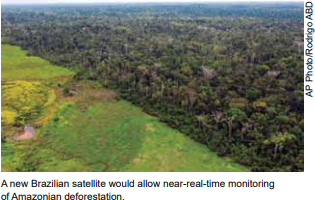
The fate of Brazil’s satellite program — and the country’s capacity to monitor disappearing Amazon forest — will be decided in 17 minutes and 30 seconds on February 28. That’s the time it will take to launch Amazonia-1, the first satellite entirely developed by the country. If the mission goes well, Brazil will join about 20 countries that have managed the whole chain of design, production, and operation of a satellite. Amazonia-1 will give researchers more frequent updates on deforestation and agricultural activity in the world’s largest tropical rainforest. Nevertheless, other challenges await, since Brazilian scientists deal with increasing cuts in research funding.
The satellite represents “a milestone for Brazil,” says Adenilson Silva, an engineer at Brazil’s National Institute for Space Research (INPE) who leads the mission and will oversee the launch at the Indian space center on the island of Sriharikota. The satellite’s development, which began in 2008, has involved more than a dozen Brazilian companies and an investment of 360 million reais ($60 million) — about one-sixth what it would cost to import ready-to-use equipment, Silva says. Amazonia-1 is the first of three Amazon-monitoring satellites INPE aims to build with the same manufacturing platform.
The new satellite is a 2.5-meter-long metallic cuboid weighing 640 kilograms. It’s loaded with 6 kilometers of cables and three wide-angle cameras capable of detecting any area of deforestation bigger than four soccer fields. A planned launch in 2018 was postponed because of a lack of funding and delays in the supply of key components from collaborating companies.
(Sofia Moutinho. www.sciencemag.org, 26.02.2021. Adapted.)
In the second paragraph, Adenilson Silva’s words about the satellite mean that he feels
Questão 29 7237049
PUC-PR Inverno Demais Cursos 2021Read the excerpt below and answer.
The Indian diver who has saved more than 100 lives
For years, Shiva helped police find bodies in Hussain Sagar lake in the southern Indian city of
Hyderabad. And then one day, he stopped someone before they jumped, saving a life for the
first time. BBC Telugu's Balla Satish reports.
Shiva, who uses only one name, says he was about 10 years old when he came across a group of
policemen who were offering to pay anyone who would bring a body out of a nearby pond.
Police in India are underfunded and poorly trained. Many don't know how to swim and are not given
funds to hire professional divers. So, it's not uncommon for them to rely on such informal, even
risky, arrangements.
But when Shiva volunteered, he says, they were taken aback. "They initially refused saying I was
too young. But I convinced them," he recalls.
He did the job and walked away with 40 rupees, now worth about $0.54 or £0.42 but a decent sum
for him at the time.
That was 20 years ago. He is now 30 and still helping the local police.
https://www.bbc.com/news/world-asia-india-54550336
About the text, it is CORRECT to state that
I. The man uses the name Shiva in honor of a famous God.
II. Shiva was still a child when he started working with the police.
III. The policemen immediately agreed to let Shiva work with them.
IV. Indian police gets informal help due to their lack of funds and expertise.
V. Although he is considered a volunteer, he received some money.
Questão 20 7032324
FEMA Medicina 2021/1Analise o infográfico para responder à questão.

No trecho “Domestic violence can have lasting effects”, o termo sublinhado equivale, em português, a:
Questão 15 7032203
FEMA Medicina 2021/1Leia o texto para responder à questão.
One of the abiding images of any virus outbreak is people in surgical masks. Using them to prevent infection is popular in many countries around the world, most notably China during the current coronavirus outbreak where they are also worn to protect against high pollution levels.
Virologists are sceptical about their effectiveness against airborne viruses. But there is some evidence to suggest the masks can help prevent hand-to-mouth transmissions.
Dr David Carrington, of St George’s, University of London, told BBC News “routine surgical masks for the public are not an effective protection against viruses or bacteria carried in the air”, which was how “most viruses” were transmitted, because they were too loose, had no air filter and left the eyes exposed. But they could help lower the risk of contracting a virus through the “splash” from a sneeze or a cough and provide some protection against hand-to-mouth transmissions.
Jonathan Ball, professor of molecular virology at the University of Nottingham, said: “In one well controlled study in a hospital setting, the face mask was as good at preventing influenza infection as a purpose-made respirator.”
Respirators, which tend to feature a specialised air filter, are specifically designed to protect against potentially hazardous airborne particles.
“However, when you move to studies looking at their effectiveness in the general population, the data is less compelling - it’s quite a challenge to keep a mask on for prolonged periods of time,” professor Ball added.
Dr Connor Bamford, of the Wellcome-Wolfson Institute for Experimental Medicine, at Queen’s University Belfast, said “implementing simple hygiene measures” was more effective. “Covering your mouth while sneezing, washing your hands, and not putting your hands to your mouth before washing them, could help limit the risk of catching any respiratory virus,” he said.
(www.bbc.com, 23.01.2020. Adaptado.)
No trecho do quinto parágrafo “potentially hazardous airborne particles”, o termo sublinhado pode ser substituído, sem alteração de sentido, por:
Questão 14 7032200
FEMA Medicina 2021/1Leia o texto para responder à questão.
One of the abiding images of any virus outbreak is people in surgical masks. Using them to prevent infection is popular in many countries around the world, most notably China during the current coronavirus outbreak where they are also worn to protect against high pollution levels.
Virologists are sceptical about their effectiveness against airborne viruses. But there is some evidence to suggest the masks can help prevent hand-to-mouth transmissions.
Dr David Carrington, of St George’s, University of London, told BBC News “routine surgical masks for the public are not an effective protection against viruses or bacteria carried in the air”, which was how “most viruses” were transmitted, because they were too loose, had no air filter and left the eyes exposed. But they could help lower the risk of contracting a virus through the “splash” from a sneeze or a cough and provide some protection against hand-to-mouth transmissions.
Jonathan Ball, professor of molecular virology at the University of Nottingham, said: “In one well controlled study in a hospital setting, the face mask was as good at preventing influenza infection as a purpose-made respirator.”
Respirators, which tend to feature a specialised air filter, are specifically designed to protect against potentially hazardous airborne particles.
“However, when you move to studies looking at their effectiveness in the general population, the data is less compelling - it’s quite a challenge to keep a mask on for prolonged periods of time,” professor Ball added.
Dr Connor Bamford, of the Wellcome-Wolfson Institute for Experimental Medicine, at Queen’s University Belfast, said “implementing simple hygiene measures” was more effective. “Covering your mouth while sneezing, washing your hands, and not putting your hands to your mouth before washing them, could help limit the risk of catching any respiratory virus,” he said.
(www.bbc.com, 23.01.2020. Adaptado.)
O trecho do quarto parágrafo “‘the face mask was as good at preventing influenza infection as a purpose-made respirator’” afirma que a máscara facial
06