


![[Marketing] Questao Topo - deslogado](https://storage.estuda.com.br/banners/0_6b7ebee90b03af1c560c73bb8bcce34a_banner_deslogado_70_dias.png)
Questões de Inglês
19.971 Questões
Questão 38 7334489
UNIPAM 2010/2Extinction 'Gene': Some Species Are More at Risk
By Bryan Walsh Friday, Aug. 07, 2009
(1) In the tree of life, we often envision evolution working like a patient gardener, pruning species that don't quite fit, bit by bit. But that's not how extinction works in practice. Throughout our planet's history, mass extinction has occurred five times — most recently 65 million years ago, when the dinosaurs finally died out — taking out vast amounts of life all at once, usually due to a catastrophic and sudden climatic change.
(2) But it turns out that even during the relatively peaceful eras between global calamities, during what is known as background extinction, whole families of species can disappear, pushed out of existence together. And it's not random. According to a new study published in the August 7 issue of Science, vulnerability to extinction runs in families, meaning that some groups of species have a higher likelihood of becoming extinct than others. "It turns out that some branches of the tree of life are more extinction-prone than others," says Kaustuv Roy, a biology professor at the University of California, San Diego. "Those traits aren't just a part of extinctions that human beings cause, but a general feature of extinction itself."
(3) Roy and his colleagues at the Smithsonian Institution and the University of Chicago examined 200 million years of history of marine clams, oysters and mussels; they picked the simple bivalves because they have a long and detailed fossil record. Going back to the Jurassic period, researchers analyzed when each genus — a taxonomic category just above species — disappeared, and whether relatives vanished at the same time. On average they found that closely related groups of clams went extinct together at a rate that was more often than expected by blind chance — generally those groups of species were confined to a fairly small geographic area. "Extinctions tend to be clustered, which means the effects tend to be worse than what you might expect from random," says Roy. "That's true for mass extinctions as well — they end up culling the most vulnerable lineages, leaving the more resistant ones."
(4) This matters because if extinction were truly random, we'd have a much richer evolutionary history, because at least some representatives of all living things would make it to the present. But because extinction tends to be clumped around certain lineages, when extinction occurs we lose whole groups of species. "The long-term consequences are therefore much worse for biodiversity," says Roy.
(5) The Science study will provide needed ammunition for modern-day conservationists as well. We're in the middle of what some scientists have begun to call the sixth great extinction event, this one caused almost entirely by human beings. Human expansion, hunting, deforestation and ultimately climate change are eliminating species at a rate up to 1,000 times higher than the evolutionary norm. Species like the Yangtze River dolphin and the golden toad have disappeared, while a range of animals — from the Sumatran tiger to the silky Sifaka lemur of Madagascar are on the brink.
(6) Since extinction tends to target groups of vulnerable species, conservationists would be smart to identify and focus their efforts on the most susceptible families. That means species that have a narrow geographic spread — always a risk factor for extinction, in case something happens to their habitat — and, interestingly, large body size, which also tends to be associated with extinction. "It's a quick and dirty way to get a better picture of which species are likely to be most impacted," says Roy. "Then you can go in and mark your priorities." Extinction may be a part of life, but as the dominant species, we have the ability to influence it — for better or for worse.
(taken from the website: http://www.time.com/time/health/article/0,8599,1915055,00.html#ixzz0bHFxP4Tw )
Scientists say that we are in the middle of the “sixth great extinction event” and they also say it has been caused by
Questão 37 7334488
UNIPAM 2010/2Extinction 'Gene': Some Species Are More at Risk
By Bryan Walsh Friday, Aug. 07, 2009
(1) In the tree of life, we often envision evolution working like a patient gardener, pruning species that don't quite fit, bit by bit. But that's not how extinction works in practice. Throughout our planet's history, mass extinction has occurred five times — most recently 65 million years ago, when the dinosaurs finally died out — taking out vast amounts of life all at once, usually due to a catastrophic and sudden climatic change.
(2) But it turns out that even during the relatively peaceful eras between global calamities, during what is known as background extinction, whole families of species can disappear, pushed out of existence together. And it's not random. According to a new study published in the August 7 issue of Science, vulnerability to extinction runs in families, meaning that some groups of species have a higher likelihood of becoming extinct than others. "It turns out that some branches of the tree of life are more extinction-prone than others," says Kaustuv Roy, a biology professor at the University of California, San Diego. "Those traits aren't just a part of extinctions that human beings cause, but a general feature of extinction itself."
(3) Roy and his colleagues at the Smithsonian Institution and the University of Chicago examined 200 million years of history of marine clams, oysters and mussels; they picked the simple bivalves because they have a long and detailed fossil record. Going back to the Jurassic period, researchers analyzed when each genus — a taxonomic category just above species — disappeared, and whether relatives vanished at the same time. On average they found that closely related groups of clams went extinct together at a rate that was more often than expected by blind chance — generally those groups of species were confined to a fairly small geographic area. "Extinctions tend to be clustered, which means the effects tend to be worse than what you might expect from random," says Roy. "That's true for mass extinctions as well — they end up culling the most vulnerable lineages, leaving the more resistant ones."
(4) This matters because if extinction were truly random, we'd have a much richer evolutionary history, because at least some representatives of all living things would make it to the present. But because extinction tends to be clumped around certain lineages, when extinction occurs we lose whole groups of species. "The long-term consequences are therefore much worse for biodiversity," says Roy.
(5) The Science study will provide needed ammunition for modern-day conservationists as well. We're in the middle of what some scientists have begun to call the sixth great extinction event, this one caused almost entirely by human beings. Human expansion, hunting, deforestation and ultimately climate change are eliminating species at a rate up to 1,000 times higher than the evolutionary norm. Species like the Yangtze River dolphin and the golden toad have disappeared, while a range of animals — from the Sumatran tiger to the silky Sifaka lemur of Madagascar are on the brink.
(6) Since extinction tends to target groups of vulnerable species, conservationists would be smart to identify and focus their efforts on the most susceptible families. That means species that have a narrow geographic spread — always a risk factor for extinction, in case something happens to their habitat — and, interestingly, large body size, which also tends to be associated with extinction. "It's a quick and dirty way to get a better picture of which species are likely to be most impacted," says Roy. "Then you can go in and mark your priorities." Extinction may be a part of life, but as the dominant species, we have the ability to influence it — for better or for worse.
(taken from the website: http://www.time.com/time/health/article/0,8599,1915055,00.html#ixzz0bHFxP4Tw )
The Smithsonian Institution and the University of Chicago
Questão 60 7334357
UNIPAM 2010/1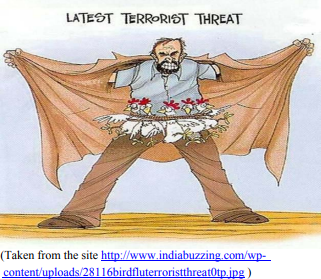
The charge above shows us that …
Questão 59 7334356
UNIPAM 2010/1About the Flu
1 Flu refers to illnesses caused by a number of different influenza viruses. Flu can cause a range of symptoms and effects, from mild to lethal.
3 Two strains of flu, seasonal flu and the H1N1 (Swine) flu, are currently circulating in the United States. A third, highly lethal H5N1 (Bird) flu is being closely tracked overseas.
5 Most healthy people recover from the flu without problems, but certain people are at high risk for serious complications.
7 Extensive efforts are underway to track and monitor the spread of all flu viruses. In the U.S., epidemiologists at the Centers for Disease Control (CDC) are working with states to collect, compile and analyze reports of flu outbreaks.
10 Flu symptoms may include fever, coughing, sore throat, runny or stuffy nose, headaches, body aches, chills and fatigue. In H1N1 (Swine) flu infection, vomiting and diarrhea may also occur.
12 Annual outbreaks of the seasonal flu usually occur during the late fall through early spring. Most people have natural immunity, and a seasonal flu vaccine is available. In a typical year, approximately 5 to 20 percent of the population gets the seasonal flu and approximately 36,000 flurelated deaths are reported.
16 This year, the H1N1 (Swine) flu virus may cause a more dangerous flu season with a lot more people getting sick, being hospitalized and dying than during a regular flu season. H1N1 (Swine Flu) is a new virus first seen in the United States. It is contagious and spreads from person to person. Like seasonal flu, illness in people with H1N1 can vary from mild to severe.
20 A flu pandemic occurs when a new influenza A virus emerges for which there is little or no immunity in the human population; the virus causes serious illness and spreads easily from personto-person worldwide. On June 11, 2009, the World Health Organization (WHO) declared that a global pandemic of H1N1 (Swine) flu is underway.
24 H5N1 (Bird) flu is an influenza A virus subtype that is highly contagious among birds. Rare human infections with the H5N1 (Bird) flu virus have occurred. The majority of confirmed cases have occurred in Asia, Africa, the Pacific, Europe and the Near East. Currently, the United States has no confirmed human H5N1 (Bird) flu infections, but H5N1 (Bird) flu remains a serious concern with the potential to cause a deadly pandemic.
(Taken and adapted from the site http://www.flu.gov/individualfamily/about/index.html )
In the sentence “A flu pandemic occurs when a new influenza A virus emerges for which there is little or no immunity in the human population; the virus causes serious illness and spreads easily from person-to-person worldwide.” (lines 20-22) the underlined verbs can be replaced by the verbs … respectively:
Questão 57 7334352
UNIPAM 2010/1About the Flu
1 Flu refers to illnesses caused by a number of different influenza viruses. Flu can cause a range of symptoms and effects, from mild to lethal.
3 Two strains of flu, seasonal flu and the H1N1 (Swine) flu, are currently circulating in the United States. A third, highly lethal H5N1 (Bird) flu is being closely tracked overseas.
5 Most healthy people recover from the flu without problems, but certain people are at high risk for serious complications.
7 Extensive efforts are underway to track and monitor the spread of all flu viruses. In the U.S., epidemiologists at the Centers for Disease Control (CDC) are working with states to collect, compile and analyze reports of flu outbreaks.
10 Flu symptoms may include fever, coughing, sore throat, runny or stuffy nose, headaches, body aches, chills and fatigue. In H1N1 (Swine) flu infection, vomiting and diarrhea may also occur.
12 Annual outbreaks of the seasonal flu usually occur during the late fall through early spring. Most people have natural immunity, and a seasonal flu vaccine is available. In a typical year, approximately 5 to 20 percent of the population gets the seasonal flu and approximately 36,000 flurelated deaths are reported.
16 This year, the H1N1 (Swine) flu virus may cause a more dangerous flu season with a lot more people getting sick, being hospitalized and dying than during a regular flu season. H1N1 (Swine Flu) is a new virus first seen in the United States. It is contagious and spreads from person to person. Like seasonal flu, illness in people with H1N1 can vary from mild to severe.
20 A flu pandemic occurs when a new influenza A virus emerges for which there is little or no immunity in the human population; the virus causes serious illness and spreads easily from personto-person worldwide. On June 11, 2009, the World Health Organization (WHO) declared that a global pandemic of H1N1 (Swine) flu is underway.
24 H5N1 (Bird) flu is an influenza A virus subtype that is highly contagious among birds. Rare human infections with the H5N1 (Bird) flu virus have occurred. The majority of confirmed cases have occurred in Asia, Africa, the Pacific, Europe and the Near East. Currently, the United States has no confirmed human H5N1 (Bird) flu infections, but H5N1 (Bird) flu remains a serious concern with the potential to cause a deadly pandemic.
(Taken and adapted from the site http://www.flu.gov/individualfamily/about/index.html )
It is not correct to say about the common flu that …
Questão 56 7334350
UNIPAM 2010/1The Influenza Pandemic of 1918
1 The influenza pandemic of 1918-1919 killed more people than the Great War, known today as World War I (WWI), at somewhere between 20 and 40 million people. It has been cited as the most devastating epidemic in recorded world history. More people died of influenza in a single year than in four-years of the Black Death Bubonic Plague from 1347 to 1351. Known as "Spanish Flu" or "La Grippe" the influenza of 1918-1919 was a global disaster.
6 In the fall of 1918 the Great War in Europe was winding down and peace was on the horizon. The Americans had joined in the fight, bringing the Allies closer to victory against the Germans. Deep within the trenches these men lived through some of the most brutal conditions of life, which it seemed could not be any worse. Then, in pockets across the globe, something erupted that seemed as benign as the common cold. The influenza of that season, however, was far more than a cold. In the two years that this scourge ravaged the earth, a fifth of the world's population was infected. The flu was most deadly for people ages 20 to 40. This pattern of morbidity was unusual for influenza which is usually a killer of the elderly and young children. It infected 28% of all Americans. An estimated 675,000 Americans died of influenza during the pandemic, ten times as many as in the world war. Of the U.S. soldiers who died in Europe, half of them fell to the influenza virus and not to the enemy. An estimated 43,000 servicemen mobilized for WWI died of influenza. 1918 would go down as unforgettable year of suffering and death and yet of peace.
18 The effect of the influenza epidemic was so severe that the average life span in the US was depressed by 10 years. The influenza virus had a profound virulence, with a mortality rate at 2.5% compared to the previous influenza epidemics, which were less than 0.1%. The death rate for 15 to 34-year-olds of influenza and pneumonia were 20 times higher in 1918 than in previous years. People were struck with illness on the street and died rapid deaths. One anecdote shared of 1918 was of four women playing bridge together late into the night. Overnight, three of the women died from influenza. Others told stories of people on their way to work suddenly developing the flu and dying within hours. One physician writes that patients with seemingly ordinary influenza would rapidly "develop the most viscous type of pneumonia that has ever been seen" and later when cyanosis appeared in the patients, "it is simply a struggle for air until they suffocate," (Grist, 1979). Another physician recalls that the influenza patients "died struggling to clear their airways of a blood-tinged froth that sometimes gushed from their nose and mouth," (Starr, 1976). The physicians of the time were helpless against this powerful agent of influenza.
(Taken and adapted from the site http://virus.stanford.edu/uda/ )
In the sentence “ The influenza of that season, however, was far more than a cold.” (lines 10-11), the underlined word however wants to express that …
06