


![[Marketing] Questao Topo - deslogado](https://storage.estuda.com.br/banners/0_6b7ebee90b03af1c560c73bb8bcce34a_banner_deslogado_70_dias.png)
Questões de Inglês
19.971 Questões
Questão 42 41326
UNEMAT 1° Dia 2011/1Texto 1
CAN A VIRUS MAKE YOU FAT?
Although the idea sounds more like the premise of a B movie than scientific theory two scientists at the University of Wisconsin in Madison believe they've found a virus that causes some people to get fat. Nikhil Dhurandhar and Richard Atkinson reported recently that when they injected a virus known as AD36 into mice and chickens, the animals' body fat increased. Because humans were unlikely to volinteer for such exiperimentation, the scientists decided to test for the presence of antibodies to the virus. Of 154
people tested, about 15 percent of those who were obese had the antibodies. None of the lean people did.
However, the findings don't necessarily prove that the virus caused obesity in the test group. As several virologists have pointed out, obese people may simply be more susceptible to such a virus.

Biologists have
found a virus
that causes
obesity in
animals such as
chickens. Now
the researchers
are testing
people for it.
De acordo com o texto, é correto afirmar.
Questão 41 41325
UNEMAT 1° Dia 2011/1Texto 1
CAN A VIRUS MAKE YOU FAT?
Although the idea sounds more like the premise of a B movie than scientific theory two scientists at the University of Wisconsin in Madison believe they've found a virus that causes some people to get fat. Nikhil Dhurandhar and Richard Atkinson reported recently that when they injected a virus known as AD36 into mice and chickens, the animals' body fat increased. Because humans were unlikely to volinteer for such exiperimentation, the scientists decided to test for the presence of antibodies to the virus. Of 154
people tested, about 15 percent of those who were obese had the antibodies. None of the lean people did.
However, the findings don't necessarily prove that the virus caused obesity in the test group. As several virologists have pointed out, obese people may simply be more susceptible to such a virus.
Biologists have
found a virus
that causes
obesity in
animals such as
chickens. Now
the researchers
are testing
people for it.
O texto fala sobre:
Questão 87 40036
FUVEST (USP) 2011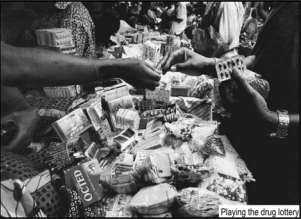
The perils of counterfeit drugs go way beyond being ripped off by dubious online pill-pushers. The World Health Organization (WHO) estimates that 50 per cent of all medicines sold online are worthless counterfeits. In developing nations fake pills may account for as much as 30 per cent of all drugs on the market. Even in the developed world, 1 per cent of medicines bought over the counter are fakes.
Some key events illustrate the risk these pose. In Nigeria, 2500 children died in 1995 after receiving fake meningitis vaccines. In Haiti, Bangladesh and Nigeria, around 400 people died in 1998 after being given paracetamol that had been prepared with diethylene glycol – a solvent used in wallpaper stripper. The fakers are nothing if not market-aware: in the face of an outbreak of H5N1 bird flu in 2005, they began offering fake Tamiflu.
What can be done? The WHO coordinates an umbrella body called the International Medical Products Anti-Counterfeiting Taskforce (IMPACT), an industry initiative that issues alerts when it finds anomalies in the medicine supply chain. Such events include sudden drops in wholesale prices, hinting at fakes coming onto the market, or the mimicking of anti-counterfeiting features on packaging, such as holograms or barcodes, says Nimo Ahmed, head of intelligence at the UK’s Medicine and Healthcare Products Regulatory Agency
New Scientist, 10 July 2010, p. 18. Adaptado.
O texto informa que os falsificadores
Questão 17 14044643
UFPI PSIU 1ª Série 2010Leia os textos e responda à questão.
TEXTO 01
New law claims fetuses feel pain
Can fetuses feel pain – and if so, when? The questions have long been debated by scientists and are key for
opponents of abortion. But this week Nebraska became the first US state to restrict abortion on that basis.
The Nebraska law, passed on 13 April, lays out several arguments about fetal pain. Each was contradicted
last month in a letter to the Nebraska legislature by Mark Rosen of the University California, San Francisco,
[5] co-author of a 2005 review on the subject.
The law states that at 20 weeks a fetus “has the physical structures necessary to experience pain”. But
Rosen argues that fetuses don’t have the brain connections needed to feel pain until about 29 weeks.
The law also claims that after 20 weeks fetuses have reflex responses to evade painful stimuli. Rosen
counters that these responses are involuntary, and, like “knee-jerk” reflexes, don’t correspond to pain.
[10] Vivette Glover of Imperial College London says that fetuses may feel pain at 20 weeks, but they can be
given anaesthetics in any case.
Rosen and others believe the law is designed to provoke a legal challenge from LeRoy Carhart, a surgeon
who performs late-term abortions in Nebraska. This could take the claims of fetal pain to the US Supreme Court,
which has the power to overturn the Roe vs Wade ruling of 1973 that gave US women almost unrestricted
[15] access to abortion.
(NewScientist, 24 April 2010.)
TEXTO 02
Fetuses have their own immunity
Fetuses aren’t as defenceless as they seem – they may be armed to fight off viruses long before birth.
It was thought that fetal immune cells were too immature to be useful and that fetuses and newborns relied
on antibodies provided by their mothers. Now David Vermijlen at the Institute for Medical Immunology in
Brussels, Belgium, and his colleagues have shown that fetuses just 21 weeks old may be capable of fending off
[5] infections using their own immune cells. This could lead to new vaccines for newborns and unborn babies.
Vermijlen’s team analysed cord blood from 19 newborns infected with cytomegalovirus (CMV) – which can
cause serious symptoms in infected infants and give fetuses brain damage – and 22 uninfected newborns. The
team found that the number of gamma delta T-cells was higher in the CMV-infected babies, and that a greater
proportion of these immune cells were activated.
[10] When the team compared the types of immune cells activated in the fetus with those in the mother, there
were clear differences, suggesting that fetuses generate an independent immune response to CMV (Journal of
Experimental Medicine, DOI: 10.1084/jem.20090348).
(NewScientist , 1 May 2010.)
Marque a opção na qual todas as palavras são formadas por prefixo.
Questão 4 14041683
UEG Conhecimentos Gerais 2010/1TEXTO
Literacy in Brazil
The statistics for educational exclusion in Brazil are staggering. Of a total population of about 184 million (of whom 62% are aged under 29) there are 65 million young people and adults aged 15 or over who have not completed primary education. Of these 65 million:
• 33 million are functionally illiterate and have not even completed 4th grade;
• 14.6 million are completely illiterate.
In the 15 to 24 year age bracket - an important age-group that will provide the future critical mass of the country - 19 million people have not finished primary education and almost three million are completely illiterate.
These numbers illustrate the need to rescue the idea of education as a right of all young people and adults who have been excluded from the education system. Although Brazil has made significant progress in the field of education, especially in adult and youth education, the Brazilian government recognises there is still much to do, particularly in confronting a range of interrelated illiteracies: in education, culture, politics and citizenship.
The Ministry of Education organises its action strategy by giving priority to the articulation between social and educational inclusion and literacy. In addition to being a right, the articulation between literacy and programmes of social inclusion is strategic and re-defines the horizons of citizenship. Links within the federal sphere and also with local state and municipal programmes and links between literacy and the income transfer programme (Bolsa Família) permit an important focus on those living in extreme poverty. The literacy and adult and youth education agendas form the structural base of inclusion. The articulation with vocational courses expresses the role of literacy as the gateway to inclusion and citizenship.
Disponível em: http://www.nrdc.org.uk/content.asp?CategoryID=1033. Acesso em: 8 set. 2009. (Adaptado).
Ainda com relação à estrutura linguística do texto, é CORRETO afirmar:
Questão 1 14041649
UEG Conhecimentos Gerais 2010/1TEXTO
Literacy in Brazil
The statistics for educational exclusion in Brazil are staggering. Of a total population of about 184 million (of whom 62% are aged under 29) there are 65 million young people and adults aged 15 or over who have not completed primary education. Of these 65 million:
• 33 million are functionally illiterate and have not even completed 4th grade;
• 14.6 million are completely illiterate.
In the 15 to 24 year age bracket - an important age-group that will provide the future critical mass of the country - 19 million people have not finished primary education and almost three million are completely illiterate.
These numbers illustrate the need to rescue the idea of education as a right of all young people and adults who have been excluded from the education system. Although Brazil has made significant progress in the field of education, especially in adult and youth education, the Brazilian government recognises there is still much to do, particularly in confronting a range of interrelated illiteracies: in education, culture, politics and citizenship.
The Ministry of Education organises its action strategy by giving priority to the articulation between social and educational inclusion and literacy. In addition to being a right, the articulation between literacy and programmes of social inclusion is strategic and re-defines the horizons of citizenship. Links within the federal sphere and also with local state and municipal programmes and links between literacy and the income transfer programme (Bolsa Família) permit an important focus on those living in extreme poverty. The literacy and adult and youth education agendas form the structural base of inclusion. The articulation with vocational courses expresses the role of literacy as the gateway to inclusion and citizenship.
Disponível em: http://www.nrdc.org.uk/content.asp?CategoryID=1033. Acesso em: 8 set. 2009. (Adaptado).
De acordo com o texto, é CORRETO afirmar sobre a alfabetização no Brasil:
06