


![[Marketing] Questao Topo - deslogado](https://storage.estuda.com.br/banners/0_6b7ebee90b03af1c560c73bb8bcce34a_banner_deslogado_70_dias.png)
Questões de Inglês
19.971 Questões
Questão 51 43651
UEMG 2011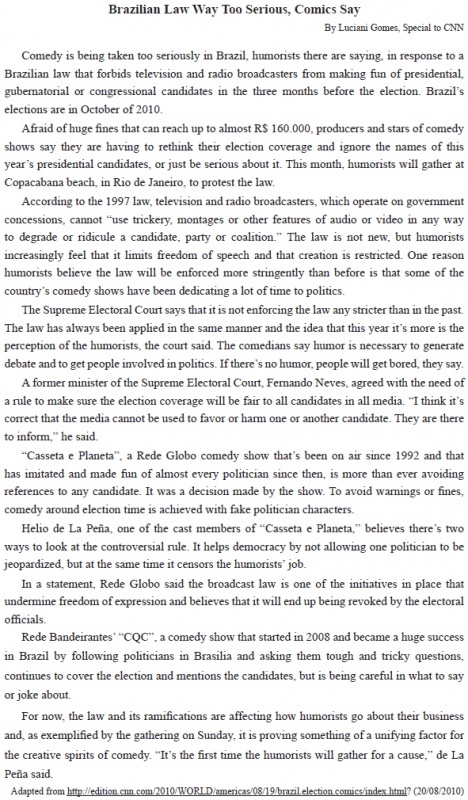
According to the Supreme Electoral Court, the 1997 law
Questão 50 43650
UEMG 2011Brazilian Law Way Too Serious, Comics Say
By Luciani Gomes, Special to CNN
Comedy is being taken too seriously in Brazil, humorists there are saying, in response to a Brazilian law that forbids television and radio broadcasters from making fun of presidential, gubernatorial or congressional candidates in the three months before the election. Brazil’s elections are in October of 2010.
Afraid of huge fines that can reach up to almost R$ 160.000, producers and stars of comedy shows say they are having to rethink their election coverage and ignore the names of this year’s presidential candidates, or just be serious about it. This month, humorists will gather at Copacabana beach, in Rio de Janeiro, to protest the law.
According to the 1997 law, television and radio broadcasters, which operate on government concessions, cannot “use trickery, montages or other features of audio or video in any way to degrade or ridicule a candidate, party or coalition.” The law is not new, but humorists increasingly feel that it limits freedom of speech and that creation is restricted. One reason humorists believe the law will be enforced more stringently than before is that some of the country’s comedy shows have been dedicating a lot of time to politics.
The Supreme Electoral Court says that it is not enforcing the law any stricter than in the past. The law has always been applied in the same manner and the idea that this year it’s more is the perception of the humorists, the court said. The comedians say humor is necessary to generate debate and to get people involved in politics. If there’s no humor, people will get bored, they say.
A former minister of the Supreme Electoral Court, Fernando Neves, agreed with the need of a rule to make sure the election coverage will be fair to all candidates in all media. “I think it’s correct that the media cannot be used to favor or harm one or another candidate. They are there to inform,” he said.
“Casseta e Planeta”, a Rede Globo comedy show that’s been on air since 1992 and that has imitated and made fun of almost every politician since then, is more than ever avoiding references to any candidate. It was a decision made by the show. To avoid warnings or fines, comedy around election time is achieved with fake politician characters.
Helio de La Peña, one of the cast members of “Casseta e Planeta,” believes there’s two ways to look at the controversial rule. It helps democracy by not allowing one politician to be jeopardized, but at the same time it censors the humorists’ job.
In a statement, Rede Globo said the broadcast law is one of the initiatives in place that undermine freedom of expression and believes that it will end up being revoked by the electoral officials.
Rede Bandeirantes’ “CQC”, a comedy show that started in 2008 and became a huge success in Brazil by following politicians in Brasilia and asking them tough and tricky questions, continues to cover the election and mentions the candidates, but is being careful in what to say or joke about.
For now, the law and its ramifications are affecting how humorists go about their business and, as exemplified by the gathering on Sunday, it is proving something of a unifying factor for the creative spirits of comedy. “It’s the first time the humorists will gather for a cause,” de La Peña said.
Adapted from http://edition.cnn.com/2010/WORLD/americas/08/19/brazil.election.comics/index.html? (20/08/2010)
The CORRECT active voice subject in parenthesis of the extract “…the law will be enforced more stringently than before…” is :
Questão 49 43649
UEMG 2011Brazilian Law Way Too Serious, Comics Say
By Luciani Gomes, Special to CNN
Comedy is being taken too seriously in Brazil, humorists there are saying, in response to a Brazilian law that forbids television and radio broadcasters from making fun of presidential, gubernatorial or congressional candidates in the three months before the election. Brazil’s elections are in October of 2010.
Afraid of huge fines that can reach up to almost R$ 160.000, producers and stars of comedy shows say they are having to rethink their election coverage and ignore the names of this year’s presidential candidates, or just be serious about it. This month, humorists will gather at Copacabana beach, in Rio de Janeiro, to protest the law.
According to the 1997 law, television and radio broadcasters, which operate on government concessions, cannot “use trickery, montages or other features of audio or video in any way to degrade or ridicule a candidate, party or coalition.” The law is not new, but humorists increasingly feel that it limits freedom of speech and that creation is restricted. One reason humorists believe the law will be enforced more stringently than before is that some of the country’s comedy shows have been dedicating a lot of time to politics.
The Supreme Electoral Court says that it is not enforcing the law any stricter than in the past. The law has always been applied in the same manner and the idea that this year it’s more is the perception of the humorists, the court said. The comedians say humor is necessary to generate debate and to get people involved in politics. If there’s no humor, people will get bored, they say.
A former minister of the Supreme Electoral Court, Fernando Neves, agreed with the need of a rule to make sure the election coverage will be fair to all candidates in all media. “I think it’s correct that the media cannot be used to favor or harm one or another candidate. They are there to inform,” he said.
“Casseta e Planeta”, a Rede Globo comedy show that’s been on air since 1992 and that has imitated and made fun of almost every politician since then, is more than ever avoiding references to any candidate. It was a decision made by the show. To avoid warnings or fines, comedy around election time is achieved with fake politician characters.
Helio de La Peña, one of the cast members of “Casseta e Planeta,” believes there’s two ways to look at the controversial rule. It helps democracy by not allowing one politician to be jeopardized, but at the same time it censors the humorists’ job.
In a statement, Rede Globo said the broadcast law is one of the initiatives in place that undermine freedom of expression and believes that it will end up being revoked by the electoral officials.
Rede Bandeirantes’ “CQC”, a comedy show that started in 2008 and became a huge success in Brazil by following politicians in Brasilia and asking them tough and tricky questions, continues to cover the election and mentions the candidates, but is being careful in what to say or joke about.
For now, the law and its ramifications are affecting how humorists go about their business and, as exemplified by the gathering on Sunday, it is proving something of a unifying factor for the creative spirits of comedy. “It’s the first time the humorists will gather for a cause,” de La Peña said.
Adapted from http://edition.cnn.com/2010/WORLD/americas/08/19/brazil.election.comics/index.html? (20/08/2010)
According to Luciani Gomes’ article, all statements below are correct EXCEPT:
Questão 90 43205
UFG 2011/1
Body language is a form of non-verbal communication, which consists of body posture, gestures, facial expressions, and eye movements. Which picture shows a typical expression of a dreamer who is waiting for a soul mate that will certainly appear at some point?
Questão 89 43204
UFG 2011/1“I Love You, But...”
“Honey, I Love You BUT...”
is NOT a declaration of love.
Joy Stevens
Declaration of love, manipulation, power play,
or verbal abuse?
What is it?
No!
It is actually a strategy for power and control by guilt. The “Ilove-
you-but... person” uses negativity for leverage.
[...]
declaration of love. After all, it can be said with a smile on the face and innocent patience in the voice.But is it tender and loving?
It can also be quite psychologically damaging, then, to be in a relationship with this person. Your partner is constantly belittling you while hiding behind a guise of love.
You are being manipulated in a power play. You are probably confused and often feeling guilty. You are being verbally abused!
Disponível em: <http://www.cyberparent.com/abuse/but.htm>. Acesso em: 13 set. 2010. [Excerto]
Vocabulário
leverage: poder
belittling: depreciando, deprimindo
guise: aparência
Based on the argument presented in the text, an unconditional declaration of love is:
Questão 88 43203
UFG 2011/1“I Love You, But...”
“Honey, I Love You BUT...”
is NOT a declaration of love.
Joy Stevens
Declaration of love, manipulation, power play,
or verbal abuse?
What is it?
No!
It is actually a strategy for power and control by guilt. The “Ilove-
you-but... person” uses negativity for leverage.
[...]
declaration of love. After all, it can be said with a smile on the face and innocent patience in the voice.But is it tender and loving?
It can also be quite psychologically damaging, then, to be in a relationship with this person. Your partner is constantly belittling you while hiding behind a guise of love.
You are being manipulated in a power play. You are probably confused and often feeling guilty. You are being verbally abused!
Disponível em: <http://www.cyberparent.com/abuse/but.htm>. Acesso em: 13 set. 2010. [Excerto]
Vocabulário
leverage: poder
belittling: depreciando, deprimindo
guise: aparência
Taking into account this power relationship where one manipulates the other, which statement is related to the person who is being manipulated?
06