


![[Marketing] Questao Topo - deslogado](https://storage.estuda.com.br/banners/0_6b7ebee90b03af1c560c73bb8bcce34a_banner_deslogado_70_dias.png)
Questões de Inglês
19.971 Questões
Questão 24 105524
FAMEVAÇO Caderno G01 2011/2TEXT:
The net isn’t as important as we think
Ha-Joon Chang, born in South Korea in 1963, is an economist based at Cambridge University specializing in development. He is the author of several books, including Kicking Away the Ladder (2002) and Bad Samaritans: The Myth of Free Trade and the Secret History of Capitalism (2008). In his new book, 23 Things They Don’t Tell You About Capitalism (Allen Lane) Chang debunks many myths about the free market. In one chapter, he says: “The washing machine changed the world more than the internet.”
Is it really true that the washing machine has changed the world more than the internet?
When we assess the impact of technological changes, we tend to downplay things that happened a while ago. Of course, the internet is great – I can now google and find the exact location of a restaurant in Liverpool, or whatever. But when you look at the impact of this on the economy, it’s mainly in the area of leisure.
The internet may have significantly changed the working patterns of people like you and me, but we are in a small minority. For most people, its effect is more about keeping in touch with friends and looking up things here and there. Economists have found very little evidence that since the internet revolution productivity has grown.
And the washing machine was more transformative?
By liberating women from household work and helping to abolish professions such as domestic service, the washing machine and other household goods completely revolutionized the structure of society. As women have become active in the labor market they have acquired a different status at home – they can threaten their partners that if they don’t treat them well they will leave them and make an independent living. And this had enormous economic consequences. Rather than spend their time washing clothes, women could go out and do more productive things. Basically, it has doubled the workforce.
The washing machine is just one element here. Other factors have contributed to the liberation of women feminism, the pill and so on.
Yes, but feminism couldn’t have been implemented unless there was this technological basis for a society where women went out and worked. Of course it’s not just the washing machine, it’s piped water, electricity, and son on.
Do we tend to overestimate the importance of communications revolutions?
Not always. The invention of the printing press was one of the most important events in human history. But we overestimate the internet and ignore its downsides. There’s now so much information out there that you don’t actually have time to digest it.
But what about the sheer speed at which it allows us to do things?
That is exaggerated too. Before the invention of the telegraph in the late 19th century, it took two to three weeks to carry a message across the Atlantic. The telegraph reduced it to 20 or 30 minutes – an increase of 2,000 – 3,000 times. The internet has reduced the time of sending, say, three or four pages of text from the 30 seconds you needed with a fax machine down to maybe two seconds – a reduction by a factor of 15. I can’t think of anything where it’s really so important that we send it in two seconds rather than a few minutes.
Do we fundamentally misunderstand the nature of capitalism, as the title of your book implies?
Let me start by saying that I am an advocate of capitalism. To paraphrase Winston Churchill, I think it’s the worst economic system except for all the others. So I’m not an anti-capitalist, or anarchist. I want capitalism to work. But the version of capitalism that we have practiced in the past two or three decades is a very extreme free-market version which, contrary to the claims of many economists, is not the only or best way to run things. There are many different ways and in the book I show that countries that have run capitalism differently – even if they practice free-market capitalism today have done much better.
(FONTE: By William Skidelsky – The Observer – in Speak Up Magazine issue 285)
According to the text human beings means
Questão 95 101471
ENEM PPL 2° Dia 2011Slumdog Millionaire
Danny Boyle's "Slumdog Millionaire" hits the ground running. This is a breathless, exciting story, heartbreaking and exhilarating at the same time, about a Mumbai orphan who rises from rags to riches on the strength of his lively intelligence. The film's universal appeal presents the real India to millions of moviegoers for the first time.
The real India, supercharged with a plot as reliable and eternal as the hills. The film's surface is so dazzling that you hardly realize how traditional it is underneath. But it's the buried structure that pulls us through the story like a big engine on a short train.
By the real India, I don't mean an unblinking documentary like Louis Malle's "Calcutta" or the recent "Born Into Brothels." I mean the real India of social levels that seem to be separated by centuries. What do people think of when they think of India? On the one hand, Mother Teresa, "Salaam Bombay!" and the wretched of the earth. On the other, the "Masterpiece Theater"-style images of "A Passage to India," "Gandhi" and "The Jewel in the Crown."
The film uses dazzling cinematography, breathless editing, driving music and headlong momentum to explode with narrative force, stirring in a romance at the same time.
EBERT, R. Disponível em: http://rogerebert.suntimes.com. Acesso em: 11 abr. 2011 (adaptado)
O texto trata do premiado filme indiano “Slumdog Millionaire”. Segundo a resenha apresentada, a história retrata uma Índia real, uma vez que
Questão 18 99604
FCM PB Medicina 2011/1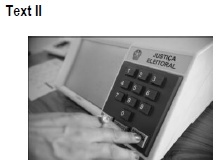
The Brazilian elections results rank among the fastest to be announced in the world. Two weeks ago, merely 7 hours after the ballots were closed, 100% of the states had declared their winners – or runoff candidates, where applicable.
While there’s still some debate over the security of a completely electronic voting process, it’s undeniable that for a country like Brazil, where there are more than 130 million voters (and voting is mandatory), no other method could be so effective.
If the electronic system is not fail-proof, voting on paper has its flaws as well. It’s a matter of continuous development of security features and auditing tools. The speed provided by the Brazilian system is decisive, though. Rapid results minimize social tension and fraud accusations, while improving accuracy, both on voting and counting – and that helps democracy.
Source: PSFK.com (Adapted from http://www.psfk.com/2010/10/, October/2010)
Which of the following is NOT mentioned in the text?
Questão 39 97693
Unioeste 2011
The green economy
1. The business world has discovered a new market to exploit – the green economy – and it now uses
2. “green” slogans to sell its products. Visit any English supermarket and you'll see products labeled
3. organic, free range and eco-friendly. The label “organic” guarantees the absence of synthetic pesticides
4. and preservatives. “Free range” eggs and meat usually come from farms where the animals live outside
5. in fields, not inside buildings. Products labeled “eco-friendly” – such as detergents, recycled paper and
6. bags – don't contain toxic chemicals and break down into harmless waste.
7. Today green activists teach the three Rs: reduce, reuse and recycle. We must reduce our consumption of
8. energy, reuse products like plastic bottles, and recycle the components and materials of our waste.
(Adapted from: Speak Up magazine, issue 255, August 2008, p. 12.)
Na sentença “Products labeled eco-friendly – such as detergents, recycled paper and bags – don\'t contain toxic chemicals and break down into harmless waste”, as palavras sublinhadas são
Questão 38 97692
Unioeste 2011The green economy
1. The business world has discovered a new market to exploit – the green economy – and it now uses
2. “green” slogans to sell its products. Visit any English supermarket and you'll see products labeled
3. organic, free range and eco-friendly. The label “organic” guarantees the absence of synthetic pesticides
4. and preservatives. “Free range” eggs and meat usually come from farms where the animals live outside
5. in fields, not inside buildings. Products labeled “eco-friendly” – such as detergents, recycled paper and
6. bags – don't contain toxic chemicals and break down into harmless waste.
7. Today green activists teach the three Rs: reduce, reuse and recycle. We must reduce our consumption of
8. energy, reuse products like plastic bottles, and recycle the components and materials of our waste.
(Adapted from: Speak Up magazine, issue 255, August 2008, p. 12.)
Assinale a alternativa em que a palavra indicada NÃO é formada por meio da adição de prefixo ou sufixo.
Questão 37 97691
Unioeste 2011The green economy
1. The business world has discovered a new market to exploit – the green economy – and it now uses
2. “green” slogans to sell its products. Visit any English supermarket and you'll see products labeled
3. organic, free range and eco-friendly. The label “organic” guarantees the absence of synthetic pesticides
4. and preservatives. “Free range” eggs and meat usually come from farms where the animals live outside
5. in fields, not inside buildings. Products labeled “eco-friendly” – such as detergents, recycled paper and
6. bags – don't contain toxic chemicals and break down into harmless waste.
7. Today green activists teach the three Rs: reduce, reuse and recycle. We must reduce our consumption of
8. energy, reuse products like plastic bottles, and recycle the components and materials of our waste.
(Adapted from: Speak Up magazine, issue 255, August 2008, p. 12.)
Sobre o texto The green economy, é correto afirmar que
06