


![[Marketing] Questao Topo - deslogado](https://storage.estuda.com.br/banners/0_6b7ebee90b03af1c560c73bb8bcce34a_banner_deslogado_70_dias.png)
Questões de Inglês
19.971 Questões
Questão 86 44114
UFG 2012/1Potatoes Can Reduce Blood Pressure
Just a couple of servings of potato a day can reduce blood pressure in obese or overweight people with high blood pressure, calling into question the lowly spud's current reputation as a fattening, unhealthy food, according to new research presented at a conference in Denver, Colorado, USA, on Wednesday.
“The potato, more than perhaps any other vegetable, has an undeserved, bad reputation that has led many healthconscious people to ban them from their diet, “said Dr Joe Vinson, a professor in the Department of Chemistry at the University of Scranton in Pennsylvania, who led the research that was presented at the 242nd National Meeting & Exposition of the American Chemical Society (ACS)
But before you go out and order French fries, the preferred way of eating this most consumed of all vegetables in the US, consider this: the research was done with purple potatoes cooked in the microwave oven, with no oil or fat whatsoever.
Disponível em: <http://www.medicalnewstoday.com/articles/233690.php>. Acesso em: 1º set. 2011.
The potato's current reputation is bad, though it might change after Dr Joe Vinson's research. Which item below also has a bad reputation?
Questão 84 44112
UFG 2012/1Read the excerpt.
A guide for new fathers
Being a new dad is overwhelming, confusing, intimidating and tiring, but also amazing and really cool.
That's the message fathers are sharing with fathers on a new website designed as a “manual” for taking care of your newborn.
WHITE, L. A guide for new fathers. 24 Hours Toronto: Wednesday, p. 21. 15 jun., 2011. [Excerpt].
What piece of advice illustrates the idea of the new fathers sharing experiences between themselves?
Questão 82 44110
UFG 2012/1Slavoj Žižek: the world’s hippest philosopher
Slavoj Žižek has got an opinion on every subject from decaffeinated coffee to sex, from seagulls and swearing to the end of the world. He talks to Helen Brown.
Žižek dismisses those who dub him “The Elvis of Philosophy” with a brisk: “To the gulag! All of them!”. “It is too traumatic for me to see myself. Whenever I see such a thing, my reaction is to ask: 'Would a woman allow me to take her daughter to the cinema?’ My God! Of course not! I don’t want to deal with myself. I don’t want to exist. I just want to think.”
But whether he wanted to or not, Slavoj Žižek came into independent existence in March 1949, in the then-Yugoslav republic of Slovenia. His father was an economist and civil servant and his mother was an accountant.
“My life is straightforward,” he says. “Nothing happened. At 15, I wanted to be a movie director. But I saw some really good European films and I accepted that I couldn’t do that. Then, at 17, I decided to become a philosopher.”
BROWN, Helen. Slavoj Zizek: the world’s hippest philosopher.Disponível em:<http://www.telegraph.co.uk/culture/books/authorinterviews/7871302/Sl avoj-Zizek-the-worlds-hippest-philosopher.html>. Acesso em: 12 set. 2011. [Excerpt]. [Adapted].
Glossary:
hippest: mais famoso
gullag: agência do governo da União Soviética responsável pelos principais instrumentos de repressão política.
Though Žižek has an opinion on every subject, he does not want to think about
Questão 81 44109
UFG 2012/1
Read the comic graph.
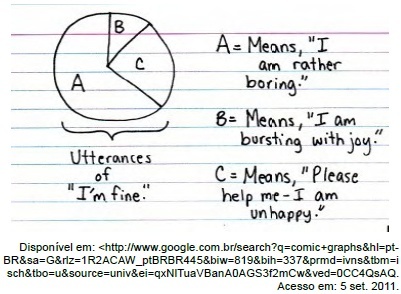
According to the graph, when people say “I'm fine”,
Questão 53 43827
FUVEST (USP) 2012JUST 10 YEARS INTO A NEW CENTURY, MORE THAN TWO-thirds of the country sees the past decade as a period of decline for the U.S., according to a new TIME/Aspen Ideas Festival poll that probed Americans on the decade since the tragic events of Sept. 11, 2001. Osama bin Laden is dead and al-Qaeda seriously weakened, but the impact of the 9/11 attacks and the decisions that followed have, in the view of most Americans, put the U.S. in a tailspin that the country has been unable to shake during two administrations and almost 10 years of trying.
ACCORDING TO THE POLL, ONLY 6% OF MORE THAN 2,000 Americans believe the country has completely recovered from the events of 9/11. Some of this pessimism can be tied to fears of more terrorist attacks. Despite the death of bin Laden, most Americans think another terrorist attack in the U.S. is likely.
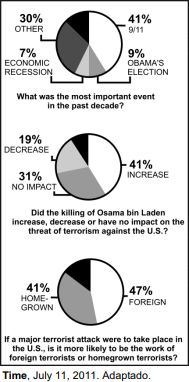
A pesquisa descrita no texto mostrou que a maioria dos norte-americanos
Questão 54 43741
UEMG 2012The Secrets of Stonehenge
All over the globe are historical mysteries left to us by the ancient world - lost civilizations, abandoned cities, and puzzling monuments. One unexplained mystery that has both inspired and mystified modern man for centuries is Stonehenge, a monument located in the United Kingdom. Though it is one of the best-known artifacts in the world, we have no definitive idea of why it was built and what it was actually used for. Today, however, two new investigations may offer some answers.
The first theory begins with findings being unearthed not at Stonehenge, but at a location nearby. Archeologist Mike Parker Pearson and his colleagues have been studying an area about three kilometers northeast of Stonehenge. Here stands Durrington Walls - a structure similar to Stonehenge but about 20 times larger. In and around Durrington Walls were three circular structures made of wood. Evidence suggests that these wooden circles were holy places, or perhaps the residences of important officials who cared for Durrington. Outside Durrington Walls, Parker Pearson and his colleagues have also recently discovered a village of up to 300 houses which date back more than 4,500 years.
What do the findings at Durrington Walls have to do with Stonehenge? Parker Pearson believes there is a connection between the two places, and he cites his recent studies of the Malagasy culture in Madagascar to help explain his theory. In Malagasy culture, stone is a symbol of hardened bones and death. Wood, in contrast, is associated with life. Using this model, Parker Pearson sees associations between the wooden structures of Durrington and the hard monument of Stonehenge. Durrington, in this new theory, is the domain of the living, while Stonehenge is a place of the dead.
Parker Pearson goes on to explain that the houses near Durrington Walls were probably occupied at certain times of the year when people gathered for the summer and winter solstices (the longest and shortest days of the year) to celebrate certain religious ceremonies. And in fact, large amounts of pottery and animal bones have been found near Durrington, suggesting that this site was used as a place for eating and drinking. In contrast, very little pottery has been found at Stonehenge. In addition, almost no human remains have been found at Durrington, but a number of graves have been uncovered at Stonehenge.
Paths from Stonehenge and Durrington Walls to the nearby River Avon also suggest that the two sites were linked. At certain times of the year, most of the dead would have been carried down the road from Durrington and put in the river. Later, remains of the society's rulers would have been brought down the river, carried up the long avenue, and deposited at Stonehenge.
In Wales, about 400 kilometers west of Stonehenge, archeologists have another theory about why the monument was built and what it was used for. In this region of Wales are the Preseli Mountains, archeologists have traced the origin of Stonehenge's oldest stones (often referred to as "bluestones" because of their appearance when wet) to this site.
One question that has puzzled archeologists for years is why ancient Britons did transport these huge stones - which weighed up to 3,600 kilos - and use them to build Stonehenge? Some archeologists believe that early people saw the Preseli hills, with their giant blue stones, as a holy place. There is also a local belief, which is still common today, that the waters coming from the Preseli Mountains can cure illness. It is possible that the motive for moving these stones the great distance to Salisbury Plain was to create a center for health and healing.
How exactly the stones were transported - without the use of wheels - remains a mystery. However it was done, transporting such enormous stones was a remarkable achievement for the time. Stonehenge was abandoned about 3,500 years ago, and because its creators wrote no texts to explain it, they have left us forever with one of history's great puzzles to solve.
Adapted from Reading Explorer 3 (Heinle 2010), by Nancy Douglas (pp. 77-78)
According to the text, all the statements below refer to Stonehenge EXCEPT:
06