


![[Marketing] Questao Topo - deslogado](https://storage.estuda.com.br/banners/0_6b7ebee90b03af1c560c73bb8bcce34a_banner_deslogado_70_dias.png)
Questões de Inglês
19.971 Questões
Questão 45 44468
UNEMAT 1° Dia 2012/1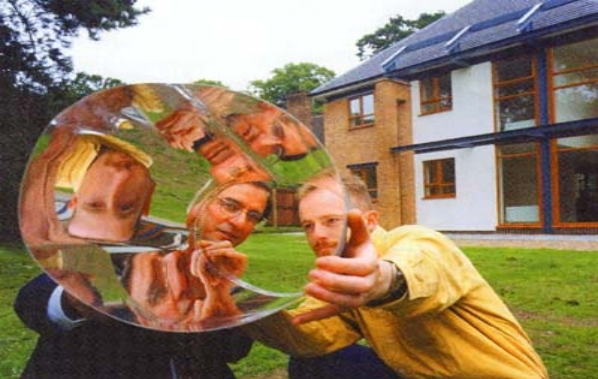
Everyone says that we must use less energy! But how? That is the
big question. In this article, you can read about the house of the
future, which uses hardly any energy at all...
Most houses use energy - lots of it. We use energy for heating,
[5] lighting, for running our household appliances - TV's, washing
machines, fridges, and so on. In winter time, most houses use
dozens of kilowatts of electricity every day, or the equivalent in
gas.
The house in the photo, on the other hand, uses virtually nothing:
[10] most of the energy that it uses comes straight from the sun, the
wind or the ground. This is an experimental house at the University
of Nottingham, and it could be the kind of house that most people
are living in fifty years from now.
During the daytime, it is rarely necessary to turn on an electric
[15] light, even in rooms without windows. Sunlight, or daylight, is
"piped" through the house, into each room, through special highreflection
aluminium tubes. You can see how well they reflect light,
by looking at the reflections of the faces in the picture!
http://linguapress.com/intermediate/no-energy.htm
Na frase: “...most of the energy that it uses comes straight from the sun, the wind or the ground” (ℓ. 08-09), o verbo sublinhado pode ser traduzido por:
Questão 44 44467
UNEMAT 1° Dia 2012/1
Everyone says that we must use less energy! But how? That is the
big question. In this article, you can read about the house of the
future, which uses hardly any energy at all...
Most houses use energy - lots of it. We use energy for heating,
[5] lighting, for running our household appliances - TV's, washing
machines, fridges, and so on. In winter time, most houses use
dozens of kilowatts of electricity every day, or the equivalent in
gas.
The house in the photo, on the other hand, uses virtually nothing:
[10] most of the energy that it uses comes straight from the sun, the
wind or the ground. This is an experimental house at the University
of Nottingham, and it could be the kind of house that most people
are living in fifty years from now.
During the daytime, it is rarely necessary to turn on an electric
[15] light, even in rooms without windows. Sunlight, or daylight, is
"piped" through the house, into each room, through special highreflection
aluminium tubes. You can see how well they reflect light,
by looking at the reflections of the faces in the picture!
http://linguapress.com/intermediate/no-energy.htm
Assinale o significado de “piped” (ℓ.13).
Questão 43 44466
UNEMAT 1° Dia 2012/1
Everyone says that we must use less energy! But how? That is the
big question. In this article, you can read about the house of the
future, which uses hardly any energy at all...
Most houses use energy - lots of it. We use energy for heating,
[5] lighting, for running our household appliances - TV's, washing
machines, fridges, and so on. In winter time, most houses use
dozens of kilowatts of electricity every day, or the equivalent in
gas.
The house in the photo, on the other hand, uses virtually nothing:
[10] most of the energy that it uses comes straight from the sun, the
wind or the ground. This is an experimental house at the University
of Nottingham, and it could be the kind of house that most people
are living in fifty years from now.
During the daytime, it is rarely necessary to turn on an electric
[15] light, even in rooms without windows. Sunlight, or daylight, is
"piped" through the house, into each room, through special highreflection
aluminium tubes. You can see how well they reflect light,
by looking at the reflections of the faces in the picture!
http://linguapress.com/intermediate/no-energy.htm
De acordo com o texto, é correto afirmar.
Questão 83 44211
UFG 2012/2Linguini: Listen, I just want you to know how honored I am to be studying under such a -...
Colette: No, you listen! I just want you to know exactly who you are dealing with! How many women do you see in this kitchen? Linguini: Well, I uh -...
Colette: Only me. Why do you think that is? Because high cuisine is an antiquated hierarchy built upon rules written by stupid, old men. Rules designed to make it impossible for women to enter this world, but still I'm here. How did this happen? Linguini: Well because you, because you -...
Colette: Because I am the toughest cook in this kitchen! I have worked too hard for too long to get here, and I am not going to jeopardize it for some garbage boy who got lucky! Got it? Linguini: Wow!
Disponível em: <http://www.imdb.com/title/tt0382932/quotes>. Acesso em: 12 set. 2011.
Glossary:
jeopardize: colocar em risco
What dialogue line is an example of an ungrammatical structure in English, which is typical of colloquial language?
Questão 81 44209
UFG 2012/2World Wide Fund (WWF) is a nature conservation organization. Read the WWF advertisement.
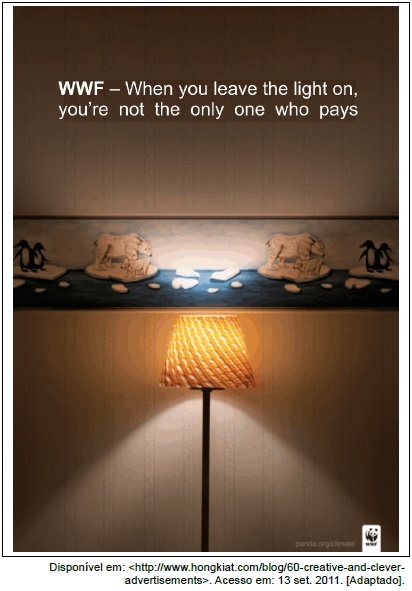
The picture shows that as a result of energy waste
Questão 88 44116
UFG 2012/1“The secret of the Great Stories is that they have no secrets. The Great Stories are the ones you have heard and want to hear again. The ones you can enter anywhere and inhabit comfortably. They don’t deceive you with thrills and trick endings. They don’t surprise you with the unforeseen. They are as familiar as the house you live in. Or the smell of your lover’s skin. You know how they end, yet you listen as though you don’t. In the way that although you know that one day you will die, you live as though you won’t. In the Great Stories you know who lives, who dies, who finds love, who doesn’t. And yet you want to know again. THAT is their mystery and magic.”
Disponível em: <http://www.goodreads.com/author/quotes/6134. ArundhatiRoy>. Acesso em: 13 set. 2011.
The text is metalinguistic because it
06