


![[Marketing] Questao Topo - deslogado](https://storage.estuda.com.br/banners/0_6b7ebee90b03af1c560c73bb8bcce34a_banner_deslogado_70_dias.png)
Questões de Inglês
19.971 Questões
Questão 15 12188141
UNIEVA Medicina 2021/2
Os sinônimos das palavras deeply, disturbing e prejudice expressas na imagem acima são, respectivamente:
Questão 12 12187915
UNIEVA Medicina 2021/2Which is an important concept for Christians and it is based on the belief that together we can make a difference and together we are much stronger?
Questão 34 12165396
UNIUBE Medicina 2021/2Leia o texto para responder à questão.
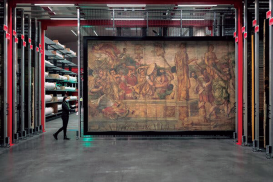
It is the most ambitious move in the history of the Louvre — a five-year project to transfer a quarter of a million artworks to an ultramodern storage site 120 miles away in northern France.
For more than 16 months, a stream of trucks has quietly hauled treasures from the museum’s central Paris basement, and other sites, to the Louvre Conservation Center, a fortress of culture set up in the town of Liévin, near Lens. Already 100,000 works have been moved — including paintings, carpets, tapestries, grand sculptures, small figurines, furniture and decorative pieces — dating from antiquity to the 19th century.
With museums in France closed because of the pandemic, Jean-Luc Martinez, the director of the Louvre, has time on his hands. He took a small group of reporters on a tour of the newly operational site, which is intended to become one of Europe’s largest art research centers and to welcome museum experts, scholars and conservators from around the world.
The Louvre sits on low ground along the banks of the Seine. In 2016, flooding in Paris was so severe that the museum itself was threatened, prompting a round-the-clock, emergency operation to wrap, crate and haul thousands of art objects out of underground storage and onto higher ground. The conservation project in Liévin, costing 60 million euros, or about $73 million, began in late 2017 as a necessary response to the river’s unpredictable, inevitable rise.
“The reality is that our museum is in a flood zone,” Mr. Martinez said on the tour. “You can’t just pick up and move marble sculptures around,” he noted. “There was a danger that the sewers would back up and that dirty, smelly wastewater would damage the art. We had to find a solution. Urgently.”
The Louvre considered, then rejected, the idea of building a site close to Paris: too expensive and impractical. Instead, it chose Liévin, a 10-minute walk from the Louvre’s mini- -museum outpost in the adjacent town of Lens, which opened in 2012.
(Elaine Sciolino. www.nytimes.com, 12.02.2021. Adaptado.)
No trecho do sexto parágrafo “Instead, it chose Liévin, a 10-minute walk from the Louvre’s mini-museum outpost”, o termo sublinhado pode ser substituído, sem alteração de sentido, por:
Questão 18 12149868
FMP Medicina 2021Text
1 Rural producers face a wide range of adverse events that expose them to potentially heavy losses. In
agriculture, both natural risks – such as droughts, floods, pests, diseases, and fires – and market risks –
such as price variation – are frequent. While the modernization of the agricultural sector leads to commodity
specialization and the adoption of technologies with higher expected returns, it may also result in a larger
production variance, creating more uncertainty and increasing producers’ exposure to risk. Modernization
has accelerated in Brazil in recent years, raising the importance of risk management instruments.
2 Brazil has a large potential for improving risk mitigation opportunities for its producers, which will be
even more essential in the face of climate change. Improving risk management practices and public policies
could accelerate the process of modernization and sustainability in Brazilian agricultural production.
Government incentives require a design crafted to meet producers’ needs. In this report, Climate Policy
Initiative/Pontifical Catholic University of Rio de Janeiro (CPI/PUC-Rio) researchers analyze the current risk
management instruments and public policies and discuss pathways for improving their impact on Brazilian
agriculture.
Available at: https://www.climatepolicyinitiative.org/publication/risk-management-in-brazilian-agricultureinstruments-public-policy-and-perspectives/. Retrieved on: 1 st Sept. 2020. Adapted.
From the information in the first paragraph of Text, one can conclude that for rural producers risk management instruments
Questão 15 12149745
FMP Medicina 2021Text
1 What could we have done differently? It is a good question in the face of the coronavirus pandemic.
Among the answers is a clear lesson from history—the importance of investing in public health agencies.
Historian Colgrove and a team of scientists highlighted the effects of government investment in public
health on the prevention and response to health crises.
2 The choices contributed to the development of multidrug-resistant tuberculosis in New York City. In the
1950s and 1960s, increased access to antibiotic therapies and comprehensive case treatment made
tuberculosis cases decline. So, government funding for tuberculosis control was cut drastically. Public
health staff were reassigned from tuberculosis care, clinics were closed, and laboratory testing diminished,
setting the stage for a deadly drug-resistant tuberculosis outbreak in the early 1990s.
3 In combination with homelessness and the HIV/AIDS epidemic, tuberculosis control became a crisis.
Colgrove claims that the outbreak was a predictable outcome of the cuts to public health systems.
4 In contrast, scientists highlight Uganda’s infrastructure for treating hemorrhagic fevers as an example
of how investments in public health can avert infectious disease crises. In 2010, Uganda launched a
surveillance and laboratory program in collaboration with the U.S. Centers for Disease Control. Through
this collaboration, Uganda has decreased diseases such as Ebola, Marburg virus, Crimean-Congo virus,
and Rift Valley. Not only has this program saved lives in Uganda, but it has prevented small outbreaks from
escalating into international epidemics.
5 As we attempt to deal with COVID-19, it is worth considering how cuts to public health institutions
undermine the country’s ability to respond to pandemic threats. So, for the benefit of our globalized society,
it is always time to invest in public health infrastructure.
Available at: https://www.hopkinsmedicine.org/news/articles/its-time-to-invest-in-public-health-infrastructure. Retrieved on: 1 st Sept. 2020. Adapted.
From the information in the fourth paragraph of Text, one can infer that the collaboration between Uganda and U.S. Centers for Disease Control
Questão 14 12149736
FMP Medicina 2021Text
1 What could we have done differently? It is a good question in the face of the coronavirus pandemic.
Among the answers is a clear lesson from history—the importance of investing in public health agencies.
Historian Colgrove and a team of scientists highlighted the effects of government investment in public
health on the prevention and response to health crises.
2 The choices contributed to the development of multidrug-resistant tuberculosis in New York City. In the
1950s and 1960s, increased access to antibiotic therapies and comprehensive case treatment made
tuberculosis cases decline. So, government funding for tuberculosis control was cut drastically. Public
health staff were reassigned from tuberculosis care, clinics were closed, and laboratory testing diminished,
setting the stage for a deadly drug-resistant tuberculosis outbreak in the early 1990s.
3 In combination with homelessness and the HIV/AIDS epidemic, tuberculosis control became a crisis.
Colgrove claims that the outbreak was a predictable outcome of the cuts to public health systems.
4 In contrast, scientists highlight Uganda’s infrastructure for treating hemorrhagic fevers as an example
of how investments in public health can avert infectious disease crises. In 2010, Uganda launched a
surveillance and laboratory program in collaboration with the U.S. Centers for Disease Control. Through
this collaboration, Uganda has decreased diseases such as Ebola, Marburg virus, Crimean-Congo virus,
and Rift Valley. Not only has this program saved lives in Uganda, but it has prevented small outbreaks from
escalating into international epidemics.
5 As we attempt to deal with COVID-19, it is worth considering how cuts to public health institutions
undermine the country’s ability to respond to pandemic threats. So, for the benefit of our globalized society,
it is always time to invest in public health infrastructure.
Available at: https://www.hopkinsmedicine.org/news/articles/its-time-to-invest-in-public-health-infrastructure. Retrieved on: 1 st Sept. 2020. Adapted.
In the second paragraph of Text, the fragment “So, government funding for tuberculosis control was cut drastically" the word so expresses the idea of
06