


![[Marketing] Questao Topo - deslogado](https://storage.estuda.com.br/banners/0_6b7ebee90b03af1c560c73bb8bcce34a_banner_deslogado_70_dias.png)
Questões de Inglês
19.971 Questões
Questão 18 46221
UFT Manhã 2012/1Read the following text to answer question 18:
William's words - Confessions of a Latin teacher (part 2)
By Justin Ratcliffe
The UK government has ignored demands to offer Latin in all schools. But the ancient world still holds our imaginations, from law and politics through to films like Clash of Titans and Percy Jackson and the Lightning Thief.
Politically, Roman laws passed through two houses. The UK copied this arrangement. The US went further, placing the Senate and House of Representatives on Capitol Hill. Money stamped with our leader's faces is inspired by Roman coins. The Romans gave us public and civil law, trial by jury and the principle "innocent till proven guilty". Today's politicians are still influenced by Cicero's oratory. We take rhetorical devices from classical: simile and metaphor, synecdoche and metonymy. Although we may prefer films to poetry, we use their literary genres: tragedy and comedy, epic and satire.
Ever since Freud, psychology has used classical words and concepts. We are aware of our ego, id and superego. We recognise narcissism, mania and the Oedipus complex. Philosophy is built upon Plato and Aristotle, giving us arguments a priori and a posteriori, syllogism and reduction ad absurdum. Everybody knows Descartes' phrase: "Cogito ergo sum".
Science is full of Latin from geometry's humble oval to paleontology's mighty Tirannosaurus rex. In meteorology, we have cumulo-nimbus clouds; in physics, the quantum. We named the planets after Roman gods. Neighbours Venus and Mars reflect the mythical entanglement of love and war. [...]
In sport, Romans took Greek pursuits and turned them into big business, with stadiums and gambling. Watch today's racing, horses or Formula One, and you can't help thinking of chariot racing in the Circus Maximus. The celebrities and hysteria in boxing, wrestling, rugby and football recall Rome's gladiators. [...]
Oxford classics professors recently urged the British government to give Latin the same status in schools as modern languages. The Department for Education replied: ―Latin is an important subject, valuable for learning of modern languages and a useful basis for many disciplines. It is, however, not classified in curriculum as modern language as pupils cannot interact with native Latin speakers or visit parts of the world where Latin is spoken as native language‖. A diplomatic response!
Speak up. São Paulo: Editora Rickdan, n. 285, ano XXIII, maio de 2011, p.40-41 (Adapted).
In the sentence "innocent till proven guilty" the word ―till‖ can be replaced, without changing its meaning, by:
Questão 17 46220
UFT Manhã 2012/1Read the following text to answer question 17.
William's words - Confessions of a Latin teacher (part 2)
By Justin Ratcliffe
The UK government has ignored demands to offer Latin in all schools. But the ancient world still holds our imaginations, from law and politics through to films like Clash of Titans and Percy Jackson and the Lightning Thief.
Politically, Roman laws passed through two houses. The UK copied this arrangement. The US went further, placing the Senate and House of Representatives on Capitol Hill. Money stamped with our leader's faces is inspired by Roman coins. The Romans gave us public and civil law, trial by jury and the principle "innocent till proven guilty". Today's politicians are still influenced by Cicero's oratory. We take rhetorical devices from classical: simile and metaphor, synecdoche and metonymy. Although we may prefer films to poetry, we use their literary genres: tragedy and comedy, epic and satire.
Ever since Freud, psychology has used classical words and concepts. We are aware of our ego, id and superego. We recognise narcissism, mania and the Oedipus complex. Philosophy is built upon Plato and Aristotle, giving us arguments a priori and a posteriori, syllogism and reduction ad absurdum. Everybody knows Descartes' phrase: "Cogito ergo sum".
Science is full of Latin from geometry's humble oval to paleontology's mighty Tirannosaurus rex. In meteorology, we have cumulo-nimbus clouds; in physics, the quantum. We named the planets after Roman gods. Neighbours Venus and Mars reflect the mythical entanglement of love and war. [...]
In sport, Romans took Greek pursuits and turned them into big business, with stadiums and gambling. Watch today's racing, horses or Formula One, and you can't help thinking of chariot racing in the Circus Maximus. The celebrities and hysteria in boxing, wrestling, rugby and football recall Rome's gladiators. [...]
Oxford classics professors recently urged the British government to give Latin the same status in schools as modern languages. The Department for Education replied: ―Latin is an important subject, valuable for learning of modern languages and a useful basis for many disciplines. It is, however, not classified in curriculum as modern language as pupils cannot interact with native Latin speakers or visit parts of the world where Latin is spoken as native language‖. A diplomatic response!
Speak up. São Paulo: Editora Rickdan, n. 285, ano XXIII, maio de 2011, p.40-41 (Adapted).
According to the text, mark the CORRECT answer:
Questão 44 46194
PUC-SP Verão 2012Underground river ‘Rio Hamza’ discovered 4km beneath the Amazon Scientists estimate the subterranean river may be 6,000km long and hundreds of times wider than the Amazon Alok Jha, science correspondent guardian.co.uk Friday, 26 August 2011 Covering more than 7 million square kilometres in South America, the Amazon basin is one of the biggest and most impressive river systems in the world. But it turns out we have only known half the story until now. Brazilian scientists have found a new river in the Amazon basin – around 4km underneath the Amazon river. The Hamza river, named after the head of the team of researchers who found the groundwater flow, appears to be as long as the Amazon river but up to hundreds of times wider. Both the Amazon and Hamza flow from west to east and are around the same length, at 6,000km. But whereas the Amazon ranges from 1 km to 100km in width, the Hamza ranges from 200km to 400km. The underground river starts in the Acre region under the Andes and flows through the Solimões, Amazonas and Marajó basins before opening out directly into the depths of the Atlantic Ocean. The Amazon flows much faster than the Hamza, however, draining a greater volume of water. Around 133,000m3 of water flow through the Amazon per second at speeds of up to 5 metres per second. The underground river's flow rate has been estimated at around 3,900m3 per second and it barely inches along at less than a millimetre per hour. The Hamza was located using data collected inside a series of 241 abandoned deep wells that were drilled in the Amazon region by the petrochemical company Petrobras in the 1970s and 1980s. Elizabeth Tavares Pimentel and Valiya Hamza of the Department of Geophysics at Brazil's National Observatory led the work and presented their results last week at the International Congress of the Brazilian Geophysics Society in Rio de Janeiro. According to the researchers, the presence of the Hamza river might account for the relatively low salinity of the waters around the mouth of the Amazon. Professor Hamza said Pimentel's measurements represented preliminary work on the discovery of the new river, but Hamza said he expected to confirm the existence of the flow with additional measurements within the next few years. www.guardian.co.uk/environment/2011/aug/26/underground-riveramazon/print. Adaptado.
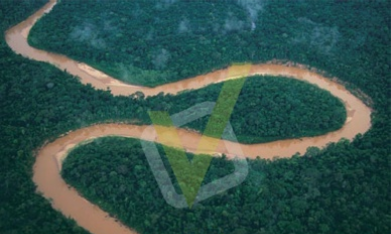
An aerial view of the Amazon river. Phorqgroph: Frans Lanting/Corbis
No trecho do segundo parágrafo – But whereas the Amazon ranges from 1 km to a 100 km in a width, the Hamza ranges from 200 km to 400 km. – a palavra whereas pode ser substituída, sem alteração de sentido, por
Questão 45 46149
PUC-SP Inverno 2012What is “Rio+20”?
“Rio+20” is the short name for the United Nations Conference on Sustainable Development to take place in Rio de Janeiro, Brazil, in June 2012 – twenty years after the landmark 1992 Earth Summit in Rio. Rio+20 is also an opportunity to look ahead to the world we want in 20 years.
At the Rio+20 Conference, world leaders, along with thousands of participants from the private sector, NGOs and other groups, will come together to shape how we can reduce poverty, advance social equity and ensure environmental protection on an ever more crowded planet.
The official discussions will focus on two main themes: how to build a green economy to achieve sustainable development and lift people out of poverty; and how to improve international coordination for sustainable development.
It is a historic opportunity to define pathways to a sustainable future – a future with more jobs, more clean energy, greater security and a decent standard of living for all.
Why do we need Rio+20?
If we are to leave a liveable world to our children and grandchildren, the challenges of widespread poverty and environmental destruction need to be tackled now.
• The world today has 7 billion people – by 2050, there will be 9 billion.
• One out of every five people – 1.4 billion – currently lives on US$1.25 a day or less.
• A billion and half people in the world don’t have access to electricity.
• Two and a half billion people don’t have a toilet.
• Almost a billion people go hungry every day.
• Greenhouse gas emissions continue to rise and more than a third of all known species could go extinct if climate change continues unchecked.
The 1992 Earth Summit in Rio laid the groundwork. Rio+20 is a new opportunity to think globally so that we can all act locally to secure our common future.
(www.un.org/en/sustainablefuture/about.shtmi. Acesso em 22.5.12)
No trecho do último parágrafo – Rio+20 is a new opportunity to think globally so that we can all act locally to secure our common future. – so that introduz
Questão 44 46148
PUC-SP Inverno 2012What is “Rio+20”?
“Rio+20” is the short name for the United Nations Conference on Sustainable Development to take place in Rio de Janeiro, Brazil, in June 2012 – twenty years after the landmark 1992 Earth Summit in Rio. Rio+20 is also an opportunity to look ahead to the world we want in 20 years.
At the Rio+20 Conference, world leaders, along with thousands of participants from the private sector, NGOs and other groups, will come together to shape how we can reduce poverty, advance social equity and ensure environmental protection on an ever more crowded planet.
The official discussions will focus on two main themes: how to build a green economy to achieve sustainable development and lift people out of poverty; and how to improve international coordination for sustainable development.
It is a historic opportunity to define pathways to a sustainable future – a future with more jobs, more clean energy, greater security and a decent standard of living for all.
Why do we need Rio+20?
If we are to leave a liveable world to our children and grandchildren, the challenges of widespread poverty and environmental destruction need to be tackled now.
• The world today has 7 billion people – by 2050, there will be 9 billion.
• One out of every five people – 1.4 billion – currently lives on US$1.25 a day or less.
• A billion and half people in the world don’t have access to electricity.
• Two and a half billion people don’t have a toilet.
• Almost a billion people go hungry every day.
• Greenhouse gas emissions continue to rise and more than a third of all known species could go extinct if climate change continues unchecked.
The 1992 Earth Summit in Rio laid the groundwork. Rio+20 is a new opportunity to think globally so that we can all act locally to secure our common future.
(www.un.org/en/sustainablefuture/about.shtmi. Acesso em 22.5.12)
No trecho do texto – more than a third of all known species could go extinct if climate change continues unchecked. – a expressão could go extinct pode ser substituída, sem alteração de sentido, por
Questão 43 46147
PUC-SP Inverno 2012What is “Rio+20”?
“Rio+20” is the short name for the United Nations Conference on Sustainable Development to take place in Rio de Janeiro, Brazil, in June 2012 – twenty years after the landmark 1992 Earth Summit in Rio. Rio+20 is also an opportunity to look ahead to the world we want in 20 years.
At the Rio+20 Conference, world leaders, along with thousands of participants from the private sector, NGOs and other groups, will come together to shape how we can reduce poverty, advance social equity and ensure environmental protection on an ever more crowded planet.
The official discussions will focus on two main themes: how to build a green economy to achieve sustainable development and lift people out of poverty; and how to improve international coordination for sustainable development.
It is a historic opportunity to define pathways to a sustainable future – a future with more jobs, more clean energy, greater security and a decent standard of living for all.
Why do we need Rio+20?
If we are to leave a liveable world to our children and grandchildren, the challenges of widespread poverty and environmental destruction need to be tackled now.
• The world today has 7 billion people – by 2050, there will be 9 billion.
• One out of every five people – 1.4 billion – currently lives on US$1.25 a day or less.
• A billion and half people in the world don’t have access to electricity.
• Two and a half billion people don’t have a toilet.
• Almost a billion people go hungry every day.
• Greenhouse gas emissions continue to rise and more than a third of all known species could go extinct if climate change continues unchecked.
The 1992 Earth Summit in Rio laid the groundwork. Rio+20 is a new opportunity to think globally so that we can all act locally to secure our common future.
(www.un.org/en/sustainablefuture/about.shtmi. Acesso em 22.5.12)
One of the themes to be discussed in Rio+20 will tackle
06