


![[Marketing] Questao Topo - deslogado](https://storage.estuda.com.br/banners/0_6b7ebee90b03af1c560c73bb8bcce34a_banner_deslogado_70_dias.png)
Questões de Inglês
19.971 Questões
Questão 21 46460
UNESP 2012/1Intrução: Leia o texto e analise o gráfico para responder à questão.
Why use biofuels for aviation?
The aviation industry has seen huge growth since its beginning. Today, more than two billion people enjoy the social and economical benefits of flight each year. The ability to fly conveniently and efficiently between nations has been a catalyst for the global economy and has shrunk cultural barriers like no other transport sector. But this progress comes at a cost.
In 2008, the commercial aviation industry produced 677 million tones of carbon dioxide (CO2 ). This is around 2% of the total man-made CO2 emissions of more than 34 billion tones. While this amount is smaller compared with other industry sectors, such as power generation and ground transport, these industries have viable alternative energy sources currently available. For example, the power generation industry can look to wind, hydro, nuclear and solar technologies to make electricity without producing much CO2 . Cars and buses can run on hybrid, flexible fuel engines or electricity. -powered trains can replace locomotives.
The aviation industry has identified the development of biofuels as one of the major ways it can reduce its greenhouse gas emissions. Biofuels provide aviation with the capability to partially, and perhaps one day fully, replace carbon-intensive petroleum fuels. They will, over time, enable the industry to reduce its carbon footprint significantly.
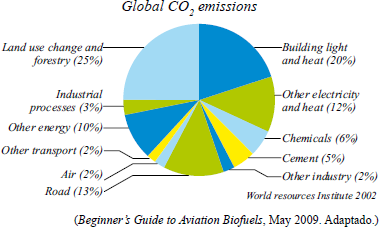
Duas das razões apontadas para o desenvolvimento de biocombustíveis e sua utilização em aviões são
Questão 24 46227
UFT Manhã 2012/1Read the following text to answer questions 24:
Hi Adriana,
How are things back in Rome? Are you glad to be home again? Sorry I haven't written lately. I've been a bit depressed. My grades aren't
as good as they used to be. Classes didn't use to be so difficult!
I have to say, I miss you. You used to be such a good influence on me! These days, I oversleep. I often miss my classes! That never used to happen because I knew I had to meet you at the café in the morning. I remember how you would complain about the coffee here in Canada. You used to call it ―brown water‖!
I'm spending too much money too. Every time I go to the mall, I see something I want to buy. That's another reason I miss you! I would see some great jacket, but you wouldn't let me buy it. You would always tell me I didn't need it and drag me away!
Also, I have a noisy new roommate, Cindy. All she ever does is gab on her cell! Remember the way we would sit around talking? You always used to make me laugh. I bet that's a big reason I never used to feel stressed like I do now!
Anyway, exams will be over on Friday, so I'm sure I'll feel better then.
Write soon!
Annie
RICHARDS, J. C.; SANDY, C. Passages. Cambridge: CUP, 2008. p.74 (Adapted).
According to the text it is CORRECT to state that:
Questão 23 46226
UFT Manhã 2012/1Read the following text to answer question 23.
Hi Adriana,
How are things back in Rome? Are you glad to be home again? Sorry I haven't written lately. I've been a bit depressed. My grades aren't
as good as they used to be. Classes didn't use to be so difficult!
I have to say, I miss you. You used to be such a good influence on me! These days, I oversleep. I often miss my classes! That never used to happen because I knew I had to meet you at the café in the morning. I remember how you would complain about the coffee here in Canada. You used to call it ―brown water‖!
I'm spending too much money too. Every time I go to the mall, I see something I want to buy. That's another reason I miss you! I would see some great jacket, but you wouldn't let me buy it. You would always tell me I didn't need it and drag me away!
Also, I have a noisy new roommate, Cindy. All she ever does is gab on her cell! Remember the way we would sit around talking? You always used to make me laugh. I bet that's a big reason I never used to feel stressed like I do now!
Anyway, exams will be over on Friday, so I'm sure I'll feel better then.
Write soon!
Annie
RICHARDS, J. C.; SANDY, C. Passages. Cambridge: CUP, 2008. p.74 (Adapted).
Judge the sentences according to the text:
I. The word ―oversleep‖ in the sentence ―These days, I oversleep,‖ means sleep for longer than intended.
II. Annie used to complain about the coffee because of its ―brown water‖ appearance.
III. We can state that the word ―miss‖ in the sentence ―I have to say, I miss you‖ has the same meaning as in the phrase ―I often miss my classes!‖
IV. Annie is a bit depressed but she thinks she will be better as soon as she finishes her exams.
V. The verb ―to gab‖ in the sentence ―All she ever does is gab on her cell!‖ means to talk continuously, especially about things which are not important.
Mark the CORRECT answer:
Questão 22 46225
UFT Manhã 2012/1
Read the following comics to answer question 22:

Mark T (true) of F (false), according to the scene shown in the comics:
I. The man pays too much attention to the bird and disregards the computer.
II. It seems that the man doesn‘t even look at the bird and, if he did, he would probably notice that the parrot doesn‘t look well.
III. Actually, it is clear that the man has spent a lot of time online and it seems that he is more interested in browsing the Web than in taking care of his pet.
IV. The parrot seems to be dead and the apparent death of the bird is completely ignored by the man.
V. In relation to the bird in the cage, the man seems to act carelessly and neglectfully.
VI. The man doesn‘t even talk to the parrot.
Mark the CORRECT answer:
Questão 20 46223
UFT Manhã 2012/1Read the following poem to answer question 20:
Our Conquering Swords
Christopher Marlowe (1564-1593)
1. Our conquering swords shall marshall us the way
2. We use to march upon the slaughter'd foe,
3. Trampling their bowels with our horses' hoofs,
4. Brave horses bred on the white Tartarian hills.
5. My camp is like to Julius Caesar's host,
6. That never fought but had the victory;
7. Nor in Pharsalia was there such hot war
8. As these, my followers, willingly would have.
9. Legions of spirits, fleeting in the air,
10. Direct our bullets and our weapons' points,
11. And make your strokes to wound the senseless light;
12. And when she sees our bloody colours spread,
13. Then Victory begins to take her flight,
14. Resting herself upon my milk-white tent--
15. But come, my lords, to weapons let us fall;
16. The field is ours, the Turk, his wife, and all.
Available at: www.poetry-archive.com/m/marlowe_christopher.html
Glossary
Fleeting: passing quickly; lasting only a short time.
Shall: modal verb indicating future predictions.
Slaughter: kill (animals or people) in large numbers.
Sword: weapon with a long thin metal blade and a protected handle.
Trample: tread heavily on sth/sb so as to cause damage or destruction.
Wound: give a wound to (sb). Wound (n): injury caused deliberately to part of the body by cutting, shooting, etc, esp. as the result of an attack.
Mark the CORRECT answer according to the poem:
Questão 19 46222
UFT Manhã 2012/1Read the following poem to answer question 19.
Our Conquering Swords
Christopher Marlowe (1564-1593)
1. Our conquering swords shall marshall us the way
2. We use to march upon the slaughter'd foe,
3. Trampling their bowels with our horses' hoofs,
4. Brave horses bred on the white Tartarian hills.
5. My camp is like to Julius Caesar's host,
6. That never fought but had the victory;
7. Nor in Pharsalia was there such hot war
8. As these, my followers, willingly would have.
9. Legions of spirits, fleeting in the air,
10. Direct our bullets and our weapons' points,
11. And make your strokes to wound the senseless light;
12. And when she sees our bloody colours spread,
13. Then Victory begins to take her flight,
14. Resting herself upon my milk-white tent--
15. But come, my lords, to weapons let us fall;
16. The field is ours, the Turk, his wife, and all.
Available at: www.poetry-archive.com/m/marlowe_christopher.html
Glossary
Fleeting: passing quickly; lasting only a short time.
Shall: modal verb indicating future predictions.
Slaughter: kill (animals or people) in large numbers.
Sword: weapon with a long thin metal blade and a protected handle.
Trample: tread heavily on sth/sb so as to cause damage or destruction.
Wound: give a wound to (sb). Wound (n): injury caused deliberately to part of the body by cutting, shooting, etc, esp. as the result of an attack.
The main idea of the poem is:
06